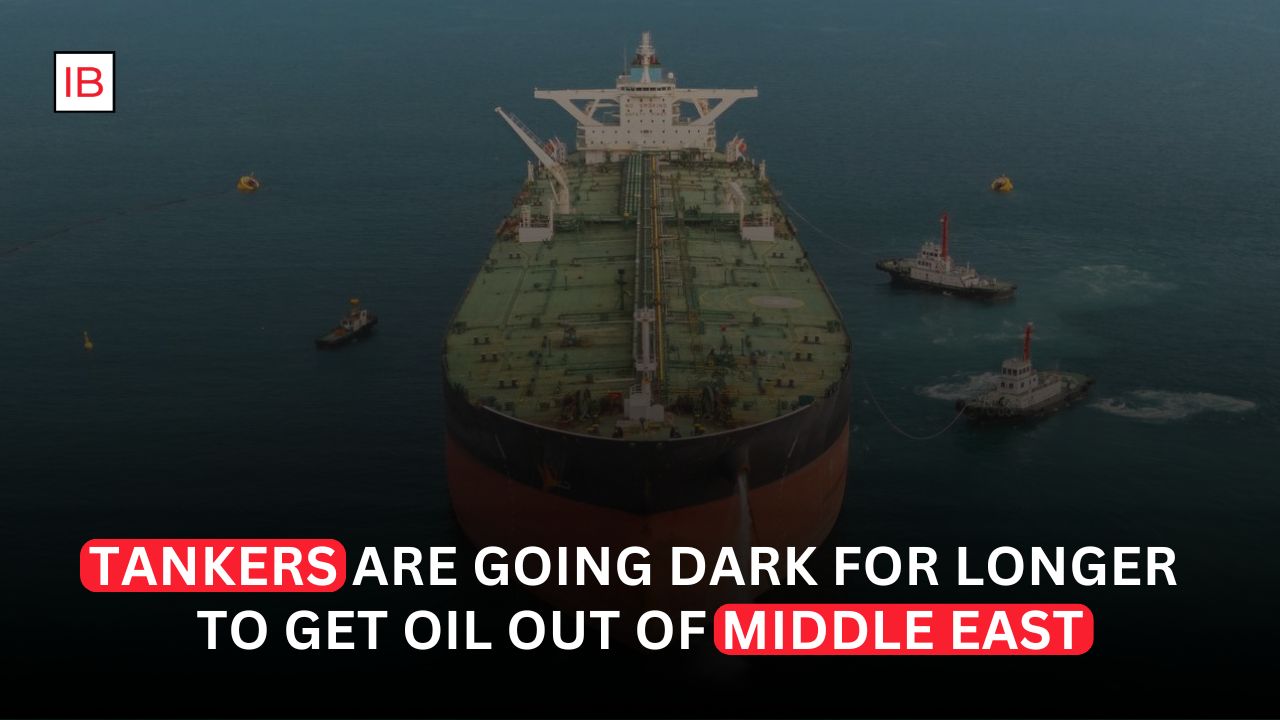
Oil tankers are increasingly switching off their tracking systems and operating “dark” for longer periods as ships try to move Middle Eastern crude through a dangerous and heavily disrupted maritime environment.
The trend reflects a broader problem: oil is still moving out of the region, but the traditional shipping data used to track those flows is becoming increasingly unreliable.
Why Tankers Are Going Dark
Commercial ships normally transmit their location through Automatic Identification System (AIS) signals.
Turning AIS off makes a vessel harder to track.
In normal circumstances, that would be unusual for an oil tanker.
Under current conditions, however, operators have an incentive to reduce visibility because ships crossing strategic waterways face heightened military and security risks.
Saudi crude exports through the Red Sea, for example, have increasingly been transported without visible AIS signals as Houthi threats against Saudi-linked shipping have intensified.
Hormuz Is the Biggest Problem
The Strait of Hormuz remains the central bottleneck.
Before the conflict, roughly 130–140 vessels a day typically passed through the waterway.
Recent traffic has been dramatically lower.
Kpler data showed only nine vessels passing through Hormuz on Thursday, compared with an August daily average of about 12.
That is still nowhere close to normal.
And the security situation remains unstable.
The UAE has accused Iran of attacking two ADNOC-linked vessels on Aug. 13, further raising the risk for ships attempting to transit the strait.
The Data Problem Is Becoming Serious
Dark shipping creates a major problem for oil analysts.
If a tanker turns off AIS, observers cannot easily determine:
- Where it is
- What cargo it is carrying
- Where the cargo originated
- When it loaded
- Where it is heading
- Whether it transferred cargo to another vessel
That makes estimates of Middle Eastern oil exports much less certain.
Reuters reported a significant gap between US government claims about oil leaving the region and estimates from vessel-tracking companies such as Kpler and LSEG.
The implication is important:
Some of the oil may be moving in ways that conventional tracking systems cannot see.
Ship-to-Ship Transfers Add Another Layer
Tankers can also transfer crude between vessels offshore.
This makes the supply chain even harder to follow.
Iranian tankers, for example, have been observed gathering near Malaysia for large-scale ship-to-ship transfers.
Once cargo changes vessels, tracing its original source becomes considerably harder.
For oil traders and analysts, that creates uncertainty over the actual volume of crude reaching international markets.
Oil Is Still Moving
It would be wrong to interpret “dark tankers” as meaning Middle Eastern oil exports have stopped.
They have not.
ADNOC has developed shuttle arrangements to move crude through the difficult Hormuz environment, while UAE exports to Asia have increased.
Iraq has also continued selling crude to buyers capable of getting cargoes through the strait.
The bigger change is how the oil is being transported.
Routes are becoming more complicated.
Ships are spending longer periods with their transponders disabled.
And cargoes are being moved through alternative logistics arrangements.
The Cost of Moving Oil Is Rising
The risks are not free.
Shipping companies face higher:
- War-risk insurance
- Freight rates
- Security costs
- Waiting times
- Fuel costs
- Operational complexity
Some tankers are also avoiding particularly dangerous routes altogether.
That means even if crude production remains relatively stable, the cost of getting barrels to international buyers can rise substantially.
This Could Distort Oil Prices
The unusual shipping environment makes the oil market harder to read.
Normally, traders can use tanker movements to estimate upcoming supply.
But when large numbers of vessels disappear from tracking systems, those estimates become less reliable.
That creates a wider range of possible outcomes.
If more oil is actually moving than visible data suggests, the physical market may be less tight than it appears.
If the missing vessels represent cargoes that are genuinely unable to reach buyers, the supply shortage could be much worse.
That uncertainty itself can increase volatility.
The US and Shipping Data Don’t Fully Agree
This is one of the most interesting aspects of the current market.
US Energy Secretary Chris Wright has said that nearly 9 million barrels per day are leaving through Hormuz, with total regional flows reaching roughly 15 million barrels per day.
But vessel-tracking estimates are considerably lower.
Reuters reported estimates ranging from about 1.74 million to 6.98 million barrels per day through Hormuz, with total regional flows estimated between 9.33 million and 12.26 million barrels per day.
Those are enormous differences.
The real answer may only become clear when destination countries report their actual imports.
The Red Sea Is Also Being Reshaped
Hormuz is not the only problem.
The threat from Yemen’s Iran-aligned Houthis is affecting shipping through the Red Sea and Bab el-Mandeb.
Saudi Arabia has responded by diverting more crude northward through the Suez Canal and SUMED pipeline, with increased loadings at Sidi Kerir.
That creates a more complicated regional oil-routing network.
Instead of simply moving crude through the shortest maritime route, producers are increasingly trying to find paths that minimize security risks.
Longer Routes Mean Higher Costs
Alternative routes can keep oil flowing, but they are not necessarily efficient.
Longer voyages mean:
More fuel.
More tanker days.
Higher freight costs.
Greater insurance exposure.
More capital tied up in transit.
That can increase the delivered cost of crude even when the underlying oil price does not rise dramatically.
Tanker Owners Are Facing a Difficult Choice
Ship operators effectively have three options.
Transit Normally
This minimizes delays but exposes vessels and crews to greater security risks.
Go Dark
This may reduce visibility but does not eliminate physical danger.
Avoid the Route
This improves safety but can leave cargo stranded or require expensive alternative logistics.
None of these options is attractive.
The growing use of dark shipping suggests some operators and cargo owners believe the commercial value of moving the oil still justifies taking the additional risk.
The Supply Deficit Could Persist
The shipping disruption is happening alongside production problems.
The US Energy Information Administration expects some Middle Eastern oil production to remain offline through 2027, even if shipping conditions improve. It estimates that around 600,000 barrels per day of regional output could remain shut through next year.
That means restoring normal shipping would not necessarily restore the entire lost supply immediately.
This is one reason the energy market remains vulnerable even if tensions eventually ease.
The Bigger Risk Is Prolonged Disruption
A short-lived shipping disruption is manageable.
A prolonged one is different.
If tankers have to operate under abnormal conditions for months, the industry could face:
- Persistent insurance premiums
- Higher freight rates
- Tanker shortages
- Longer voyage times
- Uncertain inventories
- Higher regional price differences
- Greater volatility in crude benchmarks
That can eventually feed into gasoline, diesel, aviation fuel and broader inflation.
What Investors Should Watch
The most important indicators now include:
Hormuz vessel traffic — whether daily transits return toward normal levels.
AIS activity — whether fewer tankers continue operating dark.
Ship-to-ship transfers — particularly around Malaysia and other transshipment hubs.
Saudi export routes — whether more crude continues moving through Suez and SUMED.
Tanker rates — a direct indicator of shipping stress.
War-risk insurance — another measure of perceived maritime danger.
Asian crude imports — ultimately the best confirmation of how much oil is actually reaching buyers.
The Bigger Picture
The dark-tanker phenomenon is more than a shipping story.
It shows how geopolitical conflict can disrupt the information infrastructure of commodity markets.
Oil may still be flowing.
But if traders cannot reliably see where ships are going, how much crude they carry or where the cargo originated, determining the true state of supply becomes much harder.
That creates an unusual situation:
The market is not simply dealing with an oil shortage. It is dealing with an oil-visibility shortage.
And that can be almost as important.
If dark shipments are masking larger flows than analysts realize, oil prices could eventually come under pressure when the missing barrels become visible.
If the hidden traffic is smaller than assumed, the market could discover that the physical supply deficit is substantially worse.
For now, the combination of Hormuz disruption, attacks on shipping, dark tanker movements and conflicting supply estimates means the Middle East oil market is operating with an unusually high level of uncertainty.