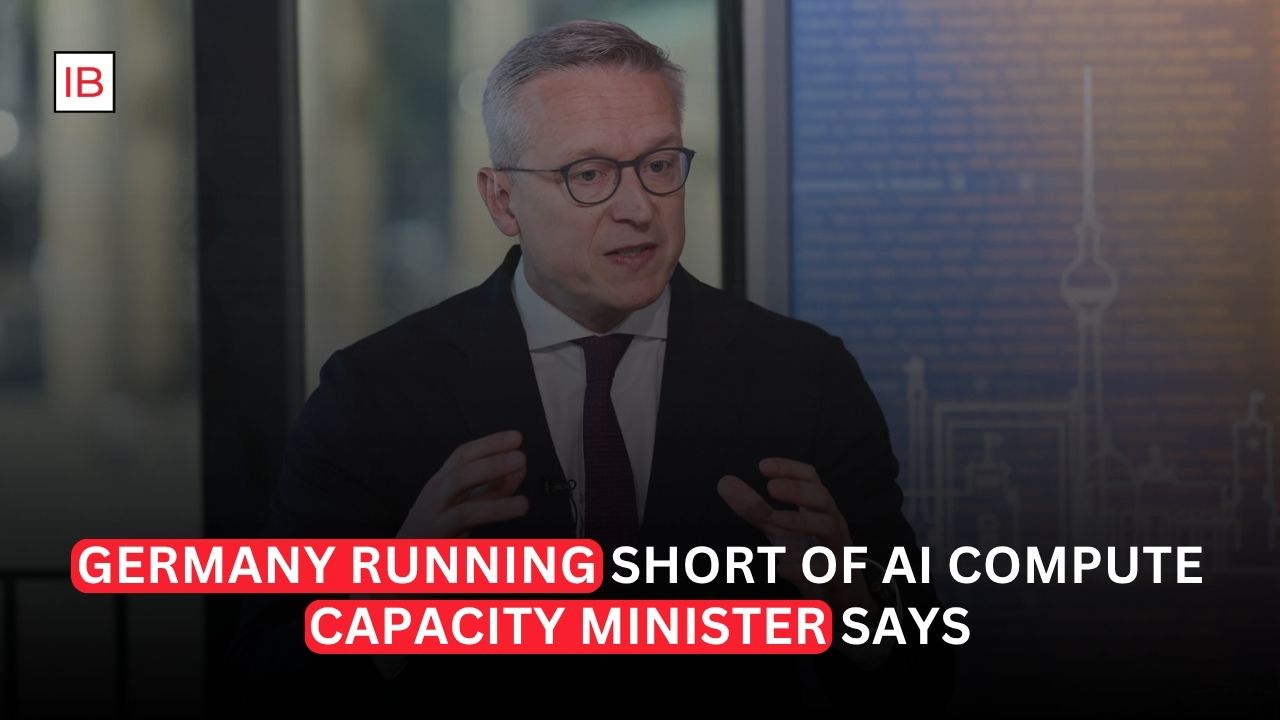
Germany is facing a growing shortage of computing capacity needed to develop and deploy artificial intelligence, according to the country’s technology leadership. The warning highlights a major challenge for Europe’s largest economy: Germany wants to become a leader in AI, but its ambitions are increasingly constrained by access to the enormous computing infrastructure required to run modern AI systems.
The problem is not simply a shortage of chips. Germany needs data centers, high-performance computing systems, electricity, cooling infrastructure, networks and access to advanced AI processors. The government has already recognized the scale of the challenge and wants to at least double Germany’s overall data-center capacity by 2030 while quadrupling capacity dedicated to high-performance computing and AI.
Germany’s AI Ambition Is Growing
Germany has traditionally been known for industrial manufacturing rather than consumer technology.
Its economic strength comes from companies involved in automobiles, machinery, chemicals, pharmaceuticals and industrial equipment.
AI is changing the competitive landscape.
Manufacturers increasingly want AI for automated production, predictive maintenance, robotics, product development and supply-chain management.
That means Germany cannot treat AI infrastructure as something relevant only to technology companies.
It is becoming part of the country’s industrial infrastructure.
Compute Is Becoming a Strategic Resource
The most advanced AI models require enormous amounts of computing power.
Training a model can involve thousands of specialized processors working together in large data centers.
Inference—the process of actually using AI models—also requires substantial computing capacity when millions of users and businesses access AI services simultaneously.
This is creating a new strategic competition for compute.
Countries that have abundant access to advanced processors and data centers can develop AI systems faster.
Countries that lack capacity may become dependent on foreign cloud providers.
That is a problem Germany increasingly wants to avoid.
Germany Wants More Data Centers
The German government has set an ambitious target for expanding computing infrastructure.
Its national data-center strategy aims to at least double data-center capacity by 2030.
For high-performance computing and AI, the target is even more aggressive: capacity should increase by at least four times.
The objective is not merely to accommodate today’s AI demand.
Berlin wants to prepare for a much larger AI economy in the future.
The Electricity Problem
More computing capacity requires more electricity.
AI data centers are extremely energy-intensive because thousands of processors operate simultaneously.
That creates a difficult challenge for Germany.
The country wants to expand AI infrastructure while also maintaining reliable and affordable electricity supplies.
The government has specifically identified energy and sustainability as key elements of its data-center strategy.
Without sufficient power-grid capacity, new data centers may not be able to operate at the scale required by AI developers.
AI Infrastructure Is Expensive
Building an advanced AI data center is far more complicated than constructing a conventional office building.
Developers need specialized electrical systems, cooling technology, high-speed networking and access to large quantities of computing hardware.
The costs can quickly reach billions of euros for the largest facilities.
Germany is therefore competing for both private and public investment.
The European Union’s planned AI Gigafactories are expected to require roughly €4 billion to €5 billion each, according to German government information.
Germany Wants an AI Gigafactory
One of Germany’s major objectives is to host one of Europe’s planned AI Gigafactories.
The government has already set aside €805 million in a special fund as a potential financing contribution toward such a facility.
The projects are intended to provide much larger computing capabilities than existing AI factories.
Germany sees these facilities as important for strengthening Europe’s technological independence.
Digital Sovereignty Is Becoming a Political Priority
The shortage of computing capacity has a geopolitical dimension.
Germany and other European countries do not want critical AI infrastructure to depend entirely on American or Asian technology companies.
Cloud platforms operated by US technology giants already play an enormous role in European computing.
That provides access to advanced technology but also creates dependency.
German officials increasingly describe domestic AI infrastructure as part of digital sovereignty.
Why Dependence on Foreign Compute Matters
If German companies cannot access sufficient domestic computing power, they may have to rely on foreign cloud platforms.
That can create several problems.
First, costs can increase when demand for compute rises.
Second, sensitive industrial data may need to be processed outside Germany.
Third, European companies could become dependent on foreign infrastructure providers for strategically important AI applications.
For Germany’s industrial sector, those risks are particularly important.
Manufacturing Needs AI Compute
Germany’s automotive and industrial companies are among the world’s largest users of advanced manufacturing technology.
AI can help these companies optimize production lines, design vehicles and machines, detect defects and predict equipment failures.
But those applications require computing resources.
The more companies adopt AI, the more demand will rise for specialized infrastructure.
Germany’s AI compute shortage could therefore eventually become an industrial competitiveness issue.
The Automotive Industry Is a Major Test
Germany’s carmakers are under pressure from Chinese competitors and rapidly evolving electric-vehicle technology.
AI is becoming increasingly important in vehicle development, autonomous-driving systems, manufacturing and customer services.
Companies that can train and deploy sophisticated AI models efficiently could gain an advantage.
If German companies struggle to obtain sufficient compute capacity, they risk falling behind competitors that have easier access to AI infrastructure.
Europe Faces the Same Problem
Germany is not alone.
Across Europe, governments are trying to expand AI computing infrastructure.
The European Union has promoted AI factories and larger AI Gigafactories as part of its strategy to build a competitive regional AI ecosystem.
The goal is to create enough computing capacity for startups, researchers, universities and established companies.
The challenge is that Europe’s AI ambitions are expanding faster than its physical infrastructure.
AI Demand Is Growing Faster Than Infrastructure
This is the central problem.
Building data centers takes years.
AI adoption can accelerate within months.
A company can suddenly require ten times more computing resources after launching a successful AI product.
Infrastructure cannot always respond at the same speed.
That creates periods in which demand exceeds supply.
Germany’s current warning suggests that this gap is becoming increasingly visible.
Germany Has Strong Research Capabilities
Germany has an important advantage: its research institutions.
The country has universities, research centers and industrial laboratories with strong capabilities in engineering, mathematics and computer science.
But research talent alone is not enough.
Scientists need access to powerful computers to train models and run simulations.
If computing resources are limited, research projects can be delayed or scaled back.
Startups Could Be Particularly Vulnerable
Large corporations can sometimes afford to purchase computing capacity directly from major cloud providers.
Startups have fewer resources.
A young AI company may need expensive GPU access before it has generated significant revenue.
If compute prices remain high or capacity is difficult to obtain, startups may struggle to compete.
That could push promising German companies to relocate to countries where computing infrastructure is more abundant.
The Risk of an AI Talent Drain
Germany has another concern.
If researchers and AI engineers cannot access sufficient infrastructure domestically, they may move to technology centers with greater computing resources.
The United States has enormous AI infrastructure and some of the world’s largest technology companies.
That creates a powerful attraction for European talent.
Germany therefore needs both people and machines if it wants to build a competitive AI ecosystem.
The Government Is Increasing Investment
Berlin is already committing significant resources.
Germany plans to invest up to €1.5 billion in European projects focused on AI and edge-computing infrastructure, with private investment expected to supplement government funding.
The strategy is designed to create a stronger domestic and European technology base.
But government funding alone will not be enough.
Private companies must also invest billions in data centers, chips, networks and energy infrastructure.
Permitting Can Slow Development
One of the less visible problems is bureaucracy.
Data centers require planning approvals, electricity connections, environmental assessments and suitable land.
If approval processes take too long, demand can grow faster than new capacity.
Germany’s industrial strength has historically been supported by reliable infrastructure, but infrastructure projects can face long approval processes.
Speed will therefore become increasingly important.
Land and Location Matter
Not every location is suitable for an AI data center.
Developers need access to electricity and telecommunications networks.
They also need sufficient land and cooling resources.
Germany’s data-center strategy identifies location and land availability as important policy areas alongside energy and technology sovereignty.
The competition for suitable sites could therefore become intense.
Cooling Is Another Challenge
AI processors generate enormous amounts of heat.
Modern AI data centers require sophisticated cooling systems.
Traditional air cooling can become less efficient as computing density increases.
Liquid-cooling technologies are increasingly important for high-performance AI infrastructure.
That means data-center expansion is also a technology challenge.
The Chip Supply Problem
Even if Germany builds enough facilities, it still needs advanced processors.
Most leading AI accelerators are designed and manufactured outside Germany.
That creates another dependency.
The global semiconductor supply chain remains concentrated in a relatively small number of companies and countries.
Germany can expand its data centers, but without access to advanced chips, those facilities cannot deliver their full potential.
Nvidia and the AI Hardware Race
Nvidia has become central to the global AI infrastructure boom because its GPUs dominate many advanced AI workloads.
Demand for Nvidia’s processors has surged as companies build AI clusters.
Germany and Europe therefore depend heavily on the global supply of advanced AI chips.
This is one reason European policymakers are increasingly discussing semiconductor sovereignty as well as computing sovereignty.
The AI Infrastructure Race Is Global
Germany is competing not only with other European countries but also with the United States, China and Middle Eastern economies.
The United States has enormous hyperscale data-center investment.
China is building substantial domestic AI infrastructure.
Countries in the Middle East are investing billions in AI computing and data centers.
That creates pressure on Europe to move faster.
AI infrastructure is increasingly viewed as part of national economic power.
Germany Wants Industrial AI, Not Just Consumer AI
Germany’s objective is different from that of Silicon Valley.
It does not necessarily need to produce the world’s most popular consumer chatbot.
Its advantage could come from industrial AI.
That means applying AI to manufacturing, engineering, energy, transportation and other sectors where Germany already has deep expertise.
A strong domestic compute infrastructure could help Germany combine its industrial capabilities with advanced AI.
The Economic Opportunity
If Germany successfully expands its AI infrastructure, the benefits could extend far beyond technology companies.
More compute could support:
- AI startups
- Industrial automation
- Robotics
- Autonomous systems
- Scientific research
- Pharmaceutical development
- Automotive engineering
- Energy optimization
- Financial services
- Government digital services
That could increase productivity across the economy.
But Infrastructure Alone Is Not Enough
There is a danger in assuming that more computing capacity automatically produces an AI advantage.
It does not.
Germany also needs skilled workers, data, software, capital and companies capable of turning computing resources into useful products.
A massive data center without sufficient users could become an expensive underutilized asset.
The government therefore needs to coordinate infrastructure investment with broader AI policy.
The Cost of Falling Behind
The opposite scenario could be more serious.
If Germany cannot provide enough computing resources, its companies may increasingly depend on foreign infrastructure.
That could mean higher costs, greater data dependency and slower AI development.
Over time, German businesses could lose competitiveness against companies in countries with stronger AI ecosystems.
For an economy heavily dependent on advanced manufacturing, that would be a significant strategic risk.
Germany’s Broader Economic Challenge
The AI compute shortage comes at a difficult time for Germany.
The country is already dealing with structural challenges involving industrial competitiveness, energy costs and competition from China.
AI offers a potential source of productivity growth.
But realizing that opportunity requires major infrastructure investment.
The country therefore faces a race against time.
What Investors Should Watch
Investors should pay attention to several areas:
- German data-center investment
- Electricity-grid expansion
- AI Gigafactory plans
- Semiconductor availability
- Nvidia GPU supply
- Cloud infrastructure
- AI startup funding
- Government subsidies
- Industrial AI adoption
- Data-center permitting
These factors will help determine whether Germany can convert its AI ambitions into economic growth.
The Bigger European Picture
Germany’s problem reflects a wider European dilemma.
Europe has world-class companies and research institutions but remains behind the United States in many areas of AI infrastructure.
The continent is now trying to close that gap.
The success or failure of Germany’s infrastructure strategy could therefore have implications beyond the country itself.
As Europe’s largest economy, Germany could become a central hub for regional AI computing.
Conclusion
Germany’s shortage of AI computing capacity highlights one of the biggest challenges facing Europe’s artificial-intelligence ambitions.
The country has strong industrial companies, research institutions and a large potential market for AI. But without enough computing power, those advantages may not translate into leadership.
The German government already recognizes the problem. Its strategy calls for data-center capacity to at least double by 2030 and AI and high-performance-computing capacity to increase at least fourfold.
Berlin is also backing the development of an AI Gigafactory and has committed hundreds of millions of euros toward potential infrastructure investment.
But the challenge goes beyond money.
Germany needs electricity, chips, land, networks, cooling systems, skilled workers and faster infrastructure development.
The stakes are also larger than the technology sector.
AI is increasingly becoming part of industrial competitiveness, national security and economic sovereignty.
If Germany solves its compute shortage, it could use AI to strengthen one of the world’s most important industrial economies.
If it fails, German companies may increasingly depend on foreign technology infrastructure just as AI becomes one of the defining technologies of the global economy.
The race for AI leadership is therefore becoming a race for something much more physical: computing power, energy and infrastructure.