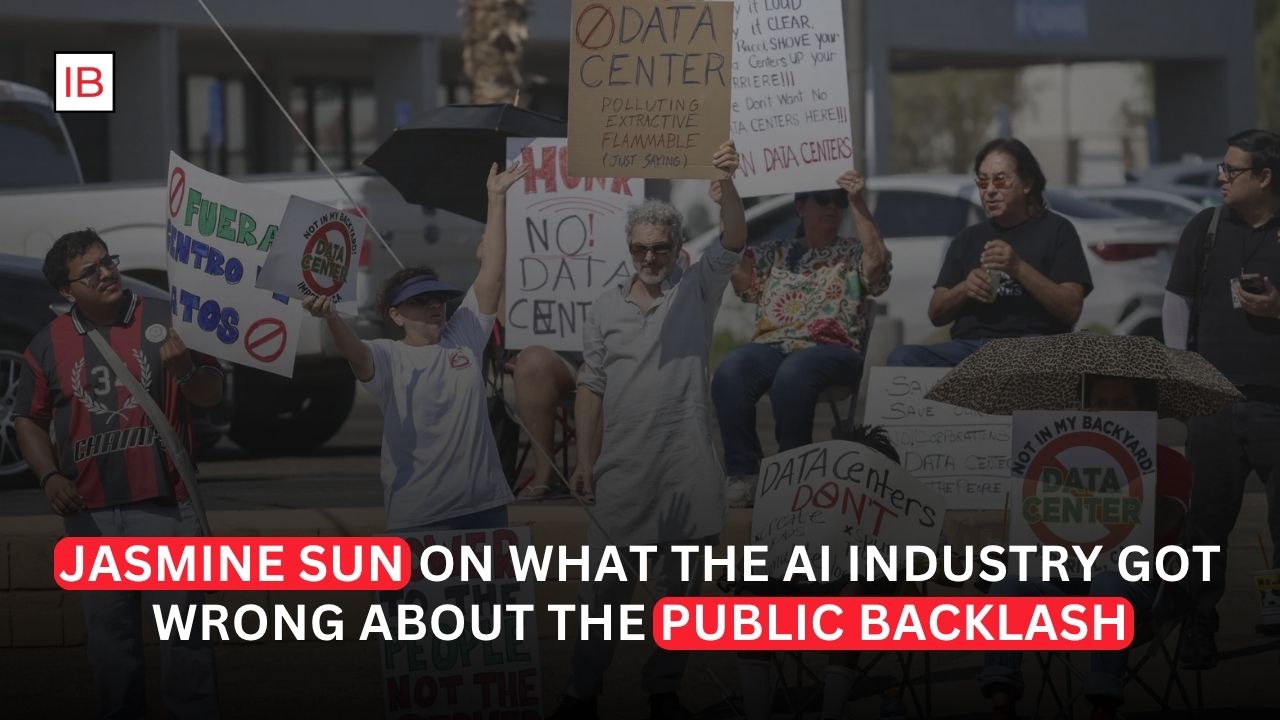
The artificial intelligence industry may have made a fundamental mistake in how it understands growing public opposition to AI. Rather than treating the backlash as a communications problem that can be solved with better advertising, public-relations campaigns or demonstrations of AI’s benefits, journalist Jasmine Sun argues that the industry’s deeper problem is a loss of public trust.
The backlash is increasingly becoming political.
Sun’s analysis focuses on what she describes as “AI populism” — a worldview in which artificial intelligence is seen not simply as a technology, but as an elite project being imposed on ordinary people by powerful technology companies and wealthy executives.
That distinction matters because it changes the question from “How can AI companies explain their technology better?” to “Why do so many people feel they were never given a meaningful choice?”
The Industry May Have Mistaken a Political Problem for a Marketing Problem
AI companies have invested heavily in public relations.
They have promoted AI’s potential to improve healthcare, education, productivity and scientific research. Companies have also emphasized responsible development and repeatedly attempted to reassure the public that the technology will ultimately create more opportunities than it destroys.
But Sun argues that this approach may no longer be sufficient.
The problem is that many people are not rejecting AI because they misunderstand what it can do.
They may understand it perfectly well — and still oppose the way it is being deployed.
That is a much harder problem for the industry to solve.
Why Public Attitudes Are Changing
The early AI narrative was dominated by excitement.
Chatbots became mainstream almost overnight. Businesses began experimenting with automation. Investors poured enormous amounts of money into AI companies. Technology leaders predicted major productivity gains and even more dramatic scientific breakthroughs.
But the public experience has often been less impressive.
People are encountering AI through:
- Workplace automation
- Job-cutting announcements
- AI-generated content
- Customer-service systems
- Algorithmic management
- Surveillance concerns
- Data-center construction
- Electricity and water consumption
- Changes to creative industries
That creates a disconnect.
Silicon Valley may see AI as a technological revolution.
A worker whose employer replaces part of their job with an AI system may see something very different.
The Jobs Question Is Becoming More Important
Employment is arguably one of the biggest sources of anxiety.
AI companies frequently argue that automation will eventually create new categories of employment while eliminating others.
But workers do not necessarily experience technological transitions from the perspective of the long-term economy.
They experience them through their own jobs.
Sun has noted that many people inside the AI industry itself expect substantial job displacement. In interviews with AI researchers, she found widespread uncertainty about what employment will look like for younger generations.
That creates an unusual situation.
The people building the technology can simultaneously believe it will be enormously beneficial and acknowledge that it could cause severe disruption.
The public may focus more heavily on the second part.
Data Centers Have Become a Physical Symbol of AI
The backlash is no longer confined to online arguments.
It is becoming visible in communities where companies are constructing enormous data centers.
These facilities require substantial amounts of electricity, land and, depending on their cooling systems, water.
Sun’s reporting from Wisconsin and Michigan found that opposition was frequently driven by concerns about local infrastructure, transparency and whether communities would actually benefit from the developments.
The important point is that residents do not necessarily have to hate AI itself.
They may simply ask:
Why should our community bear the costs of a technology whose biggest financial beneficiaries are elsewhere?
That question is much harder to answer with an advertising campaign.
Distrust May Matter More Than AI Itself
One of the strongest themes in Sun’s reporting is distrust.
Communities may become skeptical when companies negotiate major projects behind closed doors or use nondisclosure agreements that limit what local residents know.
Promises of jobs and tax revenue can also lose credibility if people have seen similar economic-development projects fail to deliver.
This creates a broader problem.
Even if an AI company is offering genuine economic benefits, residents may not believe the company’s assurances.
The argument therefore becomes less about technology and more about institutional trust.
“AI for Good” May Not Be Enough
The industry has responded to criticism by emphasizing positive applications.
AI can potentially accelerate medical research, improve productivity, assist scientists and help people perform complicated tasks.
Those benefits are real possibilities.
But Sun’s argument is that positive messaging cannot overcome concerns about power and control.
If someone believes AI is being imposed on them, telling them that AI will eventually make their lives better may actually reinforce the perception that the industry is not listening.
The problem is not necessarily that the public wants better marketing.
It may want greater control over how the technology affects its life.
The Silicon Valley Worldview Is Part of the Problem
Another issue is the cultural distance between Silicon Valley and much of the wider public.
AI companies are concentrated in communities where technological progress is deeply valued.
People working in the industry are surrounded by colleagues who believe AI represents the next major stage of technological development.
That can create an echo chamber.
Within that environment, skepticism may appear irrational or uninformed.
Outside it, skepticism can seem completely reasonable.
Sun has described a significant understanding gap between the AI world and the rest of society, arguing that technology reporting and industry culture often fail to reflect how people outside Silicon Valley experience these changes.
AI Populism Is Different From Traditional AI Safety
Another important distinction is between AI safety concerns and public backlash.
AI safety researchers often worry about technical risks such as misalignment, loss of control or potentially catastrophic outcomes.
Those concerns can be extremely serious.
But ordinary public opposition frequently focuses on different issues.
People may worry about:
- Losing their jobs
- Having AI imposed at work
- Artists losing income
- Data centers changing local communities
- Companies becoming too powerful
- Surveillance
- Corporate profits
- Government accountability
These are political and economic questions rather than purely technical ones.
That means the AI industry’s existing safety messaging may not address the reasons many people are angry.
The Industrial Revolution Offers a Useful Comparison
Sun also draws comparisons with earlier waves of automation.
During the 20th century, factories increasingly replaced manual labor with machines.
But workers were not completely powerless.
Trade unions provided a mechanism through which workers could negotiate over wages, working conditions and technological change.
The AI transition is occurring in a much less organized labor environment.
That creates a potential political problem.
If workers believe automation is inevitable but have no meaningful way to negotiate how it affects them, resentment can build.
The technology may therefore become a symbol of broader economic insecurity.
Why Better PR May Actually Fail
The most important lesson for AI companies is that public trust cannot simply be purchased.
Advertising can explain a product.
It cannot easily resolve questions about who controls the technology or who receives its benefits.
If people believe AI companies are ignoring legitimate concerns, another marketing campaign may produce diminishing returns.
In some cases, it could even make things worse.
People may interpret polished corporate messaging as evidence that companies are trying to manipulate public opinion rather than address underlying problems.
China Shows a Different Political Dynamic
Sun has also compared attitudes toward technological progress in China and the United States.
China has experienced substantial technological modernization, and the government has strongly promoted technological advancement as part of national economic development.
Public resistance does exist, including opposition to certain technologies and automated systems, but the political environment makes organized dissent considerably more difficult.
That creates a very different relationship between technology and politics.
In the US, citizens have greater opportunities to organize publicly against developments they oppose.
That makes AI’s political backlash potentially much more consequential.
The Backlash Could Become a Major Political Issue
AI is increasingly moving beyond technology policy.
It could become an issue in local elections, labor politics and national campaigns.
Data-center projects are already creating unusual political coalitions because concerns about electricity prices, land use, environmental effects and corporate power can attract people from different ideological backgrounds.
That makes AI unusual.
It is capable of creating opposition that does not fit neatly into traditional left-versus-right politics.
AI Companies Face a Difficult Choice
The industry now has two broad options.
It can continue emphasizing technological inevitability and attempt to persuade people that AI will ultimately improve their lives.
Or it can focus more heavily on democratic participation, transparency and allowing communities greater influence over how AI infrastructure is developed.
The second approach is slower.
It may also require companies to accept restrictions or conditions they would prefer to avoid.
But if the underlying problem is distrust, compromise may be more effective than persuasion.
What Companies Could Do Differently
A more sustainable strategy could include:
Greater transparency
Explain clearly how projects affect electricity, water, land and employment.
Local participation
Give communities meaningful opportunities to influence major infrastructure projects.
Worker protections
Provide stronger transition programs for employees whose jobs are automated.
Clear economic benefits
Demonstrate how local communities will actually benefit from data centers and other infrastructure.
Less inevitability messaging
Stop presenting every AI development as something society has no choice but to accept.
That final point may be especially important.
People generally resist being told that there is no alternative.
The Biggest Mistake Would Be Ignoring the Backlash
The AI industry still has enormous financial and technological momentum.
That can make opposition appear insignificant.
But political movements do not always begin as majority movements.
They can grow when people connect individual frustrations into a broader story.
A worker worried about automation, a resident worried about a data center and an artist worried about AI-generated content may initially have little in common.
But they can eventually see the same underlying problem: powerful companies making major decisions that affect ordinary people without enough public input.
That is the foundation of the AI populism Sun describes.
Conclusion
The most important argument surrounding Jasmine Sun’s analysis is that the AI industry’s public-relations problem may actually be a political problem.
AI companies have spent years explaining what their technology can accomplish.
But increasingly, people are asking a different question:
Who gets to decide how AI changes society?
That question cannot be answered with another advertisement.
The public backlash is being driven by concerns about employment, corporate power, data centers, infrastructure, transparency and the feeling that technological change is happening faster than democratic institutions can respond.
AI itself may remain enormously useful.
But usefulness does not automatically create legitimacy.
If companies want public acceptance, they may need to offer people more than promises of future benefits. They may need to give workers, communities and governments a genuine role in determining how the technology is deployed.
That could mean slower development in some areas.
It could also mean greater regulation and higher costs.
But the alternative may be a continuing political backlash that becomes harder to contain.
The AI industry’s biggest mistake may therefore have been assuming that public opposition was primarily a communications failure.
The deeper problem is trust — and trust cannot be fixed simply by marketing AI better.