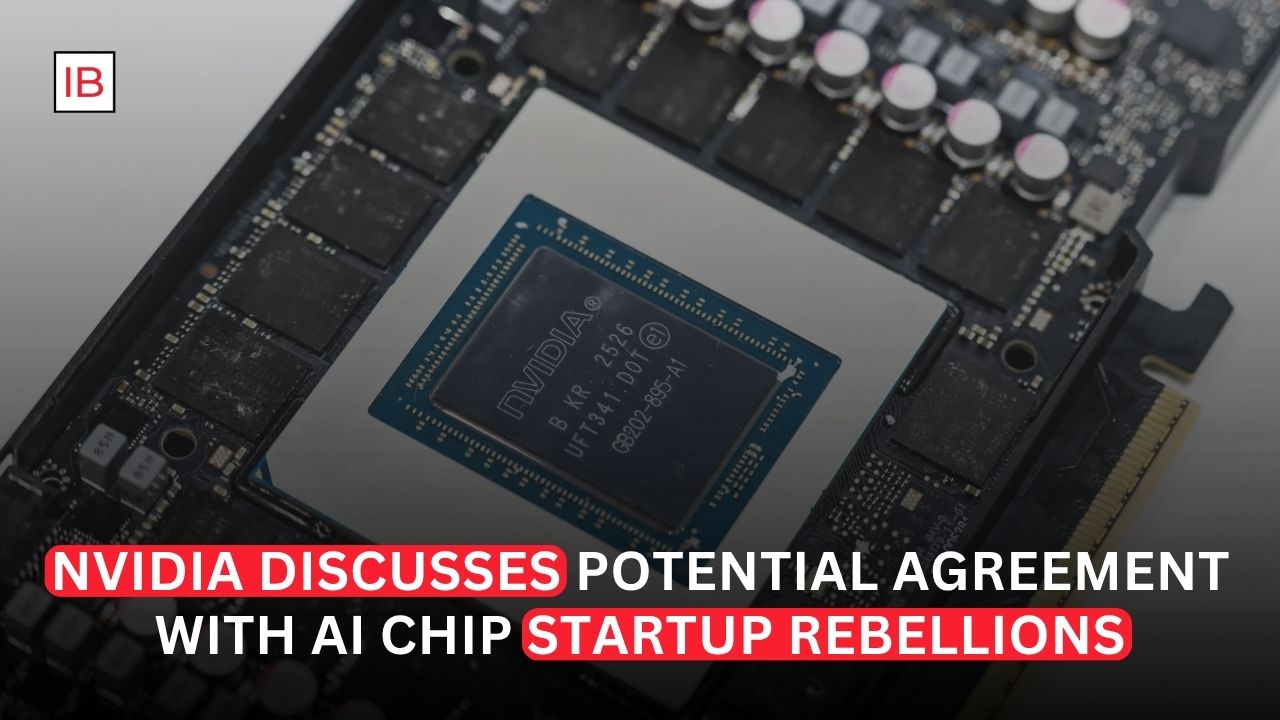
Nvidia Explores Another Move in the Fast-Growing AI Chip Market
Nvidia is reportedly in discussions with South Korean artificial intelligence chip startup Rebellions about a potential deal, highlighting the growing competition to develop specialized processors for AI computing.
A transaction involving Rebellions could give Nvidia additional access to technology and engineering talent in a market where demand for AI chips continues to expand rapidly. The talks also underline how major technology companies are increasingly looking beyond traditional graphics processors as AI workloads create demand for specialized semiconductors.
Talks Could Include Partnership, Investment or Acquisition
According to Bloomberg’s report, the discussions are still at an early stage and could result in several different types of arrangements, including a technology partnership, an equity investment or a full acquisition. Nvidia CEO Jensen Huang reportedly met Rebellions co-founder and CEO Park Sung-hyun at Nvidia’s headquarters in Santa Clara, California. No final agreement has been announced, and it remains uncertain whether the talks will lead to a transaction.
Rebellions Has Become a Major Player in South Korea’s AI Chip Industry
Founded in 2020, Rebellions focuses on AI inference infrastructure. Inference refers to the process of running trained AI models to generate responses, predictions or other outputs.
This part of the AI market is becoming increasingly important as companies move from training large models to deploying them at scale.
Rebellions has been expanding rapidly. In March 2026, the company announced a $400 million pre-IPO funding round, bringing its total funding to approximately $850 million and valuing the company at around $2.34 billion. The company said the funding would support US expansion, production of its Rebel100 platform and preparations for a future initial public offering.
The startup has also attracted backing from major technology and financial players. Its earlier $250 million Series C round included strategic support from Arm and Samsung-related investors.
AI Inference Becomes an Increasingly Valuable Market
The potential interest from Nvidia highlights a major shift in the artificial intelligence industry.
For years, much of the attention focused on training increasingly powerful AI models. Training requires enormous amounts of computing power and has been a major source of demand for Nvidia’s GPUs.
However, once a model has been trained, it must be deployed.
Every time a user asks an AI chatbot a question, generates an image or uses an AI-powered application, the system must perform inference.
That means AI infrastructure needs to optimize not only raw computing performance but also:
- Energy efficiency
- Response speed
- Cost per AI query
- Memory performance
- Scalability
- Software optimization
Specialized AI processors, including neural processing units or NPUs, are increasingly being developed to address these requirements.
Rebellions has positioned itself as a company focused specifically on this growing market.
Rebellions Is Building a Full AI Infrastructure Platform
The South Korean startup has been expanding beyond chip design alone.
In June 2026, Rebellions acquired AI inference optimization company SqueezeBits, a move designed to combine semiconductor hardware with software optimization and AI-serving technology.
The company said the acquisition would help it build an integrated platform covering hardware, software optimization and the deployment of AI services.
This strategy could make Rebellions more attractive to a larger technology company.
Instead of simply developing a chip, the company is attempting to build a broader ecosystem capable of supporting AI applications from the data-center level to the final AI service.
Why Nvidia Could Be Interested
Nvidia already dominates the market for AI accelerators, but competition is increasing.
Technology companies are developing their own custom chips, while startups are trying to create processors optimized for specific AI workloads.
A potential partnership or acquisition could give Nvidia access to:
- Specialized AI inference technology
- Semiconductor engineering talent
- A stronger presence in South Korea
- New approaches to AI chip design
- Additional software optimization capabilities
- A growing customer and partner ecosystem
The discussions also come as Nvidia continues expanding its involvement across the wider AI industry.
The company recently agreed to invest $5 billion in Safe Superintelligence, the AI startup co-founded by former OpenAI chief scientist Ilya Sutskever, as part of a broader strategic partnership.
Nvidia has increasingly invested in companies and infrastructure that could strengthen demand for AI computing.
South Korea Wants to Build Its Own AI Chip Industry
The potential deal is also significant for South Korea.
The country is already one of the world’s most important semiconductor producers because of companies such as Samsung Electronics and SK Hynix.
However, South Korea has also been trying to develop its own advanced AI chip ecosystem.
Rebellions has emerged as one of the country’s most important AI semiconductor startups.
The company previously merged with SAPEON Korea, an AI chip company created by SK Telecom, in a move intended to strengthen South Korea’s competitiveness in AI infrastructure.
More recently, Rebellions said it had been selected as the first direct investment of South Korea’s National Growth Fund, reflecting the strategic importance the country places on developing domestic AI technology.
This could make any potential acquisition particularly sensitive.
A major deal involving Nvidia would likely be viewed not only as a business transaction but also as an important development for South Korea’s technology ambitions.
An Acquisition Could Face Regulatory Questions
If Nvidia eventually attempts to acquire Rebellions, regulators could examine the transaction closely.
Nvidia already holds a dominant position in AI computing, particularly in the market for high-performance accelerators used to train and operate advanced AI models.
An acquisition of another AI chip company could therefore attract antitrust scrutiny in the United States, South Korea and other major markets.
A smaller investment or technology partnership could face fewer regulatory obstacles.
This may be one reason why the discussions reportedly include several possible structures rather than focusing exclusively on a full acquisition.
Nvidia Faces Growing Competition
Nvidia remains the dominant force in AI chips, but the competitive environment is becoming more complex.
Companies such as AMD and Intel are developing competing accelerators, while major cloud companies are investing in custom processors.
At the same time, startups are trying to challenge Nvidia in specialized areas of the AI market.
The rise of companies focused on AI inference is particularly important.
Training a frontier AI model may require enormous clusters of Nvidia hardware, but the long-term cost of serving millions or billions of AI requests could create opportunities for more specialized and energy-efficient processors.
This creates a strategic reason for Nvidia to monitor emerging companies such as Rebellions.
The AI Chip Market Is Moving Beyond Training
The potential Rebellions deal reflects a broader transformation in the semiconductor industry.
The first stage of the generative AI boom focused heavily on building increasingly powerful models.
The next stage may focus more heavily on making those models cheaper and easier to operate.
AI companies are under growing pressure to reduce the cost of inference.
Running advanced AI systems requires expensive chips, large amounts of electricity, data centers and sophisticated cooling infrastructure.
As usage grows, even small improvements in efficiency could create significant savings.
That means the future competition in AI chips may increasingly focus on performance per watt and performance per dollar, rather than simply producing the most powerful processor.
Rebellions’ Growth Makes It a Strategic Target
Rebellions has been preparing for global expansion and a potential public listing.
Its $400 million funding round in March was specifically aimed at scaling production, expanding internationally and preparing for a future IPO.
A potential Nvidia deal could dramatically change those plans.
An acquisition would place Rebellions inside the world’s most valuable AI semiconductor ecosystem.
A strategic investment could provide the startup with additional capital and access to Nvidia’s broader network.
A technology partnership could allow both companies to cooperate while maintaining Rebellions as an independent business.
At this stage, however, there is no indication of which option, if any, will ultimately be chosen.
The Deal Could Signal a New Phase of AI Consolidation
The AI industry has produced hundreds of startups focused on chips, infrastructure, models and software.
As the industry matures, larger companies may increasingly seek to acquire promising technologies and engineering teams.
This could create a new wave of consolidation.
For Nvidia, buying or investing in startups can provide access to emerging technology while potentially preventing competitors from gaining control of strategically important assets.
For startups, partnerships with major technology companies can provide capital, customers and access to global markets.
However, they can also raise questions about whether independent competition in the AI sector is being reduced.
Looking Ahead
Nvidia’s discussions with Rebellions could become an important development in the rapidly evolving AI semiconductor industry.
The talks are reportedly still preliminary and may result in anything from a technology partnership to an investment or a full acquisition. No agreement has been finalized.
Rebellions has quickly established itself as one of South Korea’s most important AI chip startups, raising around $850 million and reaching a valuation of approximately $2.34 billion as it expands its AI inference infrastructure business.
For Nvidia, a potential transaction could provide access to specialized inference technology, engineering expertise and a stronger connection to South Korea’s rapidly developing AI semiconductor ecosystem.
The discussions also highlight an important change in the AI market.
The battle is no longer focused only on who can build the largest and most powerful AI models. Increasingly, the industry is competing to determine who can run those models faster, cheaper and with less energy.
That makes AI inference an increasingly valuable part of the semiconductor market.
Whether Nvidia ultimately partners with, invests in or acquires Rebellions remains uncertain. But the discussions show that the competition for the next generation of AI infrastructure is continuing to intensify.
As AI usage expands from experimental projects to everyday business and consumer applications, companies capable of reducing the cost and complexity of AI computing could become some of the industry’s most valuable assets.
For Nvidia, Rebellions represents more than just another chip startup. It could offer a potential foothold in the next major battle of the AI revolution: making artificial intelligence efficient enough to operate at global scale.