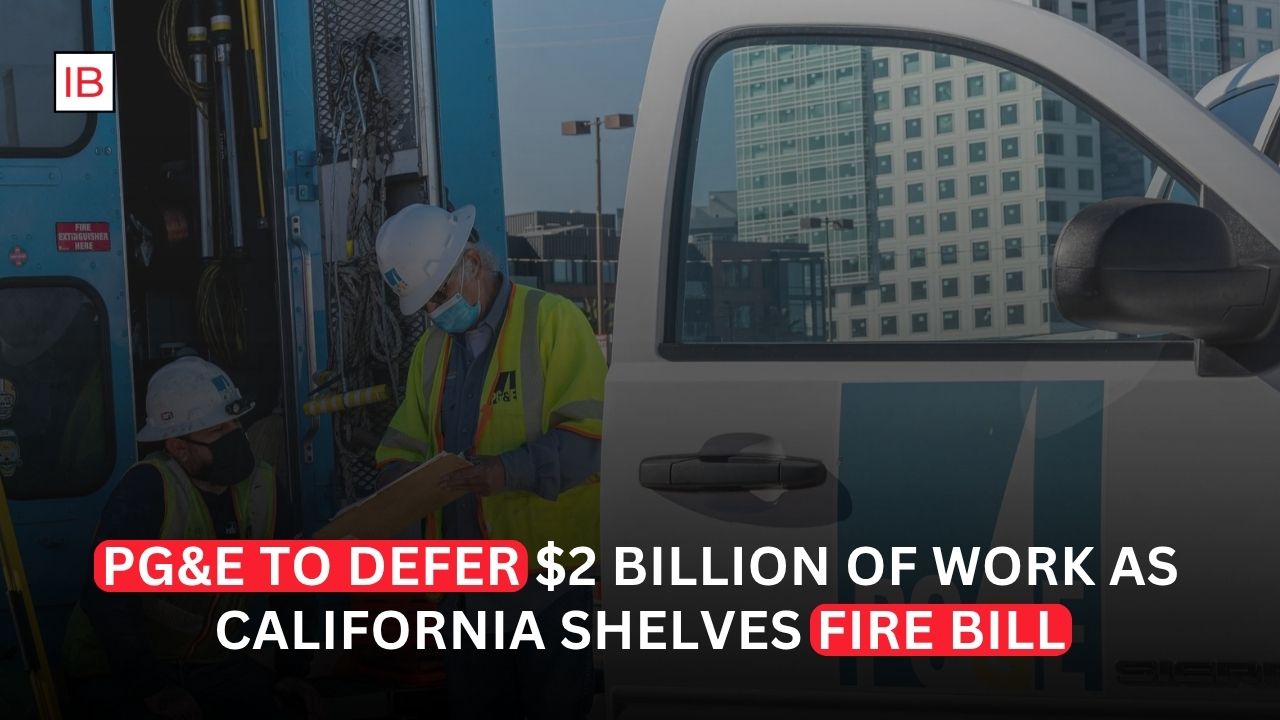
Pacific Gas & Electric Co. is delaying about $2 billion of planned investment for 2027 after California lawmakers failed to advance legislation that would have provided greater certainty around wildfire liabilities. The decision highlights how the unresolved cost of catastrophic fires is increasingly influencing investment plans at one of the state’s largest utilities.
PG&E said the deferral is designed to reduce financing needs and borrowing costs while preserving projects considered essential to safety and regulatory compliance. The company still expects to invest roughly $11.4 billion in California during 2027, meaning the move represents a postponement of part of its capital program rather than a broad withdrawal from infrastructure spending.
The decision follows a major setback in Sacramento. California lawmakers effectively shelved Senate Bill 492 on the final day of the legislative session after the Assembly declined to bring it to a vote. The legislation had been the product of weeks of negotiations over how the state should compensate wildfire victims while protecting utilities from potentially destabilizing financial exposure.
Governor Gavin Newsom and California’s investor-owned utilities had pushed for a more comprehensive framework that could reduce the financial consequences of utility-caused fires. But the version that emerged from negotiations did not provide the liability protections utilities and investors were seeking. Instead, lawmakers focused on measures such as speeding compensation for survivors, restricting trading of wildfire claims and limiting certain executive compensation following catastrophic fires.
For PG&E, the uncertainty is especially important because wildfire exposure has previously pushed the company into financial distress. The utility entered bankruptcy in 2019 after enormous liabilities from California wildfires, making investors highly sensitive to any possibility that future disasters could generate obligations beyond insurance and state-backed mechanisms.
PG&E has argued that California needs a durable solution capable of protecting wildfire survivors while also making it possible for utilities to raise capital at reasonable costs. In a statement before the latest legislative failure, the company said SB 492 did not adequately address the financing risks created by the state’s current wildfire liability framework.
The company’s latest capital decision therefore represents a financial response to political uncertainty. By postponing $2 billion of investment, PG&E can reduce the amount of debt financing it needs in the near term. That could help strengthen its balance sheet and limit pressure from higher borrowing costs, particularly as investors demand greater compensation for holding companies exposed to wildfire liabilities.
The move does not mean PG&E is abandoning wildfire prevention. The company says critical safety programs will continue to receive funding, including work associated with its wildfire mitigation and compliance obligations. Earlier this year, PG&E reported that it had constructed 37 miles of underground power lines and installed 100 miles of strengthened poles and covered conductors in high-risk areas. It plans to complete more than 1,900 miles of undergrounding and more than 2,000 miles of strengthened or covered lines by the end of 2027.
The political uncertainty has already had a major effect on PG&E’s stock. Shares suffered a sharp selloff after it became clear that lawmakers were not providing the liability protections investors had expected. Other California utilities, including Edison International, were also hit as markets reassessed the potential costs of future wildfires.
PG&E’s challenge now extends beyond managing its own projects. The company must balance infrastructure investment, customer affordability, credit quality and shareholder returns while California continues searching for a sustainable wildfire financing model. The state’s $21 billion wildfire fund was established to help utilities manage catastrophic losses, but questions remain about whether existing funding mechanisms are sufficient as fires become more destructive.
For California consumers, the stakes are significant. Delaying investment could reduce near-term financing pressure, but prolonged uncertainty could eventually make it harder or more expensive to upgrade an aging electricity system. At the same time, stronger wildfire protections are essential as extreme heat, drought and development in fire-prone regions increase risks.
PG&E’s $2 billion deferral is therefore more than a routine capital adjustment. It is a signal that California’s unresolved wildfire liability debate is beginning to affect real-world infrastructure spending. Until lawmakers establish a framework that investors, utilities and wildfire survivors can accept, major investment decisions are likely to remain closely tied to the state’s political and financial response to catastrophic fires.