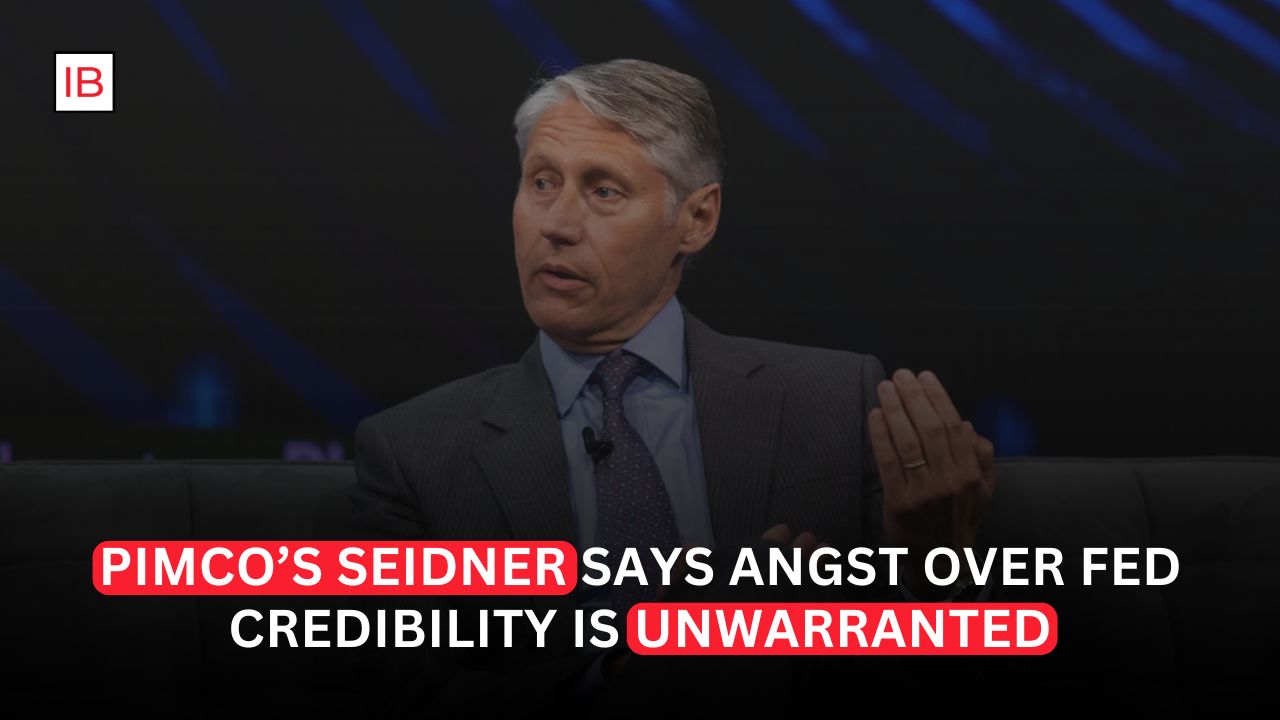
Concerns that the Federal Reserve is losing credibility are being overstated, according to PIMCO’s Marc Seidner, as investors debate the central bank’s policy direction, inflation outlook and independence.
The argument comes at a sensitive moment for US monetary policy. Markets are closely watching the Fed’s approach to interest rates, while questions about inflation, economic growth and political pressure have increased uncertainty around the path of borrowing costs.
Seidner’s view is important because PIMCO is one of the world’s largest fixed-income investment managers, giving its executives a direct perspective on Treasury markets and investor positioning.
The debate is ultimately about something bigger than the next interest-rate decision: Can the Federal Reserve maintain investor confidence while navigating an unusually complicated economic and political environment?
Why Fed Credibility Matters
Central-bank credibility is one of the most important intangible assets in financial markets.
When investors believe the Fed will respond appropriately to inflation and economic weakness, they are more willing to trust its policy signals.
That confidence affects Treasury yields, mortgage rates, corporate borrowing costs and the value of the US dollar.
If investors begin to believe policymakers are willing to tolerate persistently high inflation, they may demand higher yields on long-term government bonds.
That can tighten financial conditions even if the Fed itself has not raised its policy rate.
This is why concerns about credibility have become such an important part of the current market debate.
Seidner Takes a More Relaxed View
Seidner’s position challenges the more pessimistic interpretation.
Rather than viewing recent uncertainty as evidence of a fundamental loss of confidence, the PIMCO executive sees the market as adjusting to a changing policy environment.
That distinction matters.
A central bank can experience periods of uncertainty without permanently losing credibility.
Markets regularly reassess monetary policy when inflation, employment and economic growth move in unexpected directions.
The more important question is whether investors ultimately believe policymakers will respond to the data rather than political pressure.
The Fed Faces a Difficult Balancing Act
The Federal Reserve has to manage two competing risks.
Cut rates too aggressively and inflation could remain elevated or accelerate again.
Keep rates too high for too long and economic growth could weaken, potentially damaging employment and investment.
The problem becomes even more complicated when energy prices are affected by geopolitical disruptions.
Higher oil prices can push inflation upward while simultaneously reducing household purchasing power.
That creates a policy dilemma for central bankers.
The Fed cannot directly produce more oil or resolve geopolitical conflicts.
It can only respond to the economic consequences through monetary policy.
Markets Often Focus Too Much on the Next Meeting
One weakness in the current debate is the tendency to reduce monetary policy to a simple question: Will the Fed cut or raise rates next?
The more important issue is the longer-term reaction function.
Investors need to understand how policymakers will respond if inflation remains above target while unemployment rises.
A central bank that communicates a consistent framework can retain credibility even when its individual decisions surprise markets.
Conversely, frequent shifts in messaging can damage confidence even if individual policy decisions are economically defensible.
That is why Fed communication has become almost as important as the interest-rate decision itself.
Treasury Yields Are the Real Test
The bond market provides one of the clearest measures of investor confidence.
If investors become increasingly concerned about inflation or the Fed’s independence, long-term Treasury yields can rise even without a change in the federal-funds rate.
That would increase borrowing costs across the economy.
Mortgage rates, corporate bonds and government financing would all be affected.
PIMCO’s own research has emphasized that fixed-income returns can remain attractive even when rates stay higher for longer, particularly when starting yields are elevated.
This creates an interesting contrast.
High Treasury yields can reflect attractive investment opportunities, but they can also reflect greater perceived macroeconomic risk.
The challenge for investors is distinguishing between the two.
Political Pressure Remains a Key Risk
The Fed’s credibility debate cannot be separated entirely from politics.
Central banks are most effective when markets believe their decisions are based primarily on economic conditions rather than short-term political objectives.
Any perception that monetary policy is being influenced by political demands can increase the risk premium investors assign to US government debt.
That does not necessarily mean the Fed immediately loses credibility.
Credibility tends to deteriorate gradually when investors see repeated evidence that policymakers are prioritizing something other than their stated mandate.
The distinction between political criticism and actual political interference is therefore crucial.
A Credibility Crisis Would Look Different
It is also worth asking what would constitute genuine evidence of a Fed credibility problem.
A single market selloff would not be enough.
Neither would a temporary increase in Treasury yields.
More convincing evidence would include persistently elevated inflation expectations, sustained increases in long-term real yields, a weakening dollar caused by monetary-policy concerns, or repeated market reactions showing investors no longer believe the Fed’s guidance.
That is a much higher threshold than simply saying investors are nervous.
This is where Seidner’s argument has some weight.
Market anxiety and institutional credibility are not the same thing.
Inflation Is Still the Biggest Challenge
The Fed’s credibility ultimately depends on inflation.
If price growth remains stubbornly above the central bank’s objective, investors could begin questioning whether policymakers are prepared to accept weaker economic growth to restore price stability.
That would create a difficult environment for financial markets.
Bond investors would demand greater compensation for inflation risk.
Equity valuations could also come under pressure because higher discount rates reduce the present value of future corporate earnings.
The result could be tighter financial conditions without an official Fed tightening.
But Growth Cannot Be Ignored
The opposite mistake would be to assume that inflation is the only issue.
If economic growth deteriorates significantly, keeping monetary policy restrictive could create unnecessary damage.
A credible central bank therefore has to demonstrate flexibility.
It must be willing to tighten when inflation requires it and ease when economic conditions justify it.
That flexibility should not be confused with inconsistency.
The difference is whether policy changes can be explained by changes in the economic data.
What Bond Investors Are Watching
For fixed-income investors, several indicators will be particularly important.
Inflation expectations will show whether markets believe price pressures are becoming entrenched.
Treasury term premiums will indicate how much additional compensation investors require for holding longer-dated government debt.
The US dollar will provide another signal about confidence in US monetary and fiscal policy.
And labor-market data will determine how much room the Fed has to prioritize inflation over employment.
These indicators together are more informative than simply watching the next rate decision.
PIMCO’s Perspective Matters
PIMCO has a particularly strong interest in the credibility question because its investment universe is heavily exposed to global fixed-income markets.
The firm has continued to argue that bonds can offer attractive opportunities even when the path of rate cuts is uncertain. Its recent research compares historical easing cycles and notes that higher starting yields can provide a meaningful cushion for fixed-income investors.
That suggests the firm’s focus is not simply on predicting the next Fed move.
It is also assessing whether current bond yields adequately compensate investors for inflation, duration and policy risks.
The Bigger Risk May Be Mispricing
There is another possibility investors should consider.
The biggest danger may not be that the Fed has already lost credibility.
It may be that markets are mispricing the uncertainty surrounding the central bank.
If investors assume rapid rate cuts that never arrive, longer-term yields could remain elevated.
If they assume inflation will quickly return to target and it does not, bond markets could experience another repricing.
Likewise, if markets overestimate political influence over monetary policy, they could demand an unnecessarily large risk premium.
In all three cases, the problem is less about the Fed suddenly becoming untrustworthy and more about investors incorrectly estimating its future behavior.
What Happens Next
The credibility debate will probably remain a major theme for financial markets.
The Fed’s decisions over the coming months will be judged not only by whether rates move up or down, but by whether policymakers can explain those decisions consistently.
If inflation falls while economic growth remains reasonably resilient, the credibility debate could fade.
If inflation stays high and policymakers appear reluctant to respond, concerns would become more serious.
And if political pressure becomes more direct, markets could demand a larger premium for holding US government debt.
For now, Seidner’s message is essentially that investors should distinguish between uncertainty and institutional failure.
The Fed is operating in an unusually difficult environment, but difficult policy decisions do not automatically mean its credibility has collapsed.
The real test will come through the bond market.
If investors continue to trust the Fed’s commitment to price stability, Treasury markets should remain relatively orderly even through periods of volatility.
If that confidence genuinely begins to disappear, the consequences will be much broader — affecting borrowing costs, currencies, equities and the global financial system.
Until then, declaring a full-blown credibility crisis may be getting ahead of the evidence.