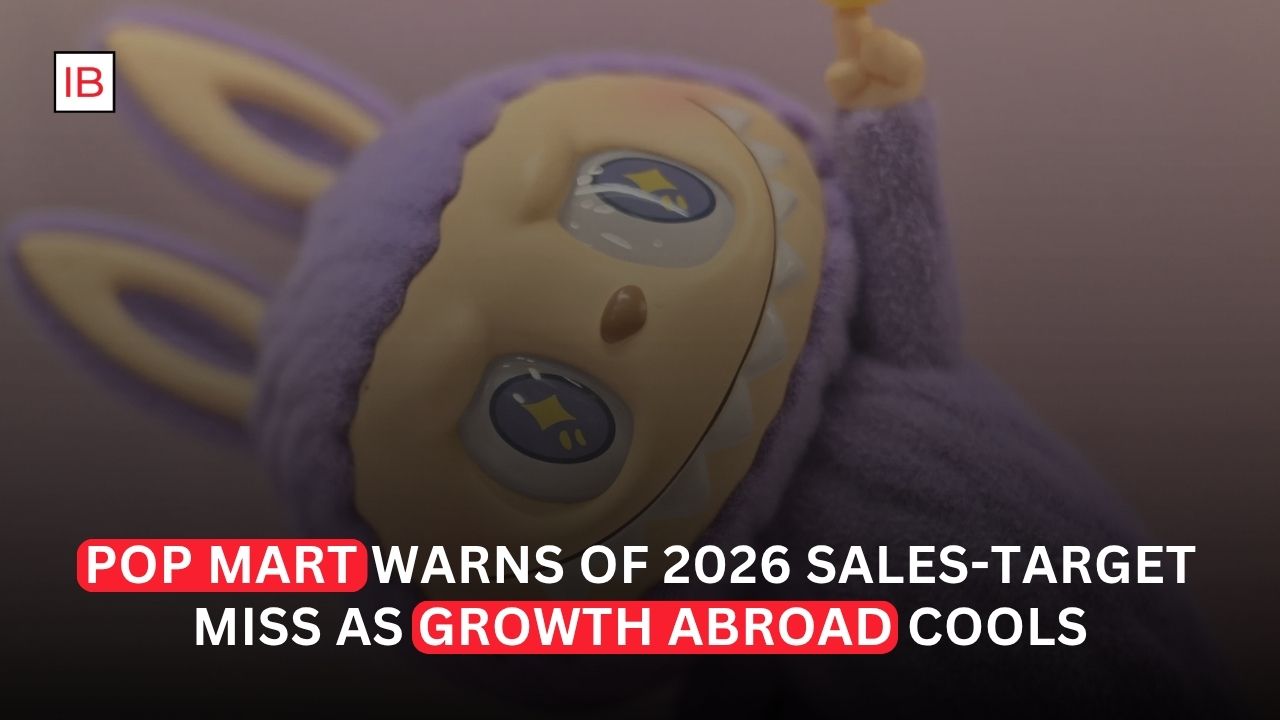
Pop Mart International, the Chinese collectibles company behind the globally popular Labubu dolls, is facing a much tougher growth environment after two years of extraordinary expansion. The company has warned that slowing momentum in overseas markets could make it difficult to achieve its 2026 sales target, raising fresh questions about whether the Labubu phenomenon can be transformed into a sustainable global business.
The warning comes at an uncomfortable moment for the company. Pop Mart’s growth has slowed sharply from the extraordinary pace recorded during the previous year, while demand for some newer versions of its best-known characters appears to be cooling. At the same time, its international expansion, which was expected to become one of the company’s most important growth engines, is showing signs of losing momentum.
The development matters because Pop Mart’s valuation and investor expectations were built around the assumption that the company could turn a Chinese collectible-toy success story into a worldwide consumer brand.
That strategy is now facing its first serious test.
Labubu’s Global Explosion Is Losing Momentum
Pop Mart’s rise was driven primarily by The Monsters collection, which includes Labubu, the mischievous-looking character created by artist Kasing Lung.
The character became an international sensation after moving beyond China’s collector community and becoming a fashion and social-media phenomenon.
Labubu‘s appeal was not limited to children.
Young adults, celebrities and social-media influencers helped transform the toys into highly visible lifestyle accessories. Limited availability, blind-box packaging and collectible variations encouraged consumers to repeatedly purchase products in search of rare editions.
The strategy worked extraordinarily well.
For a period, demand appeared almost impossible to satisfy.
But consumer trends are rarely permanent.
The latest financial results show that Pop Mart’s growth is slowing substantially. Revenue increased 24% during the first half of 2026 to 17.17 billion yuan, or about $2.55 billion. That was well below analysts’ expectations for approximately 37% growth. Net profit rose 10% to 5.04 billion yuan, also missing market expectations.
The numbers still represent growth.
The problem is the speed of that growth.
The Company Is Coming Off an Extraordinary Growth Period
Pop Mart’s current slowdown looks more dramatic because it follows an exceptional period.
During the previous year, revenue growth was roughly three times as fast as the latest first-half figure.
That created a difficult comparison.
When a company grows explosively, investors begin to assume that the exceptional growth rate will continue. But maintaining very high growth becomes increasingly difficult as the business becomes larger.
Pop Mart now has to sell substantially more products every year simply to maintain the same percentage growth.
This creates a mathematical problem.
A company generating billions of dollars in annual sales cannot indefinitely grow at the same rate as a much smaller startup.
The question is therefore not whether Pop Mart can continue growing.
It is whether it can maintain enough growth to justify the expectations built into its valuation.
Overseas Markets Were Supposed to Drive the Next Phase
International expansion has been central to Pop Mart’s strategy.
The company has opened stores and expanded distribution across markets including the United States, United Kingdom, France, Australia, South Korea and Southeast Asia.
The objective was straightforward.
Pop Mart wanted to demonstrate that its characters could become global intellectual properties rather than remain primarily Chinese collectibles.
The initial results were extremely encouraging.
Labubu became recognizable outside China and generated a level of social-media attention that few Chinese consumer brands have achieved internationally.
But international expansion has now become more difficult.
The company’s latest warning suggests that overseas growth is cooling, creating uncertainty around the ability to hit its 2026 sales objective.
That is particularly significant because overseas markets represent a relatively young opportunity for Pop Mart.
If growth slows before the international business reaches sufficient scale, the company’s overall expansion rate could remain under pressure.
Labubu Still Matters — But Its Share of Sales Is Falling
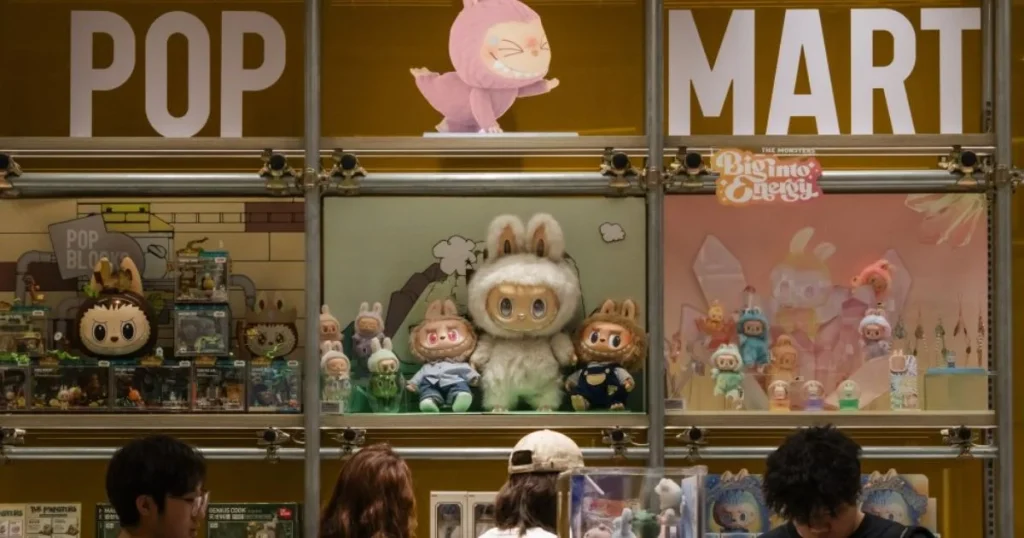
Labubu has not disappeared from Pop Mart’s business.
The Monsters collection remained the company’s largest revenue contributor during the first half of 2026.
However, its share of total revenue has declined.
The collection accounted for about one-quarter of sales in the first half, compared with roughly one-third a year earlier.
At first glance, that could be interpreted positively.
A declining revenue share could indicate that Pop Mart is successfully diversifying its business.
But there is another interpretation.
The decline may partly reflect slower momentum in Labubu itself.
That distinction is crucial.
If other characters are growing quickly enough to replace Labubu’s contribution, Pop Mart is successfully building a portfolio.
If Labubu is weakening while replacement characters fail to achieve comparable popularity, the company faces a more serious problem.
Consumer Fatigue Is Becoming a Concern
The biggest threat to Pop Mart may not be competition.
It may be consumer fatigue.
The Labubu phenomenon was driven by novelty, scarcity and social-media excitement.
But those forces can weaken quickly.
Consumers who bought multiple versions of a character may eventually decide that they already own enough.
The excitement surrounding a new release can also diminish when the character becomes widely available.
Analysts have pointed to weaker demand for some newer Labubu designs, including versions with long, styleable hair. Social-media discussion around the character has also reportedly cooled.
That is an important warning sign.
Pop Mart’s business model depends heavily on creating repeated excitement.
If every new release produces less urgency than the previous one, sales growth can slow even if the brand remains popular.
Pop Mart Needs Its Next Blockbuster Character
The company’s long-term challenge is therefore obvious:
What comes after Labubu?
Pop Mart has several other characters, including Skullpanda and Twinkle Twinkle.
Both have attracted consumers.
But neither has yet generated the same level of global enthusiasm as Labubu.
That creates a difficult strategic task.
The company cannot simply produce more Labubu merchandise indefinitely.
It needs to build a portfolio of characters that can independently generate demand.
The strongest consumer brands do not depend on one product.
Disney has multiple franchises.
Nintendo has multiple characters.
Sanrio has multiple globally recognized properties.
Pop Mart is trying to create a similar ecosystem in collectible toys.
The challenge is proving that it can repeatedly create characters capable of becoming cultural phenomena.
The Blind-Box Model Remains Central
Pop Mart’s business model is built around blind boxes.
Consumers purchase a sealed package without knowing exactly which character or design is inside.
Rare editions create scarcity and encourage repeat purchases.
This mechanism can be highly effective.
A customer who wants a specific character may need to purchase multiple boxes before finding it.
That creates additional sales while also encouraging collecting and trading.
But the same model has a weakness.
It depends on consumers remaining emotionally invested in the characters.
If excitement disappears, the blind-box mechanism becomes much less powerful.
Scarcity cannot create permanent demand by itself.
The underlying character still has to matter to consumers.
Pop Mart’s Stock Has Already Reflected Some of the Concerns
The company’s share price has begun reflecting the change in expectations.
Pop Mart’s Hong Kong-listed stock has fallen nearly 20% in 2026, reversing some of the enormous gains recorded during the previous two years.
That decline is important because the stock had previously benefited from investors’ belief that Pop Mart could become a major global consumer brand.
The market is now asking a different question:
How durable is the growth?
A company can remain profitable while its stock falls if investors believe future growth will be slower than previously expected.
That appears to be the issue facing Pop Mart.
Overseas Expansion Has a Different Challenge Than China
Pop Mart’s international markets are fundamentally different from its home market.
In China, the company understands local consumer preferences, social-media trends and retail behavior.
Overseas, it must compete with established entertainment brands and adapt to different cultural preferences.
A character that becomes a phenomenon in China does not automatically become a permanent global franchise.
That means Pop Mart has to invest in:
- Retail stores
- Marketing
- Local partnerships
- Distribution
- Product adaptation
- Brand awareness
- Social-media campaigns
All of that costs money.
If overseas sales grow more slowly, the company may have to spend more to generate each additional dollar of revenue.
That could put pressure on margins.
The US Market Could Be Particularly Important
The United States represents one of the biggest opportunities for Pop Mart.
It is also one of the hardest markets to conquer.
American consumers have enormous choices in toys, entertainment merchandise and collectibles.
Pop Mart therefore needs to compete not only with other collectible-toy companies but also with major entertainment franchises.
The company has already established a physical presence in the United States and continues expanding its retail footprint.
But a successful global brand requires more than opening stores.
The challenge is creating repeat demand after the initial trend passes.
Pop Mart Is Trying to Build an Intellectual-Property Company
The company’s broader strategy goes beyond selling toys.
It wants to create intellectual properties that can generate revenue across multiple categories.
That could eventually include:
- Toys
- Apparel
- Accessories
- Games
- Entertainment
- Theme parks
- Collaborations
- Licensing
This approach would make the business less dependent on individual product releases.
Pop Mart has already expanded beyond basic retail through experiences and digital initiatives.
The long-term goal is to turn characters into franchises.
But that transformation takes time.
The Key Risk: A One-Hit Wonder Problem
The harshest interpretation of the current slowdown is that Pop Mart could become overly dependent on one extraordinarily successful character.
Labubu has been so successful that it has raised the standard for every other product.
A new character that generates strong sales may still look disappointing if it does not match Labubu’s impact.
That creates a dangerous comparison.
Investors may begin treating each new release as a test of whether Pop Mart can repeat its previous success.
If several launches underperform, expectations could fall further.
But the Company Still Has Significant Advantages
The slowdown should not be confused with business failure.
Pop Mart still has important advantages.
1. A recognizable global brand
Labubu has achieved international recognition that few Chinese consumer brands have matched.
2. A large customer base
The company has developed a global community of collectors.
3. A proven retail model
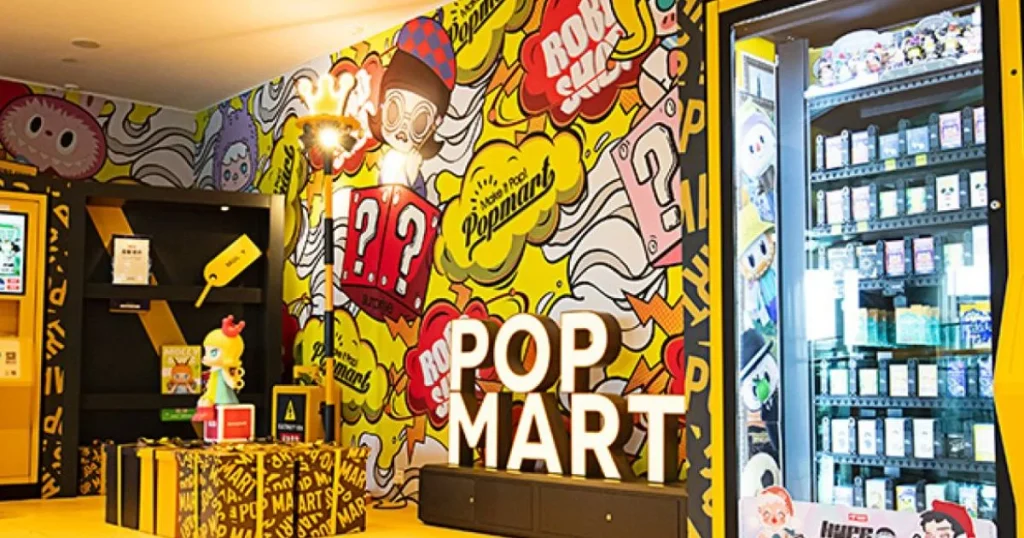
Pop Mart has demonstrated that its stores and vending machines can generate consumer traffic.
4. A broad character portfolio
The company is not dependent on only one intellectual property.
5. Strong cash-generation potential
Even with slower growth, Pop Mart remains a profitable company.
6. International expansion opportunities
Many global markets remain underpenetrated.
These advantages give management room to adjust its strategy.
The Next Phase Will Require More Discipline
During a period of explosive growth, companies can afford to prioritize expansion.
When growth slows, efficiency becomes more important.
Pop Mart may need to become more selective about store openings, inventory management and marketing spending.
The company must determine which markets have genuine long-term potential and which are simply benefiting from temporary trends.
That distinction will become increasingly important.
Rapid international expansion can look attractive when sales are growing quickly.
But poorly performing stores can become expensive liabilities once consumer excitement fades.
Pop Mart’s Biggest Test Is Sustainability
The central question surrounding Pop Mart is no longer whether it can create a viral product.
It already has.
The bigger question is whether it can create a repeatable system for building global consumer franchises.
That requires more than one successful character.
It requires a pipeline.
Pop Mart needs to continuously develop new designs, artists and characters capable of attracting collectors.
If it can do that, the current slowdown could simply represent the normalization of growth after an extraordinary period.
If it cannot, the company may face several years of slower expansion.
What Investors Should Watch
Several indicators will determine where Pop Mart goes from here.
Overseas revenue growth
If international sales continue slowing, management’s global expansion strategy may need to be reassessed.
Labubu demand
The company needs to determine whether Labubu is experiencing temporary normalization or a deeper decline in consumer interest.
New character performance
Skullpanda, Twinkle Twinkle and future characters will be important indicators of diversification.
Retail productivity
Investors should watch sales per store rather than simply the number of stores opened.
Profit margins
Slower sales combined with rising marketing and expansion costs could pressure profitability.
Inventory
Inventory levels can provide clues about whether products are moving through the retail network as expected.
The Bigger Lesson for China’s Consumer Brands
Pop Mart’s experience offers a broader lesson for Chinese companies attempting to become global consumer brands.
China has produced enormous technology and manufacturing companies.
But creating globally dominant consumer franchises is much harder.
Consumer brands depend on culture, emotion and identity.
A product can be technically excellent and still fail internationally.
Pop Mart’s success with Labubu therefore represented something unusual.
It demonstrated that a Chinese-origin character could become a global cultural trend.
The current slowdown does not erase that achievement.
But it shows how difficult it is to turn viral popularity into lasting global demand.
Conclusion: Pop Mart Has Entered Its Harder Growth Phase
Pop Mart’s warning that it may miss its 2026 sales target is significant because it arrives after one of the most spectacular growth periods in the modern collectible-toy industry.
The company remains profitable and continues expanding internationally.
But the easy part may be over.
Labubu created enormous global attention, generated repeated purchases and transformed Pop Mart from a Chinese collectibles company into an international consumer brand.
Now the company has to prove that the phenomenon can survive beyond a single character and beyond a single viral moment.
The slowdown in overseas growth makes that challenge more urgent.
Pop Mart needs new characters, stronger franchises and a retail model that can remain profitable after the initial excitement disappears.
The company also needs to determine whether international consumers will continue buying its products at high rates once Labubu becomes less novel.
That is the central issue for investors.
A 24% increase in revenue is not inherently weak. For most companies, it would be exceptional.
But Pop Mart is being judged against a history of much faster growth.
The market is therefore not asking whether the company is still growing.
It is asking how long the growth can last.
If Pop Mart successfully develops its next generation of global characters, the current slowdown could prove temporary.
If Labubu turns out to have been an unusually difficult act to follow, the company may need to reset expectations for years of slower growth.
Either way, Pop Mart has entered a new stage.
The era of explosive Labubu-driven expansion is giving way to the much harder task of building a durable global consumer empire.