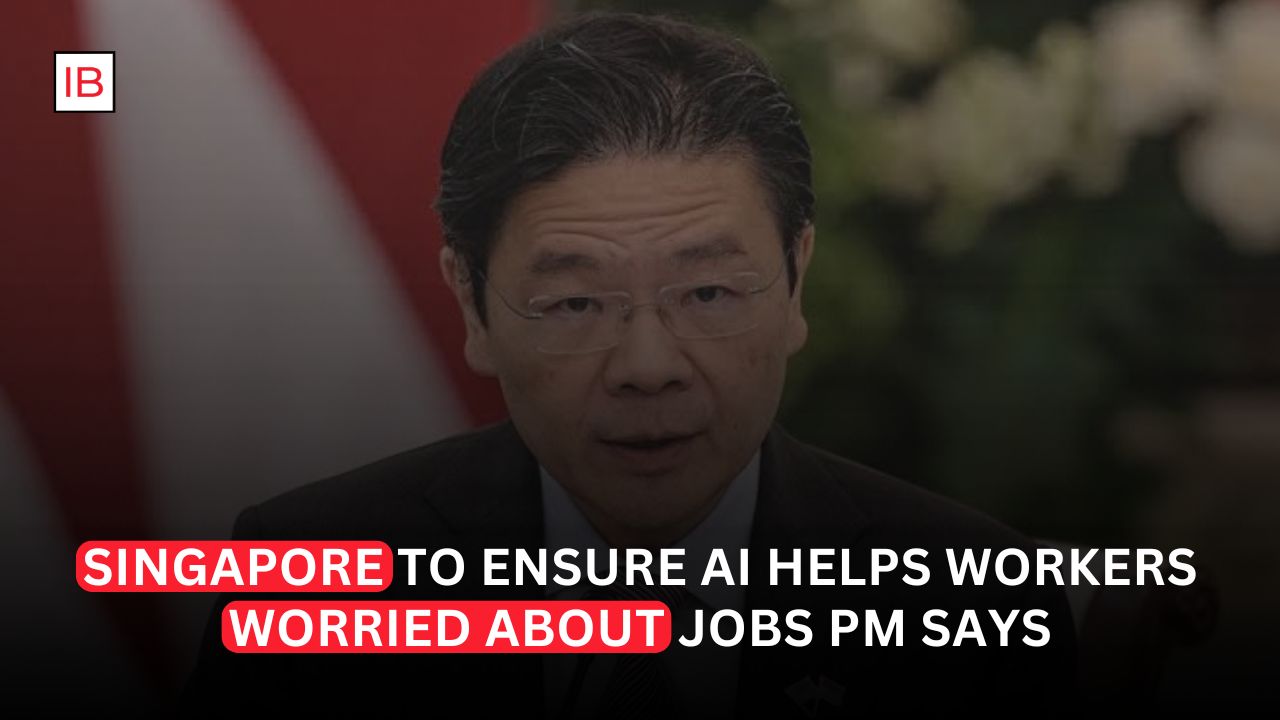
Prime Minister Lawrence Wong says Singapore will ensure artificial intelligence supports workers and creates new opportunities as businesses rapidly adopt the technology.
Singapore is seeking to make sure the rapid adoption of artificial intelligence benefits workers rather than simply replacing them, as concerns grow that automation could reshape employment across the economy. Prime Minister Lawrence Wong has emphasized that the country must prepare workers for changing job requirements while ensuring that technological progress translates into broader economic opportunities.
The issue is becoming increasingly important for Singapore because of the country’s highly skilled and digitally advanced workforce. A large share of employment is concentrated in professional and knowledge-intensive roles that are particularly exposed to generative AI. Earlier research by the International Monetary Fund found that Singapore is among the economies most exposed to AI-related changes in the workplace.
AI Adoption Is Reshaping Jobs
Singapore’s government is focusing on the idea that AI should complement workers rather than automatically replace them.
Recent data from the Ministry of Manpower shows that companies adopting AI are more commonly changing existing jobs than eliminating them. About 18.9% of firms surveyed reported redesigning job roles, while 13.9% reported creating new AI-related positions. Only 6.2% reported reductions in headcount attributable to AI.
The figures suggest that the immediate impact of AI is more complicated than straightforward job replacement. Companies are changing how employees perform tasks, introducing new responsibilities, and creating demand for workers with technology-related skills.
Government Focuses on Worker Training
Singapore is placing significant emphasis on retraining and skills development as AI becomes more deeply integrated into workplaces.
The government’s approach includes helping workers acquire skills that allow them to work alongside AI systems rather than compete directly with them. Training programs are expected to become increasingly important as employees move into new roles or take on responsibilities that require stronger digital and analytical capabilities.
Singapore’s existing SkillsFuture framework is likely to remain an important part of this transition. Research from Singapore’s Economic Development Board has found strong interest among workers in additional training that would help them use AI tools more effectively at work.
Concern Over Job Security Remains
Despite the government’s emphasis on opportunity, anxiety over job security is increasing as AI capabilities improve.
Workers in professional services, finance, administration, technology, and other knowledge-based industries face particular uncertainty because many of their daily tasks can increasingly be assisted or automated by AI systems.
Singapore has therefore stressed that economic growth should not come at the expense of workers. Parliament previously backed a motion emphasizing that the country’s AI transition should not result in “jobless growth,” reinforcing the government’s focus on inclusive economic development.
Businesses Will Need to Adapt
The government’s strategy also places responsibility on companies to ensure AI adoption improves productivity while creating sustainable employment opportunities.
Businesses may need to redesign jobs, provide training, and identify areas where AI can handle repetitive work while employees focus on decision-making, customer relationships, creativity, and other tasks requiring human judgment.
Singapore’s latest labor-market data suggests this transition is already underway, with companies reporting job redesign and the creation of new AI-related positions more frequently than outright workforce reductions.
Singapore Faces a Critical Test
The challenge for Singapore will be ensuring that the benefits of AI are distributed broadly across the workforce.
Highly skilled employees may be able to benefit quickly from productivity gains, while workers with fewer opportunities for training could face greater disruption. Earlier IMF research warned that AI exposure could worsen inequality without targeted retraining and support.
This makes continuous education and accessible training increasingly important as technology develops faster than traditional job descriptions.
Looking Ahead
Singapore’s approach to artificial intelligence is increasingly centered on making technology a tool for workers rather than simply a mechanism for reducing labor costs. The government is seeking to combine rapid AI adoption with training, job redesign, and policies designed to ensure workers can benefit from the changing economy.
The transition will not be without disruption. Some jobs will disappear, others will change significantly, and entirely new roles will emerge. Singapore’s success will depend on whether workers can move between those opportunities quickly enough.
For now, the government is signaling that AI-driven economic growth must remain closely connected to employment and social stability. As adoption accelerates, Singapore’s ability to retrain workers and encourage companies to use AI as a productivity tool could become an important test of whether advanced economies can embrace automation without leaving large parts of their workforce behind.