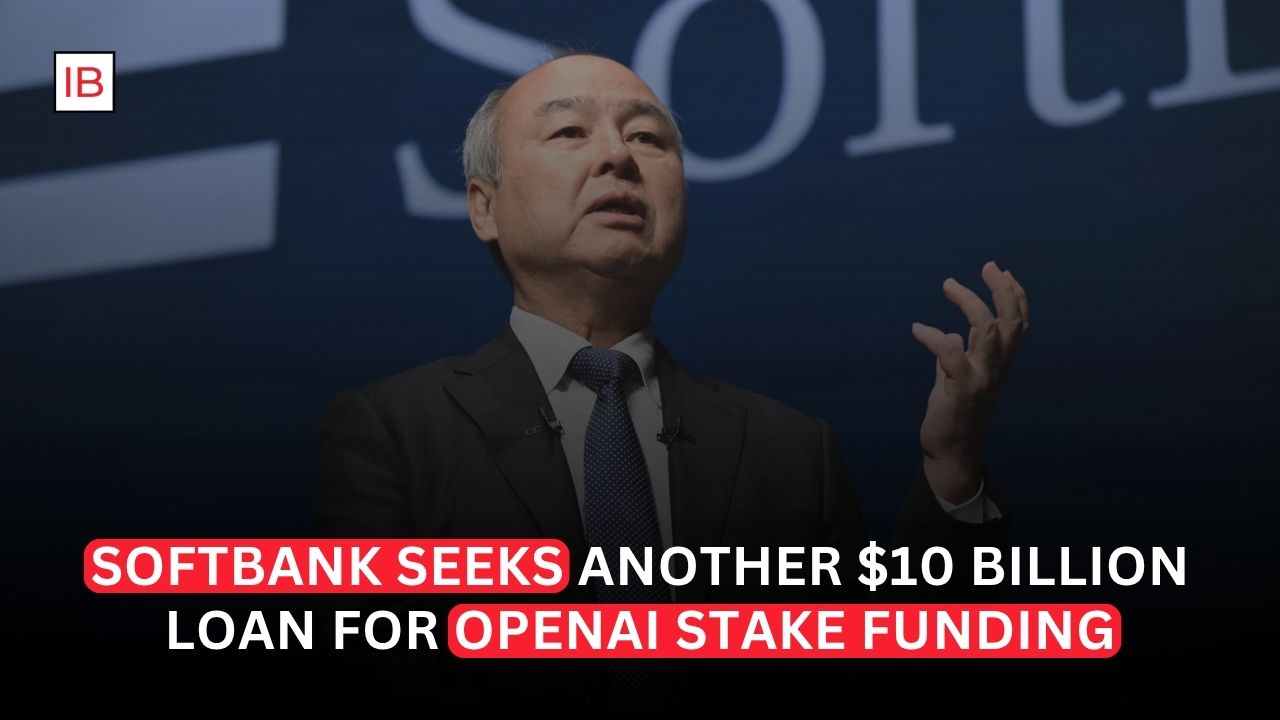
SoftBank Group is seeking another $10 billion loan as it works to finance and refinance its enormous investment in OpenAI, adding another layer of debt to the Japanese technology conglomerate’s aggressive bet on artificial intelligence.
The proposed two-year facility would reportedly carry an interest margin of about 275 basis points over the Secured Overnight Financing Rate, with Mizuho Bank acting as mandated lead arranger and bookrunner.
The financing highlights both the scale of SoftBank’s commitment to OpenAI and the growing role of debt in funding the AI investment boom.
SoftBank’s OpenAI Bet
SoftBank has committed $30 billion in follow-on investment to OpenAI. According to SoftBank’s own financial report, $20 billion had already been funded in April and July, while another $10 billion is scheduled for October.
That commitment is part of a much broader strategy led by founder Masayoshi Son to make SoftBank one of the world’s largest financial backers of artificial intelligence.
The company is betting that OpenAI and the wider AI ecosystem will become enormously valuable as demand for computing power, data centers and advanced AI models continues to grow.
Debt Is Funding the Strategy
The size of SoftBank’s OpenAI investment means the company cannot rely solely on existing cash.
SoftBank arranged a $40 billion bridge loan facility in March 2026 to support major investments. The company says $20 billion has already been drawn for OpenAI and plans to borrow another $10 billion for the remaining investment scheduled for October.
The latest proposed loan would add to that financing effort.
SoftBank intends to refinance the bridge facility before its March 2027 maturity through a combination of asset-backed financing and other forms of takeout financing.
OpenAI Shares as Collateral
One of the most important features of the financing strategy is SoftBank’s willingness to use its OpenAI investment as collateral.
That approach allows the company to borrow against an asset it expects to appreciate substantially.
But private-company shares are harder to value than publicly traded stocks.
That creates a problem for lenders because the value of the collateral can change significantly between financing transactions.
SoftBank previously faced difficulty securing a similar loan because of concerns surrounding the valuation of OpenAI’s private shares. It later offered additional protections to lenders, including a corporate guarantee.
Why Lenders Are Interested
Banks have strong incentives to participate in financing connected to the AI boom.
OpenAI is one of the most valuable and strategically important private technology companies in the world, and SoftBank is a major investor.
If OpenAI’s valuation continues rising, the collateral supporting the loans could become more valuable.
The proposed interest margin also gives lenders compensation for taking on the additional risk.
The Valuation Problem
The biggest risk is straightforward: what happens if the value of OpenAI falls?
Unlike a listed stock, OpenAI’s shares do not have a continuously visible market price.
That makes it more difficult for lenders to determine how much they can safely lend against the shares.
If OpenAI’s valuation falls sharply, SoftBank could face pressure to provide additional collateral, repay part of the borrowing or sell other assets.
SoftBank Has Other Assets
SoftBank is not dependent entirely on OpenAI.
The company owns stakes in publicly traded businesses and other technology investments, including Arm.
Its own financial strategy emphasizes maintaining control over leverage and loan-to-value ratios through asset sales, asset-backed financing and other funding methods.
That provides SoftBank with several ways to raise cash if market conditions deteriorate.
The AI Financing Boom
SoftBank’s financing needs are part of a much larger trend.
The AI industry is consuming enormous amounts of capital.
Companies are investing billions of dollars in data centers, chips, electricity infrastructure and computing capacity.
The scale of spending has pushed technology companies and investors toward increasingly complicated financing structures.
SoftBank is effectively using its balance sheet to participate in that expansion.
OpenAI Requires Massive Capital
OpenAI’s growth depends on access to enormous amounts of computing infrastructure.
Training and operating advanced AI models requires large quantities of specialized chips and data-center capacity.
That means the company’s financial requirements extend far beyond software development.
SoftBank’s investment is therefore partly a bet on the infrastructure economy developing around OpenAI.
SoftBank’s Broader AI Strategy
The company is not limiting its AI ambitions to OpenAI.
SoftBank has also committed billions of dollars to robotics and infrastructure projects.
Its planned acquisition of ABB’s robotics business for $5.4 billion and its $3.1 billion acquisition of DigitalBridge are additional examples of the company’s attempt to build a broad AI ecosystem.
This strategy increases potential returns but also increases the amount of capital SoftBank needs.
Investors Are Watching Leverage
The central concern for SoftBank shareholders is leverage.
Borrowing can amplify returns when investments perform well.
If OpenAI’s valuation rises substantially, using debt to finance the investment could make SoftBank’s equity returns more attractive.
But leverage works in both directions.
A decline in the value of SoftBank’s investments could magnify losses and increase pressure on the company’s balance sheet.
The Bridge Loan Must Be Repaid
SoftBank’s $40 billion bridge facility is scheduled to mature in March 2027.
The company therefore has a relatively clear financing deadline.
It plans to replace the temporary borrowing with longer-term financing, particularly asset-backed loans.
The new $10 billion facility could become part of that broader refinancing process.
Bond Markets Are Another Option
SoftBank is also considering large bond offerings to support its AI strategy and refinance existing debt.
Reports indicate the company has been exploring offshore bond financing worth as much as $20 billion.
It is also planning a record retail bond sale in Japan worth about ¥1 trillion, or roughly $6.3 billion, demonstrating the scale of its fundraising efforts.
The Cost of Borrowing Matters
Higher interest rates would make SoftBank’s AI strategy more expensive.
The proposed loan’s spread over SOFR shows that lenders are demanding a premium for the risk involved.
For SoftBank, the investment only makes financial sense if the returns from OpenAI and other AI assets eventually exceed the cost of financing.
That is a major assumption behind the strategy.
A High-Stakes AI Bet
SoftBank’s approach represents one of the most aggressive corporate bets on AI currently underway.
The company is effectively wagering that today’s enormous AI valuations and infrastructure spending will translate into much larger future profits.
If that happens, the debt used to finance the strategy could prove manageable.
If the AI investment cycle slows, however, SoftBank could face a much more difficult financial environment.
Conclusion
SoftBank’s pursuit of another $10 billion loan underscores how deeply debt has become embedded in its strategy to finance OpenAI and the broader AI boom.
The company has already committed $30 billion to OpenAI, with $20 billion funded and another $10 billion scheduled for October. It is using a $40 billion bridge facility and plans to refinance that borrowing through asset-backed financing and other sources.
The strategy offers substantial upside if OpenAI continues to increase in value. SoftBank could benefit from owning a large stake in one of the world’s leading AI companies while using financing to preserve its exposure to future growth.
But the risks are equally clear.
Private-company valuations are difficult to establish, borrowing costs can rise and leverage can magnify losses. If OpenAI’s valuation weakens or the AI investment boom loses momentum, SoftBank could face pressure on both its collateral and balance sheet.
For now, the company is continuing to push deeper into AI.
The latest loan effort shows that Masayoshi Son is willing to use significant financial leverage to maintain SoftBank’s position in what he sees as the defining technology investment opportunity of the coming decade.