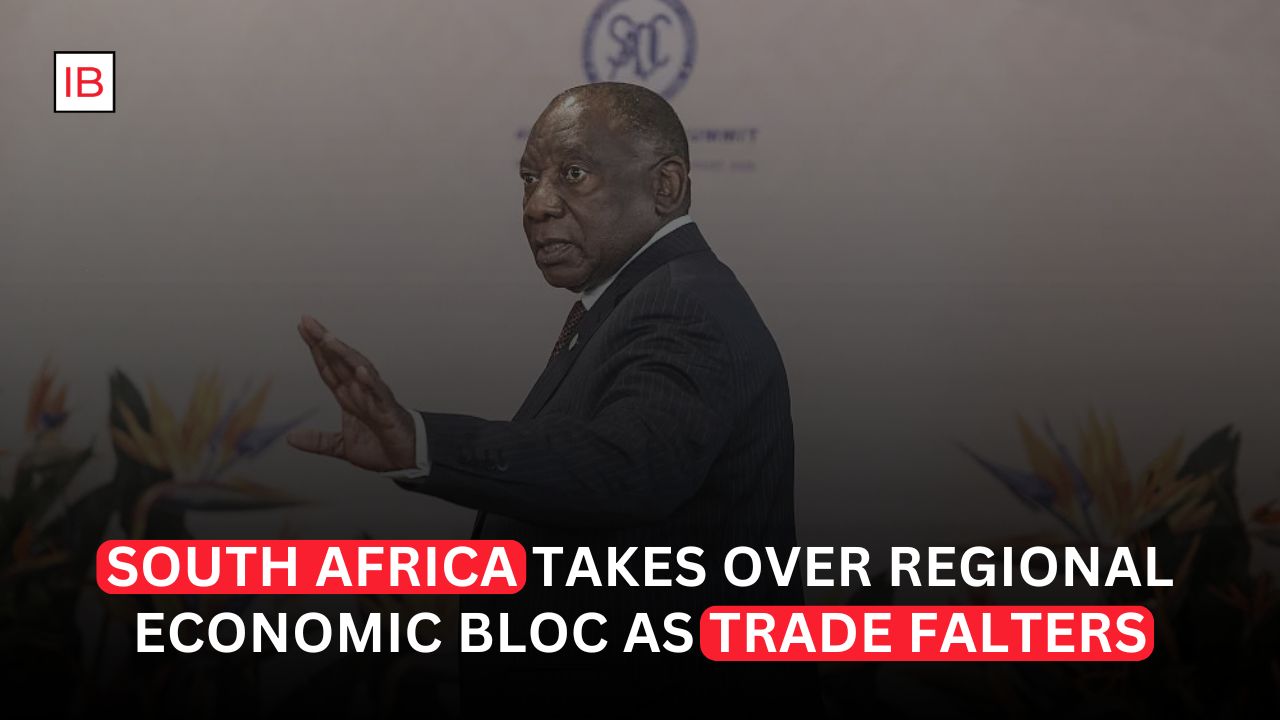
South Africa is taking on a more prominent role in regional economic integration at a difficult moment for southern Africa, as trade within the region remains below its potential and external trade pressures continue to reshape the bloc’s economic priorities.
The challenge for South Africa is straightforward: it has the largest and most diversified economy in the region, but turning that economic weight into stronger regional trade will require more than political leadership.
South Africa currently chairs both the Southern African Customs Union (SACU) and the Southern African Development Community (SADC), giving it an unusually influential position in shaping the region’s trade agenda.
Trade Is Falling Short of Its Potential
The problem is not a lack of economic connections.
South Africa already conducts substantial trade with neighboring countries, but regional commerce remains constrained by infrastructure bottlenecks, customs procedures, overlapping trade arrangements and differences in economic development.
South Africa’s own government estimates that exports to the rest of Africa were worth about R556.7 billion in 2025, representing 26.7% of its total goods exports. It has also identified roughly R1.1 trillion of unrealized export potential elsewhere on the continent through 2030.
That gap is central to the new regional strategy.
The opportunity isn’t simply to sell more South African products to neighboring markets. It is to build regional supply chains in which multiple African economies participate in manufacturing, processing and distribution.
South Africa Wants More Intra-Regional Trade
One of the country’s priorities during its SADC chairship is increasing intra-regional trade while developing stronger industrial value chains.
Recent reporting indicates that South Africa is targeting a significant increase in intra-SADC trade and wants regional integration to support industrialization, mineral processing and more competitive supply chains.
That strategy reflects a broader shift.
For years, many African economies have primarily exported raw materials while importing finished goods.
South Africa wants to use regional integration to change that pattern.
Instead of exporting minerals and agricultural commodities separately, countries could increasingly process those resources within the region and capture more of the value themselves.
But Regional Integration Has a Structural Problem
The biggest weakness is that African trade agreements do not automatically translate into efficient trade.
Businesses still face poor transport infrastructure, delays at borders, inconsistent regulations and complicated rules of origin.
South Africa’s own diplomatic material has previously identified overlapping regional memberships, divergent trade policies, infrastructure problems and weak trade-facilitation systems as major obstacles to deeper SADC integration.
This is why simply signing another agreement is unlikely to solve the problem.
The real test is whether goods can move across borders faster and more cheaply.
External Trade Pressures Are Making Regional Markets More Important
South Africa is also dealing with a less predictable global trading environment.
US tariffs have already affected important South African export industries, particularly automobiles, steel and aluminum. The South African Reserve Bank has noted that automotive exports to the US were significantly affected by the tariff regime.
That creates an incentive to diversify.
If access to major developed markets becomes more uncertain, South African companies have greater reason to look toward African consumers.
The same logic applies to other countries in the region.
A deeper regional market can provide an alternative source of demand when global trade becomes more fragmented.
India Is Another Piece of the Strategy
South Africa’s regional leadership is also occurring as SACU expands its trade relationships outside Africa.
India and SACU recently signed terms of reference to restart negotiations for a preferential trade agreement. SACU includes South Africa, Botswana, Namibia, Lesotho and Eswatini.
The proposed agreement could reduce tariffs on products including automobiles, pharmaceuticals, machinery, electrical equipment and chemicals.
For India, SACU provides access to a market of roughly 65 million people.
For southern Africa, India offers another major trading partner and potential source of investment.
The negotiations also highlight an important reality: regional integration does not mean turning inward.
South Africa is trying to strengthen African trade while simultaneously building commercial relationships with major economies outside the continent.
Critical Minerals Could Become a Major Opportunity
Another major opportunity is the region’s mineral wealth.
SACU countries have supplies of platinum-group metals, manganese, copper and other minerals that are increasingly important to manufacturing, batteries and clean-energy technologies.
India is seeking more reliable access to some of these resources as part of the trade negotiations.
South Africa therefore has an opportunity to move beyond simply exporting raw minerals.
If regional countries can develop processing and manufacturing capacity, they could capture a larger share of the global clean-energy supply chain.
But that requires substantial investment in electricity, transport, ports and industrial infrastructure.
South Africa’s Own Constraints Matter
There is a major blind spot in the regional strategy.
South Africa cannot lead regional industrialization effectively if its own infrastructure and manufacturing competitiveness continue to struggle.
Electricity reliability, rail constraints, port inefficiencies and slow economic growth have all weighed on the country’s ability to compete internationally.
That means regional leadership is partly dependent on domestic reform.
A stronger South African economy could become a powerful engine for regional trade.
A weak South African economy could instead limit the benefits of integration.
AfCFTA Provides a Bigger Framework
South Africa is also participating in the African Continental Free Trade Area, which offers a much larger potential market than SADC alone.
South Africa implemented AfCFTA in January 2024, and rules of origin have been finalized for several sectors, including automobiles, clothing and textiles.
The long-term objective is to make African markets more connected.
If successful, companies could increasingly design production networks around the continent rather than treating each country as an isolated market.
That could make African manufacturing more competitive globally.
The Investment Opportunity
For investors, deeper regional integration could benefit several sectors.
Logistics: More cross-border trade increases demand for transport and warehousing.
Manufacturing: Regional supply chains could encourage new factories.
Mining: Critical minerals remain strategically important.
Infrastructure: Roads, railways, ports and electricity networks are essential to integration.
Financial services: Cross-border commerce creates demand for payments, banking and trade finance.
Consumer businesses: A larger integrated market could allow companies to scale beyond individual national economies.
The Bigger Picture
South Africa’s leadership comes at a moment when the old model of global trade is becoming less predictable.
Tariffs are rising in some markets, supply chains are being reorganized and countries are increasingly looking for reliable regional partners.
That creates an opening for southern Africa.
But the opportunity should not be overstated.
Regional integration will not succeed simply because South Africa has taken the chair.
The harder work is reducing border delays, improving infrastructure, harmonizing regulations and making it easier for businesses to operate across multiple African markets.
South Africa has the economic weight to push that agenda, but it also has to address its own competitiveness problems.
If it succeeds, stronger regional trade could help southern Africa move from an export model dominated by commodities toward one built around manufacturing, processing, regional supply chains and higher-value exports.
The real test of South Africa’s regional leadership will therefore be measured not by the number of agreements signed, but by whether businesses can actually move goods, capital and services across southern Africa faster, cheaper and more predictably.