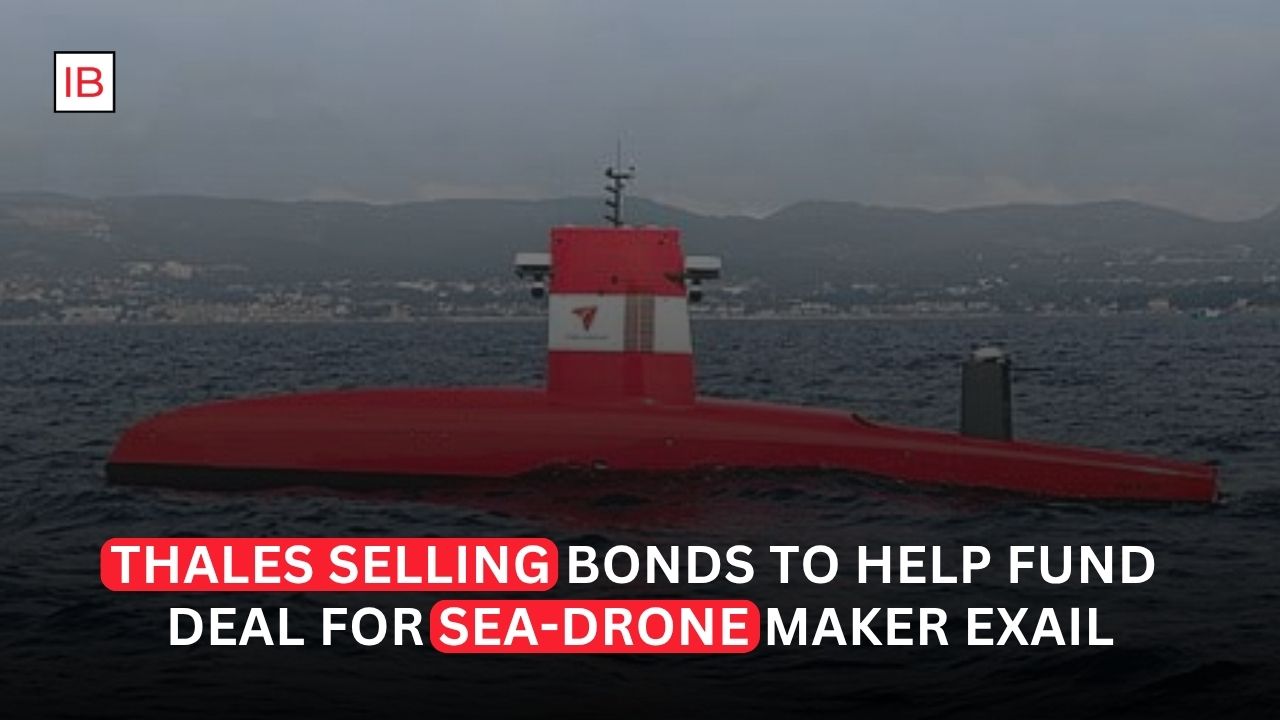
Thales is turning to the bond market to help finance its planned acquisition of Exail Technologies, bringing another major European defense transaction into focus as governments and military contractors accelerate investment in autonomous systems, underwater warfare and naval technology.
The French defense and technology group has agreed to acquire control of Exail, a specialist in maritime robotics and navigation systems, in a deal that values the target at about €3.9 billion. Thales has agreed to buy the 35.51% stake held by Exail’s controlling Gorgé family at €134 a share and plans to make a mandatory offer for the remaining shares and certain convertible bonds.
The decision to raise debt for the transaction highlights how strategically important Exail has become.
Exail is not simply another defense contractor. The company specializes in autonomous maritime systems, navigation technologies, robotics and photonics, with particular expertise in underwater drones used for mine countermeasures and other naval missions. Thales sees those capabilities as complementary to its own strengths in sonar, sensors and defense electronics.
The acquisition therefore gives Thales a stronger position in a part of the defense market that is attracting increasing attention from governments and militaries.
Underwater drones are becoming increasingly important as naval forces seek ways to monitor seabeds, locate mines, conduct surveillance and operate in waters where sending crewed vessels would be expensive or dangerous.
The strategic value of such technology has become clearer as maritime security risks have increased.
The Strait of Hormuz crisis, growing concerns over underwater infrastructure and renewed emphasis on anti-submarine warfare have all increased interest in autonomous maritime systems. Thales has argued that the market for underwater robotic operations could expand substantially in coming years. Reuters reported that the companies see the addressable anti-submarine warfare market rising to more than €700 billion by 2030, compared with about €85 billion in 2025.
That potential growth helps explain why Thales was willing to pay a significant price for Exail.
The €134-per-share offer represented a 44% premium to Exail’s unaffected share price before takeover discussions became public. The transaction gives Exail an enterprise value of roughly €3.9 billion.
For Thales, financing the purchase through bonds allows the company to preserve flexibility while gaining access to a strategically valuable business.
But borrowing to fund an acquisition also comes with risks.
Higher debt increases financing costs and puts additional pressure on the acquired business to deliver the expected earnings growth. Thales has said it expects Exail to contribute positively to earnings per share from the first year and generate more than €90 million of additional operating profit by 2032.
Those expectations will become important for investors assessing whether the transaction creates value.
Exail is considerably smaller than Thales. The company generated about €479 million in revenue in 2025 and had an order book of approximately €1.1 billion at the end of March, according to information cited in the deal announcement. Thales, by comparison, generated €22.1 billion in sales in 2025 and had an order book of €53.3 billion at the end of December.
The size difference means the acquisition will not transform Thales financially overnight.
Its importance is strategic.
Thales already has a major position in defense electronics, radar, sonar, communications and other systems. Adding Exail’s autonomous maritime capabilities could allow the company to offer a broader package of technologies to naval customers.
That could become increasingly valuable as militaries move toward fleets that combine crewed ships with autonomous platforms.
The traditional model of naval warfare is changing.
Large surface ships and submarines remain essential, but relatively inexpensive autonomous systems can perform missions that previously required expensive crewed platforms.
They can remain underwater for extended periods, gather information, inspect infrastructure or search for mines without putting sailors directly in harm’s way.
For European militaries, that is particularly attractive because defense budgets are rising while personnel remain constrained.
The acquisition also fits into a wider consolidation trend across Europe’s defense industry.
European governments are under pressure to spend more on defense and develop capabilities that reduce dependence on the United States. That is encouraging large defense companies to acquire smaller specialists with technologies that could become critical in future conflicts.
Thales was not the only company interested in Exail.
French rival Safran had also held discussions with the company before ending negotiations in early July. Thales subsequently emerged as the buyer.
The competition for Exail demonstrates how valuable maritime robotics have become.
It also suggests that European defense companies are increasingly willing to pay premium valuations for technologies that provide access to rapidly expanding markets.
For Exail’s shareholders, the transaction provides an immediate opportunity to monetize their holdings at a significant premium.
For the Gorgé family, which has controlled the company, the agreement provides a path toward a sale while maintaining the possibility of a broader transaction.
Thales and Exail signed a tender offer agreement in July confirming the terms of the planned acquisition. The agreement covers the remaining shares and ODIRNANE bonds, a form of convertible security, after Thales acquires the family’s controlling stake.
The deal still faces regulatory hurdles.
Thales expects the acquisition of the Gorgé family’s stake to close after customary approvals, including antitrust clearance. The company’s current timetable points to closing in the third quarter of 2027, followed by a mandatory tender offer that is expected to conclude by early 2028.
That long timeline means investors will have to wait before the transaction is fully completed.
It also gives Thales time to prepare for the integration.
Integration could be particularly important because Exail has developed highly specialized technologies and serves customers across defense and civilian markets. Thales will need to preserve Exail’s engineering expertise while connecting its capabilities with a much larger global organization.
There is a danger in acquisitions of this type.
Large defense companies can sometimes struggle to integrate smaller technology businesses without slowing decision-making or losing entrepreneurial talent. Exail’s value comes partly from its specialized engineering capabilities, meaning retaining key personnel will likely be essential.
The financial structure adds another consideration.
Using bonds to fund the acquisition allows Thales to complete the transaction without relying entirely on existing cash resources. But debt markets are not free. Interest payments will increase the financial burden on the company, particularly if borrowing costs remain elevated.
Investors therefore need to judge whether the expected strategic benefits justify the additional leverage.
Thales appears confident that they do.
The company has said the acquisition fits within its disciplined capital-allocation framework and will not affect its existing dividend policy.
That message is designed to reassure shareholders that the purchase will not come at the expense of returns to investors.
But the biggest potential payoff is not immediate revenue.
It is positioning.
If autonomous underwater systems become a standard component of modern naval forces, controlling a leading European maritime robotics business could give Thales a valuable competitive advantage.
The technology could also be combined with Thales’s existing sonar and defense systems.
Imagine a naval operation in which autonomous underwater vehicles identify a potential threat, Thales sonar systems track it and other platforms process the information and coordinate a response.
That type of integrated capability is likely to become increasingly important as militaries adopt networked warfare.
Exail’s navigation technology adds another strategic layer.
Accurate navigation is essential for autonomous systems, particularly underwater where satellite positioning signals cannot be used directly. A vehicle operating beneath the ocean needs sophisticated inertial navigation and sensing technology to determine its position.
Exail is a major European player in naval inertial navigation systems, according to Thales.
That capability could prove as important as the drones themselves.
It gives Thales access to a technology base that can support future autonomous platforms and potentially reduce dependence on external suppliers.
The transaction also has implications for European defense sovereignty.
European governments increasingly want domestic companies capable of producing advanced military technology without relying excessively on American suppliers. Thales is already one of Europe’s largest defense technology groups, while Exail offers specialized capabilities that could strengthen Europe’s ability to develop autonomous naval systems domestically.
That could make the acquisition attractive not only commercially but strategically.
Still, there is a valuation question.
Paying €3.9 billion for a company with less than €500 million in annual revenue represents a substantial premium. Thales is effectively betting that Exail’s future growth will be much larger than its current financial scale suggests.
That bet depends on sustained defense spending and rapid adoption of maritime robotics.
If governments increase naval spending and autonomous systems become more widespread, Exail could prove highly valuable.
If procurement programs move slowly or budgets shift toward other technologies, the expected returns could take much longer to materialize.
There is also competition from other defense companies and specialist robotics firms.
As the market grows, more companies will attempt to develop autonomous underwater systems. Thales will therefore need to keep investing heavily in research and development even after completing the acquisition.
The deal is consequently not an endpoint.
It is a bet on where naval warfare is heading.
Thales is effectively saying that underwater robotics, autonomous systems and advanced navigation will become central parts of the next generation of defense technology.
The bond financing shows that the company is willing to commit substantial financial resources to that view.
For Europe’s defense industry, the transaction is another indication that the era of relatively modest military spending is giving way to a period of sustained investment.
For investors, the key issue will be whether Thales can turn that spending into profitable growth.
The acquisition gives the company access to a promising technology portfolio, a strong order book and a specialized workforce.
But it also requires significant capital and creates integration challenges.
The bond market will help Thales pay for the deal, but ultimately the acquisition will have to pay for itself through stronger earnings, larger contracts and a stronger competitive position.
If autonomous maritime warfare develops as rapidly as many defense companies expect, Exail could become one of the most strategically important additions to Thales’s portfolio.
The company is betting that the underwater battlefield of the future will contain far more machines than sailors.
And by financing the acquisition through bonds, Thales is putting real capital behind that bet.