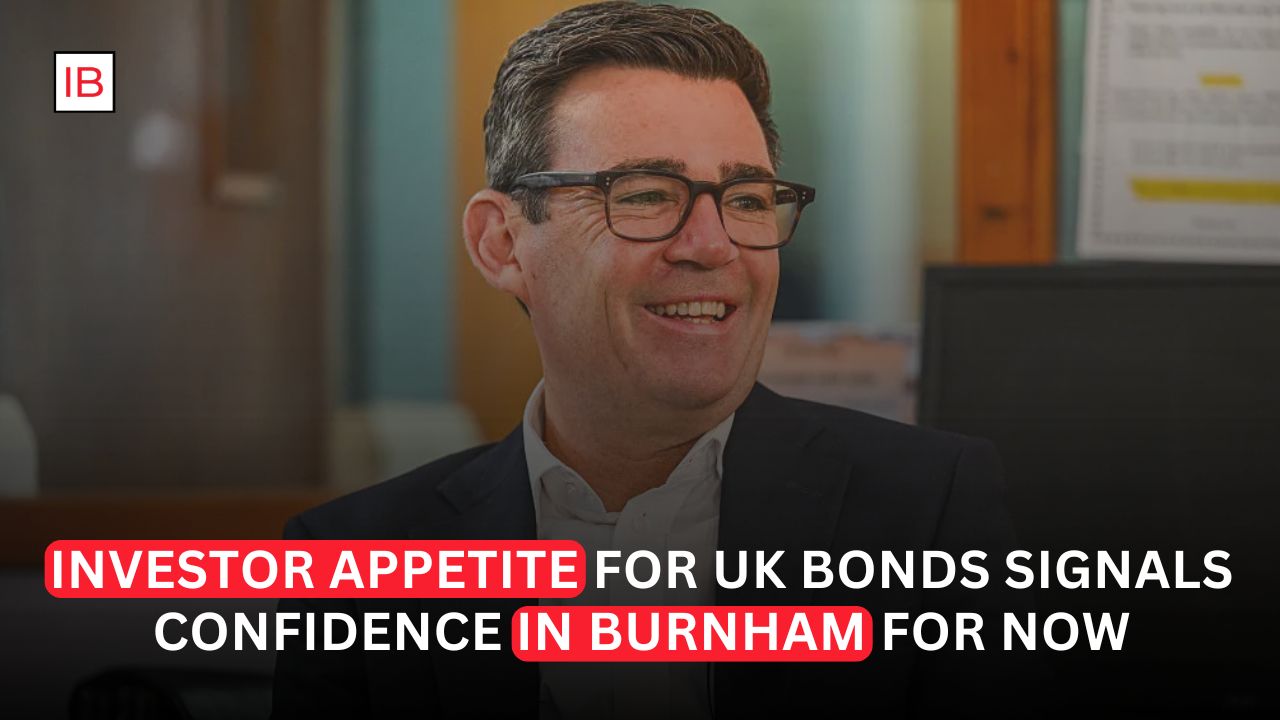
Investors Are Betting on Lower UK Borrowing Costs as Markets Give Andy Burnham’s Government Some Breathing Room Ahead of a Crucial Budget
A popular trade in UK government bonds is offering an important signal about investor confidence in Prime Minister Andy Burnham’s economic agenda, with markets increasingly betting that gilt yields could decline as inflation pressures ease and the economy loses momentum.
The shift is significant because the UK bond market has become one of the most closely watched indicators of confidence in the government’s fiscal plans.
For now, investors appear willing to give Burnham the benefit of the doubt.
That does not mean markets have completely embraced the new government’s economic strategy. Instead, the latest moves suggest investors believe there is enough room for the Bank of England to reduce interest rates and for gilt yields to fall, provided the government maintains fiscal discipline.
Gilts Become Relatively Attractive
UK government bonds, known as gilts, have recently looked more attractive compared with other major developed-market debt.
Investors have been looking at the UK as a relative safe haven while government bond markets in the United States and Japan face their own concerns.
Analysts have argued that softer UK inflation expectations and weakness in the labor market could create conditions for lower borrowing costs. Recent market commentary has even encouraged investors to increase exposure to gilts relative to US, German and Japanese government bonds.
That creates an unusual opportunity for the new UK government.
Lower gilt yields would reduce the cost of financing government debt and potentially give the Treasury more flexibility ahead of major fiscal decisions.
The Trade Is a Vote on Interest Rates
At the heart of the trade is an expectation that UK interest rates may eventually fall.
If investors believe the Bank of England will cut rates, longer-term government bonds can become more attractive because their fixed payments become relatively valuable compared with newly issued debt.
That can push bond prices higher and yields lower.
The current market positioning therefore reflects expectations about both monetary policy and the government’s economic direction.
A weaker labor market and slowing economic activity could encourage the Bank of England to move toward easier policy if inflation continues to moderate.
Inflation Remains the Key Variable
The biggest obstacle to lower borrowing costs is inflation.
The Bank of England has to balance weak economic activity against the risk that inflation remains above its target for too long.
If price pressures prove persistent, policymakers could keep interest rates higher for longer.
That would make the bullish gilt trade more difficult.
Investors are therefore watching inflation data closely as they attempt to determine whether current expectations for lower rates are justified.
The direction of wages, services inflation and energy costs will all be important.
Burnham Faces a Fiscal Test
For Andy Burnham, the bond market’s reaction is particularly important.
The new prime minister has inherited a difficult fiscal environment characterized by high public debt, elevated borrowing costs and limited room for additional spending.
His political agenda places emphasis on public services and greater government intervention, but markets ultimately care about whether those policies can be financed sustainably.
That makes the upcoming budget a critical moment.
Investors will want evidence that additional spending will be matched by credible sources of revenue or offset by savings elsewhere.
Bond Markets Can Change Quickly
The UK’s experience during the 2022 mini-budget remains a powerful reminder of how quickly investors can turn against a government.
The sharp increase in borrowing expectations at that time caused gilt yields to surge and triggered severe stress in parts of the financial system.
The Bank of England eventually intervened to stabilize the market after pension funds came under intense pressure.
Burnham’s government therefore has a strong incentive to avoid anything that could revive memories of that episode.
A favorable bond market is valuable, but confidence can disappear quickly if investors conclude that fiscal policy is becoming unsustainable.
Investors Are Comparing Britain With Other Markets
Part of the current optimism about gilts is also relative.
The US Treasury market is dealing with concerns about rising government debt and inflation. A recent 30-year Treasury auction produced a yield of 5.216%, the highest level since 2001, highlighting the pressure facing US long-term borrowing costs.
Japan is facing its own fiscal challenges, while European markets are also dealing with concerns over economic growth and government finances.
Against that backdrop, UK government bonds can look comparatively attractive.
Investors do not necessarily need to believe that Britain has solved all its economic problems.
They only need to believe that its outlook is improving relative to alternatives.
The Bank of England Holds the Key
Monetary policy remains central to the bond market outlook.
If the Bank of England becomes more confident that inflation is moving sustainably toward its target, it could gradually reduce borrowing costs.
That would support bond prices and potentially reinforce the current trade.
But the process is unlikely to be straightforward.
Energy prices remain vulnerable to geopolitical developments, while wage growth and services inflation could keep underlying price pressures elevated.
The Bank will therefore need to move carefully.
Weaker Growth Could Help Bonds
Slower economic growth can be negative for stocks and corporate profits but supportive for government bonds if it increases expectations for interest-rate cuts.
That creates an unusual dynamic for investors.
A weaker UK economy could actually benefit holders of gilts if it leads to lower interest rates.
Recent concerns about the UK labor market have therefore become an important part of the bond-market story.
If employment conditions deteriorate further, pressure on the Bank of England to support the economy could increase.
Fiscal Credibility Still Matters
Monetary policy alone cannot determine the direction of gilt yields.
Government borrowing also matters.
If investors expect the government to issue significantly more debt, they may demand higher yields to absorb the additional supply.
That means Burnham’s government must convince investors that its spending plans are compatible with sustainable public finances.
The bond market will ultimately judge the government’s plans through the price it is willing to pay for UK debt.
A successful budget could reinforce the current favorable market sentiment.
A poorly received one could quickly reverse it.
Markets Are Not Giving Burnham a Blank Check
The current gilt rally should not be interpreted as unconditional support for Burnham.
Investors remain highly sensitive to fiscal policy.
The UK’s debt burden is already substantial, and higher interest rates have increased the amount of government revenue required to service that debt.
That limits the government’s ability to make expensive commitments without identifying credible funding.
The bond market is therefore effectively giving Burnham some time.
It is not giving him unlimited freedom.
Global Risks Could Still Intervene
Even if UK domestic conditions improve, global developments could disrupt the bond trade.
A sharp increase in oil prices could reignite inflation.
A selloff in US Treasuries could spread to other government bond markets.
A geopolitical crisis could increase government borrowing requirements while simultaneously pushing investors toward safer assets.
The UK would not be immune from those forces.
That makes the current improvement in sentiment useful but fragile.
A Narrow Window for the Government
For Burnham, the present environment offers an opportunity.
If gilt yields remain under control, the government could have more room to implement its economic priorities.
Lower borrowing costs would also reduce pressure on government finances over time.
But the window may not remain open indefinitely.
The government will need to demonstrate that its policies can support economic growth without creating excessive borrowing requirements.
That balance will determine whether today’s bond-market optimism becomes a lasting trend or merely a temporary reprieve.
Looking Ahead
The popularity of the latest UK bond trade suggests that investors are currently willing to trust Andy Burnham’s government, at least enough to bet on lower borrowing costs.
Gilts have benefited from expectations of weaker inflation, a softer labor market and potential interest-rate cuts, while concerns surrounding US and Japanese debt have made UK government bonds look relatively attractive.
That is an important development for a government entering a difficult fiscal period.
Lower gilt yields could provide some relief to the Treasury and create additional flexibility ahead of the autumn budget.
But the underlying risks have not disappeared.
The bond market remains focused on inflation, government borrowing, debt sustainability and the credibility of fiscal policy.
Burnham therefore faces a delicate task.
He needs to satisfy voters who expect stronger public services and economic change while reassuring investors that Britain will remain financially credible.
The experience of the 2022 mini-budget demonstrates how quickly gilt markets can punish governments when fiscal plans lose credibility.
For now, however, investors appear prepared to give Burnham some room.
The current bond trade effectively represents a cautious vote of confidence: markets are betting that Britain’s economic slowdown and improving inflation outlook will eventually allow borrowing costs to fall, while the new government avoids a major fiscal mistake.
Whether that confidence survives will depend heavily on the policies Burnham and his chancellor put forward in the months ahead.