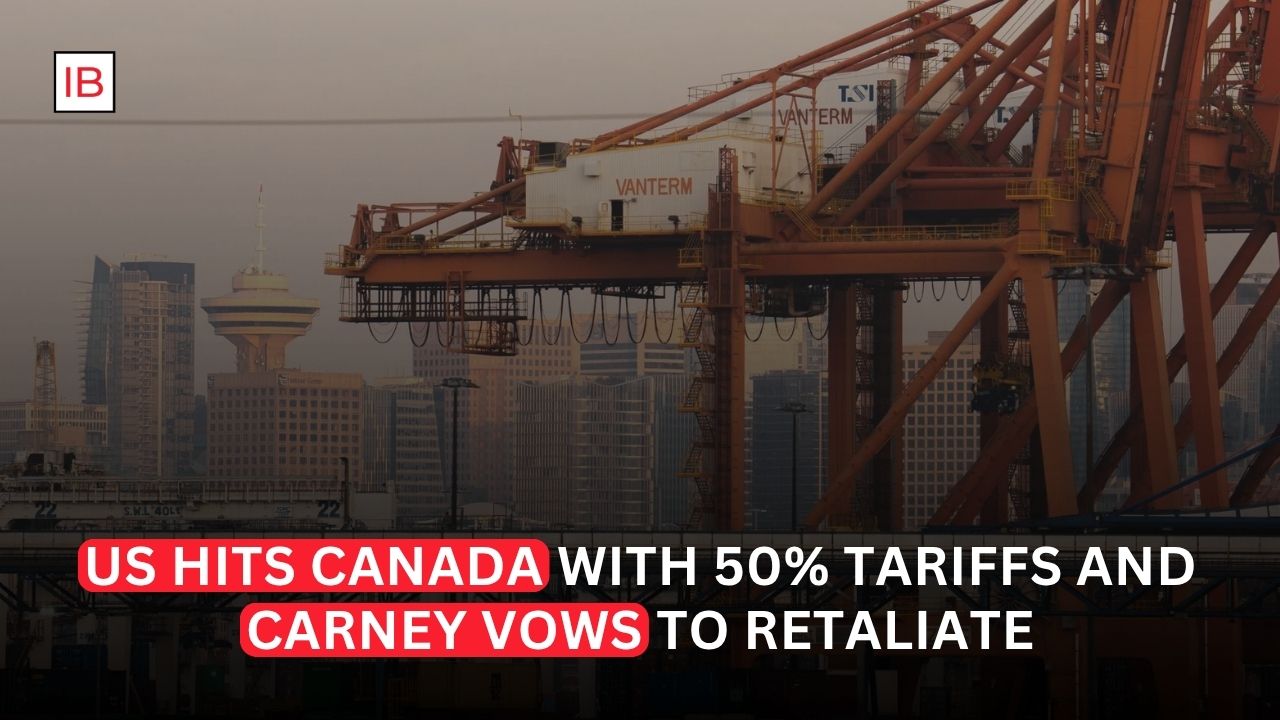
Trade negotiations between the United States and Canada have collapsed at the last minute, triggering a new round of US tariffs on Canadian goods and pushing the two longtime allies toward another major trade confrontation.
The Trump administration has imposed 50% tariffs on around $20 billion worth of Canadian products, while Canadian Prime Minister Mark Carney has suspended negotiations and promised to respond with tariffs of his own on a “dollar-for-dollar” basis.
The immediate economic impact may be limited because the affected goods represent only a relatively small portion of bilateral trade.
The political consequences could be much larger.
The breakdown threatens to complicate the broader US-Canada trading relationship, increase costs for businesses and consumers and make future negotiations over the North American trade framework considerably more difficult.
A Deal That Fell Apart at the Last Minute
The collapse came after three days of intensive negotiations in Washington.
Only days earlier, there had been signs that the two governments were moving toward an agreement.
The Trump administration had temporarily delayed the new tariffs, creating the expectation that Washington and Ottawa might be able to reach a compromise.
Negotiators discussed reducing tariffs on several major Canadian industries, including steel, aluminum, automobiles and lumber.
But the final hours produced a disagreement over the terms.
Canadian officials argued that Washington changed its proposed conditions at the last minute.
Carney described those changes as unfair and economically damaging and said they raised questions about whether any eventual agreement with Washington could be relied upon.
The US government presented a completely different version.
US Trade Representative Jamieson Greer said Canada had refused to finalize an agreement based on terms that had already been discussed and accused Ottawa of introducing new demands and retreating from previous commitments.
The 50% Tariffs Are Now in Effect
With negotiations unsuccessful, the Trump administration moved ahead with the tariffs.
The new duties affect hundreds of Canadian products, including goods such as:
- Plywood
- Liquor
- Electrical equipment
- Cement
- Clothing
- Hockey equipment
- Other consumer and industrial products
The affected imports are worth roughly $20 billion, or about 5% of Canada’s exports to the United States.
That figure is important.
The tariff rate is extremely high, but the targeted trade represents a relatively small share of total bilateral commerce.
The immediate economic damage may therefore be concentrated in specific industries rather than spread evenly across the entire Canadian economy.
Canada Threatens Dollar-for-Dollar Retaliation
Carney has responded aggressively.
Canada has suspended the negotiations and recalled its negotiating team from Washington.
More importantly, the Canadian government has said it will match the new US tariffs “dollar for dollar” to protect Canadian businesses and workers.
That creates the possibility of a new tariff escalation.
If the United States taxes Canadian goods and Canada responds with equivalent duties on American products, companies on both sides could face higher costs.
The longer the confrontation continues, the more difficult it becomes for businesses to determine their future pricing, sourcing and investment strategies.
Why the Dispute Matters Despite the Limited Initial Tariffs
It would be a mistake to judge the significance of the dispute only by the $20 billion figure.
The United States and Canada have one of the world’s largest bilateral trading relationships.
They conducted almost $900 billion in goods and services trade last year, according to reporting on the talks.
The new tariffs therefore matter partly because they threaten to destabilize a much larger economic relationship.
Businesses do not make investment decisions based only on today’s tariff rate.
They also consider whether trade rules will remain stable in the future.
That uncertainty can be economically damaging even before tariffs affect a large percentage of total trade.
Autos Remain a Major Flashpoint
Automobiles are one of the most sensitive areas in the dispute.
The US and Canadian economies have deeply integrated auto supply chains.
Vehicles and components can cross the border multiple times during production.
That means tariffs imposed at different stages can raise costs throughout the manufacturing process.
Washington had reportedly offered to reduce US tariffs on Canadian automobiles to 15%, while also discussing reductions for steel, aluminum and lumber.
For Canadian manufacturers, that would still represent a substantial burden.
For American companies using Canadian components, tariffs can also increase their own costs.
This is why trade protection can produce unintended consequences.
A tariff designed to protect one domestic industry can increase costs for another.
Steel and Aluminum Are Another Problem
Steel and aluminum have already been major sources of tension between Washington and Ottawa.
Both are essential inputs for manufacturing.
Higher tariffs can protect domestic producers from foreign competition, but downstream manufacturers may then pay more for raw materials.
That can make American products less competitive.
The same problem exists in Canada.
If Canadian manufacturers face higher costs for US inputs, they may either absorb the expense or pass it on to customers.
Either way, the economic impact spreads beyond the companies directly targeted by tariffs.
Canada’s Economy Faces a Difficult Choice
Canada is particularly vulnerable to US trade policy because of the depth of its economic relationship with its southern neighbor.
The US is Canada’s overwhelmingly dominant export market.
That makes diversification attractive.
Recent Canadian data show exports to markets outside the United States have been growing faster than exports to the US. Non-US destinations accounted for about 32.8% of Canadian exports, their highest share in four decades.
But replacing the US market is not easy.
Geography matters.
Canada and the United States share an enormous border, integrated transportation networks and decades of supply-chain relationships.
European and Asian markets can provide alternatives, but they cannot simply replace American demand overnight.
Carney Is Under Pressure to Stand Firm
The political calculation for Carney is complicated.
Giving Washington major concessions could help reduce tariffs and protect Canadian exporters.
But it could also create domestic political backlash.
Many Canadians oppose making significant concessions to Trump, and Carney has positioned himself as a leader willing to defend Canadian interests.
That means Carney has limited room to appear weak.
A quick agreement might be economically attractive but politically damaging.
A tougher response could strengthen his domestic position while increasing the economic costs of the dispute.
Trump Is Using Tariffs as Negotiating Leverage
The Trump administration views tariffs differently from traditional trade policy.
Rather than treating tariffs solely as a measure to protect domestic industries, Trump has repeatedly used them as leverage in negotiations.
The basic strategy is straightforward:
Impose or threaten tariffs, create economic pressure and use that pressure to force trading partners to make concessions.
This approach can produce agreements.
But it also carries risks.
Trading partners may retaliate rather than surrender.
Once tariffs are imposed, companies begin adapting their supply chains.
Political relationships can deteriorate.
And removing tariffs later can become more complicated than imposing them initially.
The Bigger Threat Is to USMCA
The most important consequence may concern the broader US-Mexico-Canada trade framework.
The United States, Canada and Mexico are deeply integrated through North American supply chains.
The current dispute could make negotiations over the future of that framework more difficult.
If businesses begin to believe that preferential access to neighboring markets is becoming unreliable, they may reconsider long-term investment decisions.
That could be particularly damaging in industries such as automobiles, energy, agriculture and manufacturing.
Businesses Need Predictability
Companies can sometimes adapt to high tariffs.
What is much harder to manage is uncertainty.
If a company knows that a 20% tariff will remain in place for five years, it can calculate whether to move production.
If the tariff might be removed next month or doubled next year, investment decisions become much more difficult.
The collapse of negotiations therefore creates a second economic problem beyond the tariffs themselves.
It reduces confidence in the stability of the North American trading environment.
Consumers Could Eventually Feel the Impact
The first impact will likely be felt by importers and businesses.
But tariffs rarely remain entirely inside corporate balance sheets.
Companies can respond by:
- Absorbing higher costs.
- Raising prices.
- Finding alternative suppliers.
- Moving production.
- Reducing investment.
Consumers can eventually feel those changes through higher prices or reduced product availability.
The effect will depend on how easily each affected product can be sourced elsewhere.
The Energy Relationship Is Different
One reason the overall economic impact may be less severe than the headline 50% tariff suggests is that the new measures do not cover every part of US-Canada trade equally.
Energy is particularly important to the North American economy.
Canada is a major energy supplier to the United States, and the two countries’ energy systems are deeply interconnected.
That means the political dispute exists alongside an economic relationship that neither side can easily replace.
This creates an important constraint on both governments.
They can impose tariffs.
But completely separating the two economies would be much harder.
A Trade War Would Hurt Both Sides
There is no obvious winner in a prolonged US-Canada tariff war.
Canada is more dependent on the US market.
That gives Washington significant leverage.
But the United States also depends on Canadian supplies, components and raw materials.
That means tariffs create costs on both sides.
The question is therefore not whether Canada can hurt the United States or whether the United States can hurt Canada.
Both can.
The question is which side is willing to tolerate more economic and political pain.
The Negotiating Room Is Now Smaller
The collapse of talks also creates a psychological problem.
Both governments now have publicly committed positions.
Washington says Canada walked away from an acceptable agreement.
Ottawa says the United States changed the terms unfairly.
Backing down immediately could therefore look politically embarrassing for either leader.
That makes a compromise more difficult.
Future negotiations will have to overcome not only economic disagreements but also damaged trust.
Canada May Accelerate Trade Diversification
One likely long-term consequence is a stronger Canadian push toward other markets.
Canada has already been seeking to reduce its dependence on the US.
That could mean greater emphasis on:
- Europe
- Asia
- Latin America
- Indo-Pacific markets
- Domestic supply chains
But diversification takes years.
New trade agreements are not enough.
Canadian companies need customers, infrastructure and competitive products.
The US market cannot simply be replaced by government policy.
Trump’s Strategy Could Also Encourage Diversification
This is one of the potential unintended consequences for Washington.
The more frequently the US uses tariffs against its trading partners, the greater the incentive for those partners to build alternatives.
Canada may diversify.
European countries may diversify.
Asian economies may diversify.
Companies may also move production to reduce exposure to US tariff policy.
Over time, that could reduce America’s leverage.
Tariffs can create immediate bargaining power while potentially weakening trade relationships over the longer term.
The Political Relationship Is Also Deteriorating
Trade disputes rarely remain purely economic.
The US and Canada are longstanding allies with extensive defense, intelligence and diplomatic cooperation.
Yet Trump’s relationship with Canada has already become politically tense.
Trump has repeatedly made controversial comments about Canada, including discussing the country becoming a US state and referring to its prime minister as a governor.
That rhetoric can make economic negotiations more difficult.
Trade agreements require trust.
Public insults make trust harder to establish.
There Is Still an Off-Ramp
The current escalation does not necessarily mean the dispute will become permanent.
Businesses on both sides have strong incentives to push their governments back toward negotiations.
The affected industries want certainty.
Consumers do not want unnecessary price increases.
Manufacturers want stable supply chains.
And neither government benefits from permanently damaging a relationship worth hundreds of billions of dollars annually.
Trade lawyers and former officials have already suggested that both sides will face pressure to find a way out of the confrontation.
The question is how quickly that pressure becomes politically powerful enough to overcome the current positions.
What Happens Next?
Several outcomes are possible.
1. A quick return to negotiations
Both sides could decide that the economic costs are too high and return to the negotiating table.
2. Prolonged tariff retaliation
Canada could impose its promised countermeasures while Washington keeps its tariffs in place.
3. Broader escalation
Additional products could become subject to tariffs, expanding the dispute beyond the initial $20 billion.
4. Sector-by-sector agreements
The countries could gradually reach separate deals covering autos, steel, aluminum, agriculture and other industries.
5. Long-term trade diversification
Even if tariffs are eventually reduced, Canadian businesses may continue reducing their dependence on the US market.
The Bigger Issue Is Trust
The most damaging part of the breakdown may not be the 50% tariff itself.
It is the fact that the two sides came close to an agreement and still failed to finalize it.
That suggests a significant gap in trust.
Canada says Washington changed the rules at the last moment.
Washington says Canada changed its demands.
When both sides believe the other is negotiating in bad faith, reaching a durable agreement becomes much harder.
That is the problem that will remain even if today’s tariffs eventually disappear.
Conclusion
The collapse of US-Canada trade talks marks a significant escalation in relations between two countries whose economies are deeply intertwined.
The Trump administration has imposed 50% tariffs on around $20 billion of Canadian goods, while Prime Minister Mark Carney has suspended negotiations and promised a matching response.
The immediate economic damage may be concentrated because the affected goods represent only about 5% of Canada’s exports to the United States.
But the strategic implications are much larger.
The dispute threatens to complicate the future of North American trade, increase uncertainty for businesses and put additional pressure on supply chains that have been integrated for decades.
For Canada, the challenge is balancing resistance to Washington with the reality that the United States remains its largest trading partner.
For Trump, the challenge is different: tariffs may produce negotiating leverage, but excessive pressure could encourage Canada to permanently diversify away from the US market.
Neither side can easily replace the other.
That is why the current confrontation is unlikely to be resolved simply through tariffs.
Eventually, both governments will have to return to the fundamental economic reality that binds them together.
The US and Canada can fight over trade, but their economies are too interconnected to make separation painless.
The immediate question is whether the new tariffs become a temporary negotiating weapon or the beginning of a much broader North American trade war.
The answer will depend on whether Washington and Ottawa can rebuild enough trust to return to the negotiating table.