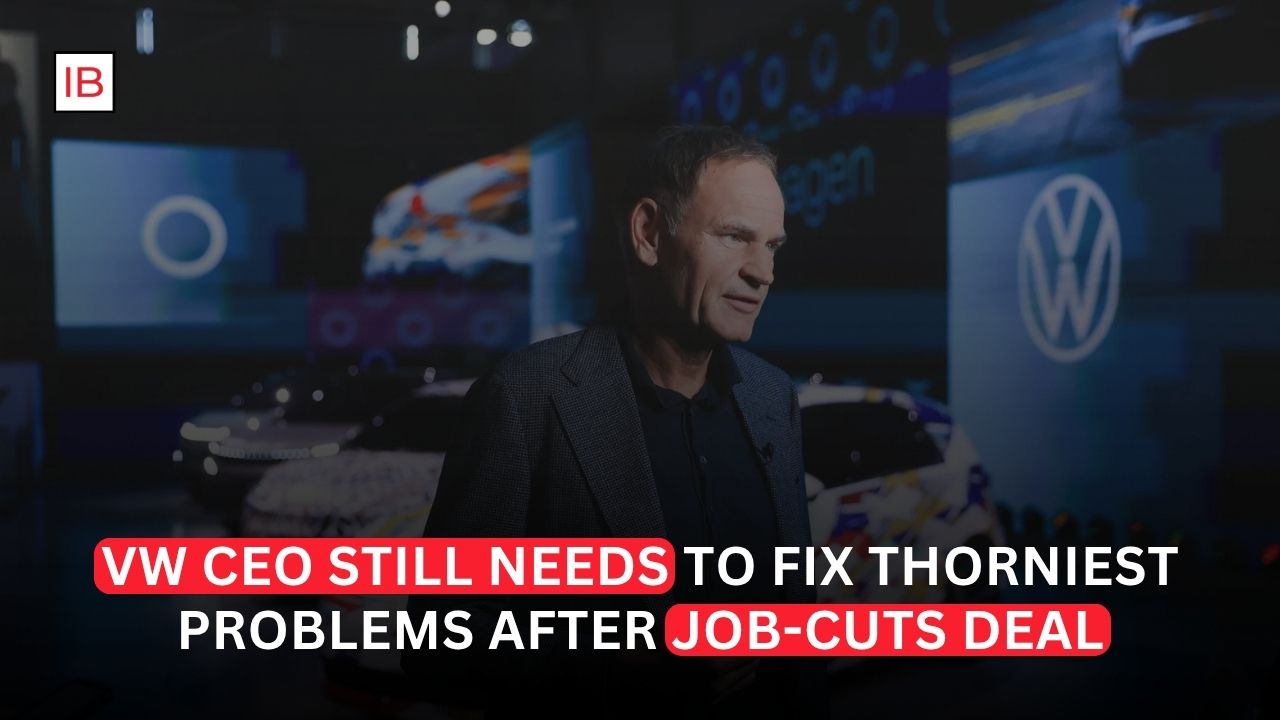
Volkswagen has finally cleared one of the biggest obstacles to its restructuring plan: management and labor have reached an agreement on a sweeping program of cost reductions and job cuts. But the agreement does not solve the problems that pushed Europe’s largest carmaker into crisis in the first place. For CEO Oliver Blume, the harder task now begins—turning a politically difficult cost-cutting plan into a sustainable recovery.
Volkswagen’s supervisory board has approved a plan that will add another 50,000 job reductions to the workforce changes already under way, bringing the potential total to around 100,000 positions by 2030. The scale is extraordinary. Volkswagen employs roughly 650,000 people globally, meaning the restructuring could eventually affect a substantial share of its workforce. The company is also planning a major simplification of its vehicle lineup and a reduction in production capacity.
Investors immediately welcomed the agreement. Volkswagen shares rose sharply after the announcement, reflecting relief that the company had overcome months of resistance from employee representatives and other stakeholders. The agreement also reduces the immediate risk of a damaging confrontation between management and labor.
But a rise in the share price does not mean Volkswagen’s competitive problems have disappeared.
The central issue is that Volkswagen has become too expensive and too complicated for the market it is now operating in. The company has built a huge industrial structure around a level of demand that no longer exists, particularly in Europe. Reports indicate that Volkswagen has more than 500,000 vehicles of excess production capacity in Europe. At the same time, competition has intensified from Chinese manufacturers, which are increasingly competitive in electric vehicles, pricing and technology.
China represents an especially serious problem. Volkswagen spent decades building one of the strongest foreign automotive positions in the Chinese market. That advantage is now under pressure as domestic Chinese brands gain ground with electric vehicles and increasingly sophisticated technology. Declining demand and tougher competition in China have contributed significantly to Volkswagen’s weaker financial performance.
The company therefore cannot simply cut costs and expect the old business model to return. It has to determine what kind of automaker it wants to become.
Blume’s restructuring plan attempts to address this by reducing complexity. Volkswagen is expected to significantly shrink its model portfolio, with the company aiming to focus on higher-volume and more profitable vehicles. The objective is straightforward: fewer models should mean fewer development costs, simpler manufacturing and better use of factories. The company has also set ambitious financial targets, including an operating margin of about 9% by 2030.
The danger is that simplification can become an excuse for retreat rather than a strategy for growth.
Volkswagen still needs products that customers actually want to buy. The automotive industry is moving rapidly toward software-defined vehicles, electric powertrains and increasingly digital customer experiences. Chinese competitors have demonstrated that they can bring new technologies to market quickly while competing aggressively on price. Cutting jobs and reducing the number of models may improve Volkswagen’s cost base, but it will not automatically close the technology and speed gap.
The company also faces a difficult manufacturing problem in Germany. Four German sites—Emden, Zwickau, Hanover and Audi’s Neckarsulm facility—have been identified as particularly vulnerable as Volkswagen restructures its production network. Rather than immediately shutting them down, the company is considering alternative uses and future production arrangements.
That approach may have been necessary to secure labor support, but it leaves an important question unanswered: how quickly can Volkswagen actually remove excess capacity?
This matters because Volkswagen’s cost disadvantage is not simply a matter of headcount. Germany remains a high-cost manufacturing location, while energy costs, regulation and wages add pressure to the company’s European operations. The restructuring therefore needs to change how factories operate, not merely how many employees work in them.
There is another challenge that is less visible but potentially just as important: Volkswagen’s complicated governance structure.
The company has traditionally operated with strong influence from employee representatives, unions, the state of Lower Saxony and other major stakeholders. That system can protect workers and provide stability, but it can also make radical restructuring difficult. The fact that Blume ultimately secured approval for such a large transformation is therefore significant. Yet the same stakeholders who accepted the overall plan will have an interest in how individual factories, jobs and investments are treated.
The agreement buys Blume political room. It does not give him unlimited freedom.
Volkswagen also has to deal with pressure from the United States. Tariffs and changing trade policies have increased the cost and uncertainty surrounding the company’s North American business. At the same time, Volkswagen must decide where to allocate capital between Europe, China and the United States at a time when every major automaker is investing heavily in electric vehicles and new technologies.
That makes capital allocation crucial. Every euro saved through layoffs will matter only if Volkswagen redirects enough of those savings toward competitive products, software, batteries and manufacturing efficiency.
This is why the job-cut agreement should be viewed as a starting point rather than a victory.
Volkswagen has now acknowledged the scale of its structural problem. It has also obtained enough support to begin addressing it. But the company still needs to prove that it can execute faster than its competitors, reduce excess capacity without destroying valuable industrial capabilities, rebuild its position in China and develop vehicles capable of competing on price and technology.
The most difficult part of a turnaround is rarely announcing the cuts. It is making the remaining organization more productive and giving customers a reason to choose its products.
For Blume, the next few years will therefore be about much more than reducing Volkswagen’s workforce. He must turn a sprawling industrial giant into a leaner company without making it weaker, preserve the brands and technologies that still create value, and convince investors that the savings will translate into durable earnings.
The job-cut agreement may have ended Volkswagen’s immediate internal confrontation. It has not ended the company’s external fight.
That battle—to become competitive again in a rapidly changing global car industry—is the one that will ultimately determine whether Blume’s turnaround succeeds.