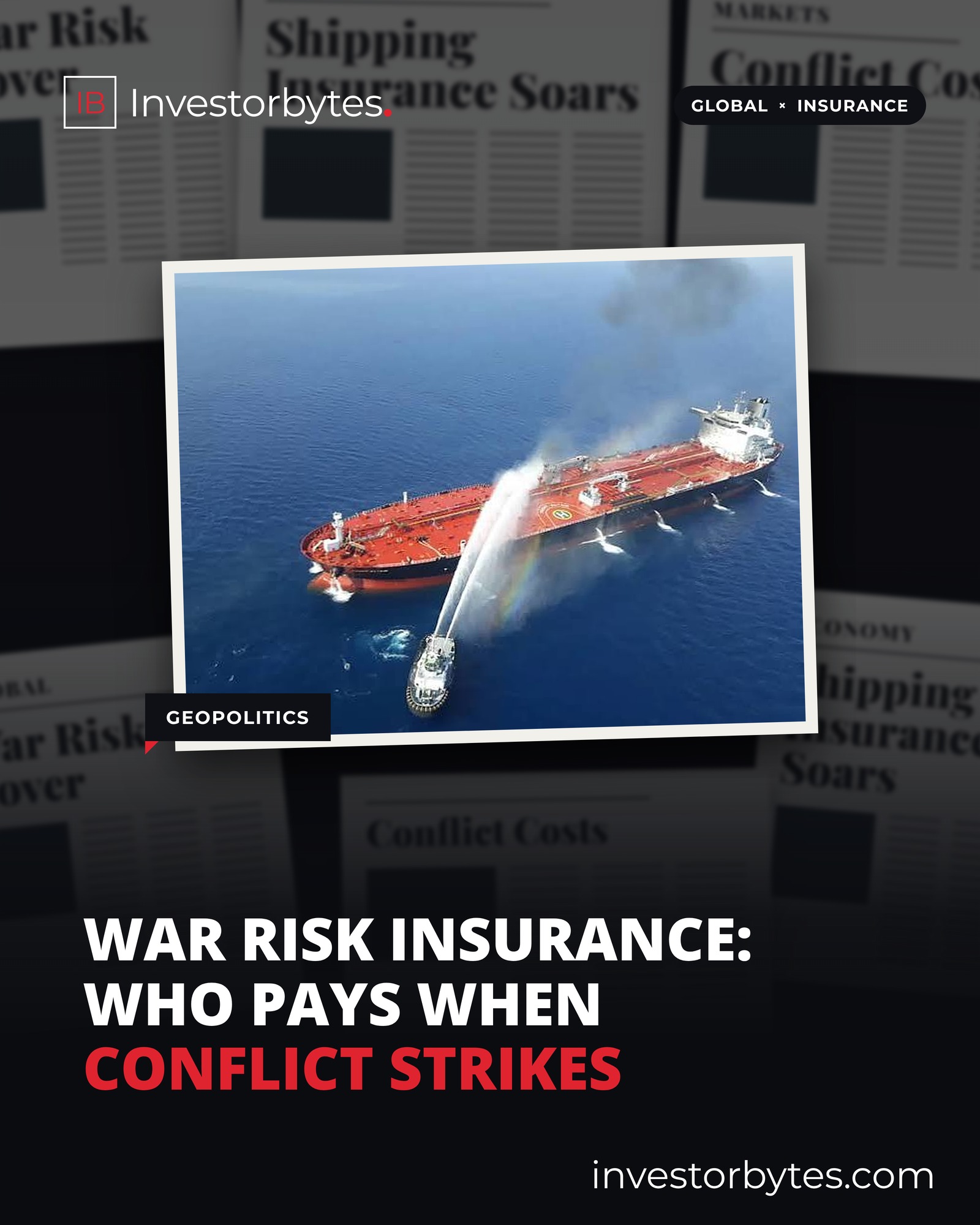
War risk insurance destroy lives and property, but they also generate a complex web of insurance claims and contracts. The conflict in the Middle East, the continuing war in Ukraine and a surge in cyber and AI-enabled threats are putting war risk insurance under intense pressure. According to World Finance’s report on the business of insuring conflict, the traditional London market has largely coped, adapting faster than many expected. The bigger battles may be fought in courtrooms, as policyholders and insurers argue over what is actually covered.
The Strait of Hormuz and a disputed backstop
The Middle East war has already produced war-risk claims for damaged and trapped ships, property losses, aviation and cyber-attacks. Business interruption claims are expected to follow as the blockade of the Strait of Hormuz ripples through supply chains. In mid-May, reinsurer Munich Re set aside €90m for anticipated claims, an amount chief executive Andrew Buchanan described as very cautious and lower than what the company paid in the first year of the Ukraine war.
Early in the conflict, President Trump announced on Truth Social a US government-backed reinsurance scheme for shipowners, implying that commercial cover for Gulf transits had dried up. London underwriters were puzzled. In early March, Chris Jones, chief executive of the International Underwriting Association, said cover remained available in the region, including the Strait of Hormuz, and the Lloyd’s Market Association called reports to the contrary inaccurate.
By late March, the US International Development Finance Corporation had persuaded Chubb to front a $20bn Maritime Reinsurance Plan, which DFC chief executive Ben Black presented as a way to restore market confidence. Two months later, however, no other US insurers had been named as participants. Andrew James, managing director of marine at broker Gallagher, called the idea that cover was unavailable a huge miscommunication. In his view, ships were staying away because captains and crews, now armed with better real-time information, chose not to take the risk.
Black Sea lessons for war risk insurance
Ukraine offers a template for how marine war risk insurance can recover after a shock. When Russia invaded in February 2022, insurers initially withdrew cover as ships were trapped, ports shelled and waters mined. Rory Colacicchi of McGill and Partners recalls rates jumping from zero to 3% of hull value and briefly spiking to 5%.
After Russia abandoned the UN- and Turkey-brokered Black Sea Grain Initiative in July 2023, Ukraine opened its own corridor along the western coast towards Romanian waters. Rates settled around 3% for most Odesa voyages, then threatened to climb again after a Liberian-flagged vessel was hit. A scheme backed by the Ukrainian and UK governments, arranged by Marsh and led by the Ascot syndicate at Lloyd’s, then offered up to $50m of hull war cover and $50m of protection and indemnity cover. Ukrainian exports are now estimated at around 90% of pre-war levels. Oscar Seikaly, chief executive of NSI Insurance Group in Miami, notes that cover tends to vanish under war exclusions at first but returns once risks can be measured, helped by London’s consortium model and real-time monitoring.
Land-based and aviation risks are harder to price
On land, cover is tougher. Aon and the European Bank for Reconstruction and Development built a €110m reinsurance facility that allowed Ukrainian insurers to offer businesses basic war-risk protection. Andrii Semchenko, chief executive of INGO, one of Ukraine’s three largest insurers, says the firm started in 2023 with first-loss cover capped at $250,000 for small and medium-sized businesses and is lifting that to $500,000 per object. It excludes sites within 100km of the front, the range of most drones and rockets, and suspends cover if fighting moves within 50km. A government scheme handles larger and frontline risks.
Blaine Rogers, a partner at Davis Levin Livingston, says energy infrastructure, oil terminals and refineries are especially difficult, often written under political violence or terrorism policies with tight sub-limits. Disputes arise when insurers try to recharacterise events to fit exclusions.
Aviation shows how costly such disputes can become. After Western sanctions forced lessors to terminate leases with Russian airlines in 2022, Russia kept roughly 400 aircraft, with losses estimated above $10bn. In June 2025, the English High Court largely sided with lessors such as AerCap and Dubai Aerospace Enterprise, ruling that the planes were effectively lost on 10 March 2022 due to Russian government action and that claims fell under war-risk policies written by insurers including AIG, Chubb, Swiss Re and Lloyd’s syndicates. Related proceedings continue in Ireland. By contrast, Gallagher’s Bill Smith says the aviation market calmed quickly during the Middle East conflict, with most extra premiums dropped after the ceasefire except for flights to Tel Aviv and Lebanon.
Cyber, drones and the fear of escalation
Newer threats are harder still. Smith says the industry’s biggest fear is escalation, noting that even a small tactical nuclear detonation would trigger automatic cancellation of airline liability policies worldwide. Ed Lluth, head of Liberty Specialty Markets, warned a Marsh aviation summit in April that the market lacks a coherent answer to AI-driven drones, citing reports of drones destroying Russian strategic bombers.
Cyber and physical attacks increasingly arrive together, says Neil Roberts of the Lloyd’s Market Association. S&P Global Ratings has warned that many firms misunderstand how hostile cyber operation exclusions might apply, especially as states work through proxies and criminal groups, making attribution murky. Gallagher’s Nick Robinson points to the March 2026 attack on medical technology group Stryker, claimed by the Iran-linked persona Handala, which wiped devices and caused a prolonged recovery. Rogers expects broad cyber-war exclusions to become a litigation flashpoint as courts examine them.
Business interruption and the next chokepoint
Business interruption claims across aviation, travel, hospitality, energy, food and logistics are expected to be large and contested, given the many war, terrorism and hostile-act exclusions in policies. The bitter disputes over UK COVID-19 closure claims offer a reminder of how such battles can unfold. Looking ahead, a conflict over Taiwan or in the South China Sea is seen as a leading risk. Singapore’s foreign minister Vivian Balakrishnan has highlighted that the Strait of Malacca is only about two nautical miles wide at its narrowest point, compared with 21 for Hormuz. A closure there would pose an enormous test for war risk insurance and global trade.
Conclusion
The conflict insurance market has shown resilience, repricing quickly and partnering with governments where needed. But as threats become more diffuse, blending missiles, drones and malicious code, the hardest question is no longer whether cover exists but whether a given loss will be paid. For businesses exposed to geopolitical risk, reading the exclusions has never mattered more.