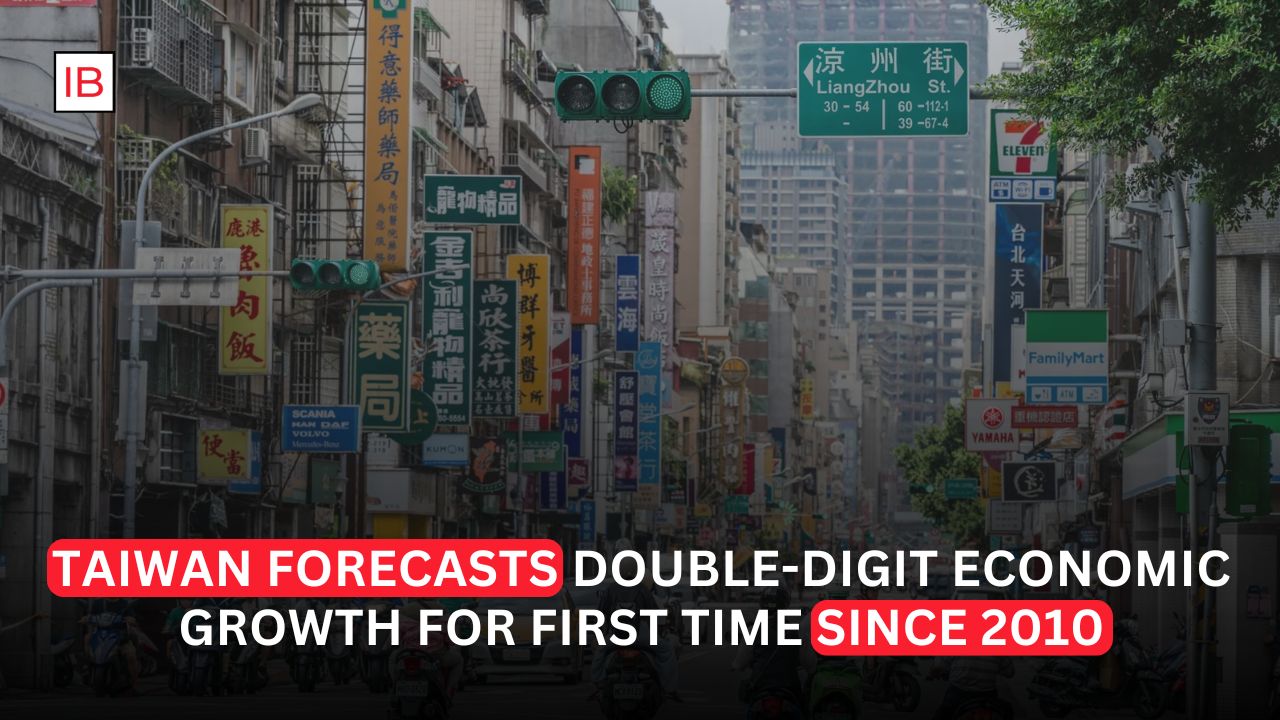
AI Boom and Semiconductor Demand Push 2026 Growth Outlook Above 11% as Taiwan’s Export Economy Continues to Accelerate
Taiwan is on course for its first year of double-digit economic growth in more than a decade, as an extraordinary boom in artificial-intelligence demand continues to drive exports, semiconductor production and business investment.
Taiwan’s government raised its 2026 economic growth forecast to 11.05%, up sharply from its previous projection of 9.64%, according to the Directorate General of Budget, Accounting and Statistics. The revision follows stronger-than-expected economic performance during the first half of the year and reflects the continuing strength of global demand for AI-related technology.
If the forecast is achieved, Taiwan would record its strongest annual expansion since 2010 and return to double-digit growth at a time when much of the global economy is expanding at considerably slower rates.
AI Boom Drives Taiwan’s Economic Expansion
The primary force behind Taiwan’s growth is the global artificial-intelligence boom.
The island is home to some of the world’s most important semiconductor manufacturers and technology suppliers, placing it at the center of the global AI supply chain.
Demand for advanced chips, AI servers, networking equipment and other high-performance computing components has surged as technology companies expand their data-center capacity.
Taiwan’s highly developed electronics industry has benefited directly from that spending.
The country’s central bank has previously identified expanding AI applications and higher capital expenditure by major global cloud-service providers as key drivers of exports and private investment.
Second-Quarter Growth Reaches Nearly 13%
Taiwan’s economic momentum became particularly clear during the second quarter.
GDP expanded by a revised 12.93% year over year, slightly above the preliminary estimate of 12.92%. The result helped convince policymakers that the economy was performing substantially better than earlier forecasts had anticipated.
The strong second-quarter performance follows an already powerful start to the year.
Rather than being driven primarily by domestic consumption, Taiwan’s growth remains heavily connected to foreign demand, particularly for advanced technology products.
That makes the global AI investment cycle critically important to the country’s economic outlook.
Exports Remain the Key Engine
Taiwan’s export performance has been extraordinary.
In July, exports increased 32.9% from a year earlier to $75.3 billion, marking another exceptionally strong month even though the result fell short of economists’ expectations for 40.7% growth.
The figures show the enormous scale of demand flowing through Taiwan’s technology sector.
Semiconductors and AI-related products have become particularly important contributors to export growth.
The country’s economic structure means that strong technology exports can have a significant impact on overall GDP through manufacturing, investment, transportation and related services.
Semiconductor Industry at the Center
Taiwan’s semiconductor industry is the foundation of its position in the global technology economy.
Companies such as TSMC manufacture advanced chips used by some of the world’s largest technology companies.
TSMC reported July revenue of NT$467.58 billion, representing a 45% increase from a year earlier, as demand for AI processors remained strong. The company has also raised its 2026 revenue-growth outlook to more than 40% in US-dollar terms.
The strength of TSMC’s business provides an important indication of the broader momentum within Taiwan’s technology sector.
As AI companies build larger computing systems, demand for increasingly advanced semiconductor manufacturing is expected to remain high.
Foxconn Adds to the Growth Story
Taiwan’s broader technology manufacturing industry is also benefiting from the AI boom.
Foxconn, the world’s largest contract electronics manufacturer and a major supplier to Nvidia and Apple, reported a 35% increase in second-quarter profit. AI servers and cloud-networking products accounted for 51% of the company’s revenue during the quarter.
That was the first time the category exceeded half of Foxconn’s revenue.
The shift illustrates how rapidly AI infrastructure is changing Taiwan’s technology manufacturing industry.
Foxconn is also preparing to begin mass production of Nvidia’s Vera Rubin AI server racks later in 2026.
Global Cloud Spending Supports Demand
Another important factor is the massive increase in capital spending by global cloud-service providers.
Major technology companies are investing billions of dollars in data centers, AI processors and networking infrastructure.
Taiwanese manufacturers are deeply integrated into those supply chains.
The central bank has estimated that capital expenditure by the four largest US cloud-service providers could reach $630 billion to $670 billion in 2026, representing growth of roughly 52% to 62%.
That investment is helping support demand for Taiwanese exports.
It also encourages domestic companies to expand production capacity, creating an additional source of economic growth.
Investment Becomes a Major Growth Driver
The AI boom is not simply increasing exports.
It is also encouraging Taiwanese companies to invest in factories, equipment and research.
The central bank’s latest economic outlook says net foreign demand and capital formation together could account for 77.6% of Taiwan’s 2026 economic growth.
This demonstrates how strongly the economy is being driven by the technology investment cycle.
If AI demand remains strong, Taiwan could continue to see high levels of corporate investment.
However, that dependence also creates risks if global technology spending eventually slows.
Economic Growth Is Not Evenly Distributed
Taiwan’s rapid economic expansion has also raised questions about how evenly the benefits are being distributed.
Recent analysis has described the economy as increasingly K-shaped, with technology companies and workers connected to the semiconductor industry benefiting substantially more than some traditional industries and households.
That creates a policy challenge for the government.
Strong GDP growth does not automatically mean that every household experiences the same improvement in living standards.
Policymakers therefore face pressure to ensure that the benefits of the technology boom spread more broadly through wages, consumption and investment.
Consumption Is Improving
Although exports remain the dominant source of growth, private consumption is also showing signs of strengthening.
The central bank has previously upgraded its expectations for household spending as economic conditions improve.
Higher incomes generated by the technology industry can support consumption in areas such as retail, restaurants, housing and services.
However, the contribution from domestic demand remains smaller than the contribution from exports and investment.
That means Taiwan’s growth outlook remains particularly sensitive to developments in global technology markets.
Risks From AI Dependence
The extraordinary strength of Taiwan’s economy also creates a potential vulnerability.
The country has become increasingly dependent on the global semiconductor and AI investment cycle.
If technology companies reduce capital spending or if demand for AI hardware weakens, Taiwan’s exports could slow rapidly.
Foreign investors have already shown some caution.
In July, foreign investors withdrew billions of dollars from Taiwanese equities amid concerns about AI spending and the sustainability of the technology boom. Taiwan experienced approximately $22.95 billion in equity outflows during the month.
That does not necessarily signal a deterioration in Taiwan’s economic fundamentals, but it demonstrates that investors remain sensitive to the valuation and sustainability of the AI trade.
Geopolitical Risks Remain
Taiwan also faces significant geopolitical risks.
The island is strategically important to the global semiconductor industry, while tensions involving China remain a major source of uncertainty for investors and businesses.
Any disruption to trade, shipping or semiconductor production could have consequences well beyond Taiwan.
The ongoing conflict in the Middle East also presents indirect risks through energy prices, global inflation and supply-chain disruptions.
Taiwan’s central bank has previously warned that a prolonged Middle East conflict could weaken global economic activity and put pressure on domestic inflation.
Global Trade Will Be Important
Taiwan’s strong growth comes despite uncertainty surrounding global trade policy.
Changes in tariffs and trade relationships could affect Taiwanese exporters, particularly companies selling products into the US and other major markets.
At the same time, the strategic importance of advanced semiconductors could give Taiwan’s technology industry considerable leverage.
As governments around the world seek to secure access to AI chips and strengthen domestic semiconductor supply chains, Taiwan is likely to remain a critical part of the global technology ecosystem.
Taiwan’s Growth Could Outpace Major Economies
An 11.05% growth rate would put Taiwan among the fastest-growing major economies in the world this year.
The pace is particularly striking because Taiwan is a mature, high-income economy rather than a developing market experiencing rapid catch-up growth.
Such an expansion highlights the extraordinary economic impact of the AI investment cycle.
It also demonstrates how a relatively small economy can experience major changes when it occupies a critical position in a rapidly expanding global industry.
Looking Ahead
Taiwan is heading toward a potentially historic year as the AI boom pushes economic growth above 11% and puts the island on track for its first double-digit annual expansion since 2010.
The government’s revised 11.05% growth forecast reflects the strength of exports, semiconductor demand, private investment and global spending on AI infrastructure.
The second-quarter GDP expansion of nearly 13% and July’s 32.9% increase in exports demonstrate how powerful the current technology cycle has become.
Companies across Taiwan’s technology ecosystem are reporting similar strength.
TSMC’s surging revenue and Foxconn’s growing AI-server business show that demand is spreading throughout the semiconductor and electronics supply chain.
But the impressive numbers also highlight Taiwan’s dependence on the AI boom.
If global technology companies continue increasing capital expenditure, Taiwan could experience another period of exceptionally strong growth. If AI investment slows, however, the country’s export-dependent economy could face a sharp adjustment.
For now, the momentum remains firmly on Taiwan’s side.
The AI revolution has transformed Taiwan into one of the world’s most important technology economies, and in 2026 that position is translating into a growth rate rarely seen in a mature economy.
The challenge for policymakers will be turning that extraordinary technology-driven expansion into broader and more sustainable prosperity while protecting the economy from the risks that come with such heavy dependence on global semiconductor demand.