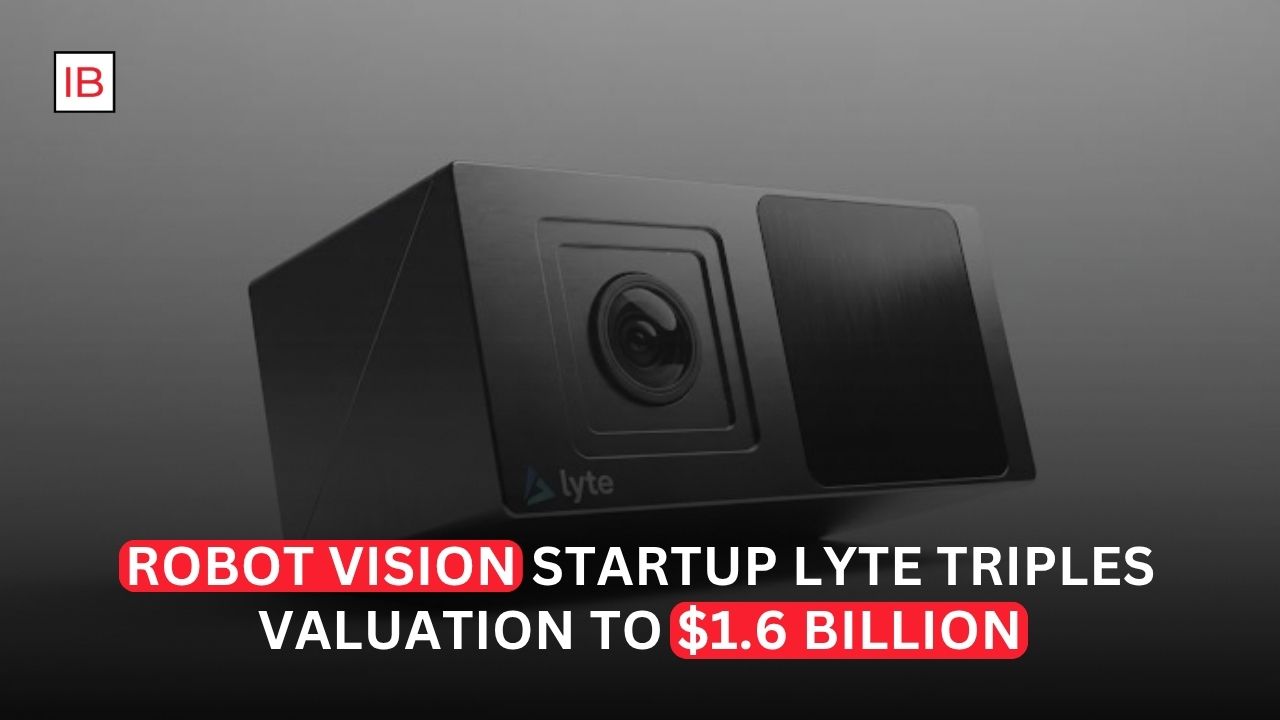
Lyte has closed a $165 million funding round, lifting the valuation of the artificial-intelligence startup to about $1.6 billion as investors increase their bets on technologies designed to give robots a better understanding of the physical world. The latest financing marks a major step for the Mountain View, California-based company and highlights growing interest in the infrastructure required to make Physical AI work outside controlled environments.
Lyte was founded by engineers with experience in advanced 3D sensing technology, including Alexander Shpunt, who previously co-founded PrimeSense. The company emerged from stealth in January with more than $107 million in aggregate funding and a mission to build a unified perception platform for autonomous machines. Its investors have included Fidelity Management & Research, Atreides Management, Exor Ventures, Key1 Capital and semiconductor entrepreneur Avigdor Willenz.
The company’s central technology is LyteVision, a perception system designed to combine 4D sensing, RGB imaging and motion awareness. Instead of forcing robotics developers to purchase and integrate multiple sensors from different suppliers, Lyte is building hardware, custom silicon and perception software as a unified platform. The goal is to reduce the engineering time and complexity involved in teaching machines how to understand their surroundings.
That problem has become increasingly important as the robotics industry moves toward Physical AI. Modern AI models can process enormous quantities of information, but robots still need reliable ways to perceive objects, depth, movement and changing environments before they can safely act. A system that performs well in a demonstration can face very different challenges in a warehouse, factory, roadway or public space, where lighting, obstacles and human behavior constantly change.
Lyte is targeting a broad range of applications, including mobile robots, robotic arms, quadrupeds, humanoid robots and autonomous vehicles. By positioning its technology as foundational infrastructure rather than a single-purpose robotics product, the company is seeking to benefit from multiple areas of the expanding automation market.
The new financing also reflects the growing amount of capital flowing into Physical AI. Investors increasingly view robotics as one of the next major applications of artificial intelligence, particularly as businesses seek automation to address labor shortages, improve productivity and reduce operating costs. However, robotics startups require substantial investment because they must develop both sophisticated software and physical hardware, while meeting demanding reliability and safety requirements.
Lyte’s founders bring experience that could give the company an advantage in this environment. Shpunt’s previous work at PrimeSense helped develop 3D-sensing technology that eventually became part of Apple’s depth-sensing capabilities following Apple’s acquisition of PrimeSense in 2013. That history provides Lyte with expertise in translating advanced perception research into commercial technology.
The startup has also been building relationships across the broader AI ecosystem. In March, Lyte announced a collaboration with Nvidia involving its Holoscan Sensor Bridge, aimed at generating digital twins from real-world perception data. In June, the company said it had joined Nvidia’s Halos ecosystem, further positioning its technology within Nvidia’s broader push toward safer Physical AI and autonomous machines.
Lyte’s earlier funding provided the resources to develop its core technology, while the latest $165 million round gives the company substantially greater financial capacity to commercialize and scale it. Reaching a $1.6 billion valuation also places Lyte among a growing group of highly valued private companies built around AI infrastructure rather than consumer-facing applications.
The challenge now is execution. Investors are placing enormous expectations on robotics, but commercial deployment can take years and requires customers to trust machines with expensive equipment, workers and critical operations. Lyte will need to demonstrate that its integrated perception system can deliver reliable performance in real-world conditions and provide enough economic value to justify adoption.
If it succeeds, Lyte could become an important supplier in the emerging Physical AI ecosystem. Its latest funding shows that investors are increasingly betting that the next stage of the AI revolution will not happen only inside data centers. It will also depend on machines capable of seeing, understanding and responding to the physical world.