Leadership Change Comes as Switzerland’s Central Bank Navigates Inflation, Franc Strength and Global Economic Uncertainty
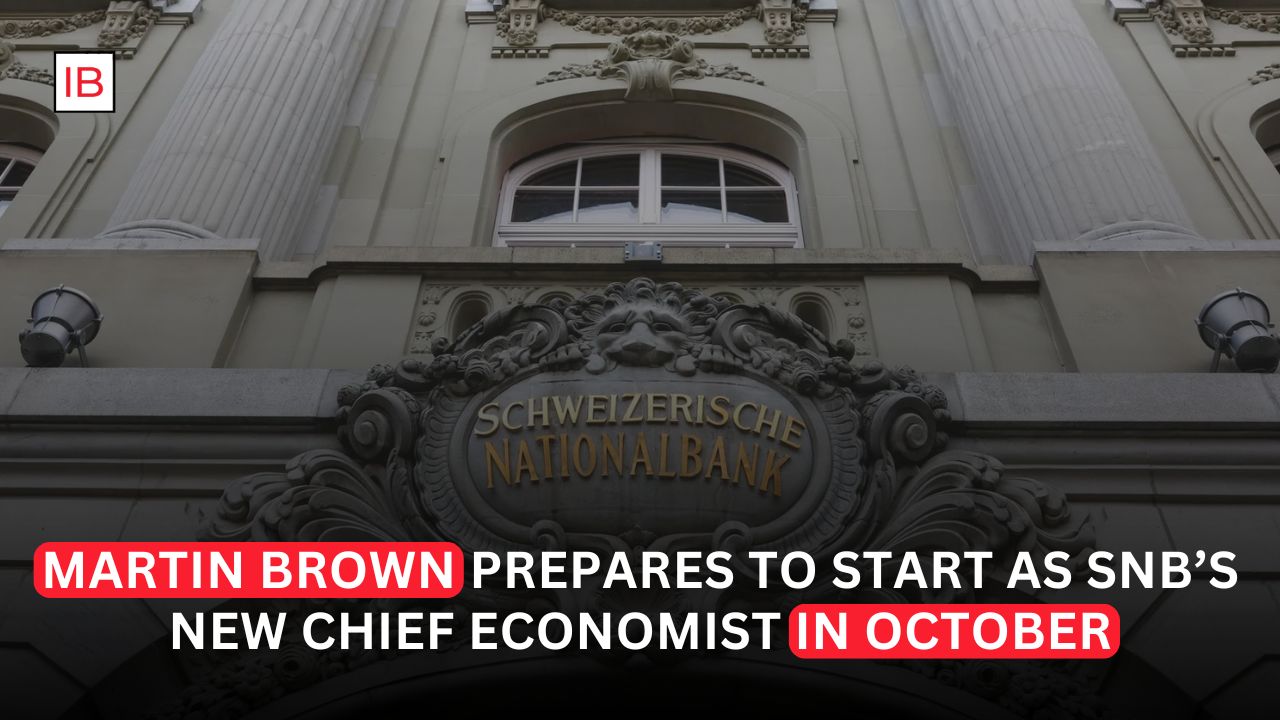
The Swiss National Bank has appointed Martin Brown as its new chief economist, with the financial economist set to take up the position on October 1, replacing Carlos Lenz as Switzerland’s central bank prepares for a change in its senior economic leadership.
Brown currently serves as director of the Study Center Gerzensee, an academic research institution associated with the Swiss National Bank. He is also an adjunct professor of financial economics at the University of St. Gallen and has previously worked as a senior economist at the SNB.
His appointment comes at an important time for Swiss monetary policy, with the central bank continuing to navigate inflation, currency movements, weak international demand and uncertainty surrounding the global economy.
Brown Brings Strong Academic and Central-Banking Experience
Brown has built his career at the intersection of financial economics, banking and monetary policy.
He holds a doctorate in economics from the University of Zurich and has held academic positions in Switzerland and the Netherlands. His research has focused on household finance, financial intermediation and monetary policy.
His previous experience at the SNB is particularly relevant.
Before becoming director of the Study Center Gerzensee, Brown worked as a senior economist at the central bank. That background means he is already familiar with the institution’s research culture and monetary-policy framework.
His return to a senior economic role therefore represents a degree of continuity rather than a dramatic change in direction.
Carlos Lenz Is Preparing to Retire
Brown will succeed Carlos Lenz, who is due to retire at the end of the year.
The SNB announced the succession earlier this year, describing Brown as the person who would take over from Lenz.
The transition is significant because the chief economist plays an important role in developing and communicating the economic analysis that supports the central bank’s monetary-policy decisions.
While the SNB’s Governing Board ultimately makes policy decisions, its economists provide much of the research and forecasting that underpin those choices.
Switzerland Faces a Complicated Economic Environment
Brown’s appointment comes against a challenging backdrop for Switzerland.
The country’s economy is highly exposed to global trade because of its large export sector.
Pharmaceuticals, machinery, chemicals, watches and other high-value industries depend heavily on international demand.
That makes Switzerland particularly sensitive to changes in global growth, trade policy and exchange rates.
The Swiss franc is another major factor.
The currency is traditionally viewed as a safe haven, meaning investors often buy francs during periods of geopolitical or financial uncertainty.
A stronger franc can help restrain inflation by making imported goods cheaper.
But it can also hurt exporters by making Swiss products more expensive for foreign customers.
The Swiss Franc Remains Central to Policy
The exchange rate has historically been one of the most important considerations for the SNB.
Unlike larger central banks such as the Federal Reserve or European Central Bank, the SNB operates in a relatively small, highly open economy.
Changes in the franc can therefore have a substantial effect on inflation and economic activity.
The central bank must balance the need to maintain price stability against the potential damage that an excessively strong currency could cause to exporters.
Brown’s background in financial economics could be particularly relevant in assessing these interactions.
Inflation Remains a Key Challenge
The SNB’s primary mandate is price stability, making inflation a central concern for its economists.
Switzerland has generally experienced lower inflation than many other advanced economies over recent years.
But that does not mean the central bank can ignore inflation risks.
Energy prices, international supply chains, wages and exchange-rate movements can all affect domestic prices.
The SNB must also consider how monetary policy decisions abroad influence Switzerland.
Interest-rate changes by the Federal Reserve and European Central Bank can affect capital flows and the value of the franc.
The ECB Matters for Switzerland
The European Union is Switzerland’s most important economic partner.
That means developments at the European Central Bank can have an indirect impact on Swiss monetary conditions.
If European interest rates rise significantly above Swiss rates, the franc could weaken.
If investors instead seek the safety of Swiss assets, the currency could appreciate.
The SNB therefore has to monitor both domestic economic indicators and international financial markets.
Brown’s research background in financial intermediation and monetary policy could help the institution assess these complex relationships.
A Familiar Face at the SNB
One advantage of Brown’s appointment is that he already understands the central bank from the inside.
His earlier career included work at the SNB before he moved into academia.
His current position at the Study Center Gerzensee has also kept him closely connected to central-bank research.
That could make the transition relatively smooth.
The appointment is less about completely changing the institution’s economic philosophy and more about bringing a new economist into a senior role at a critical moment.
Research Will Remain Important
The SNB has a strong tradition of economic research.
Its working-paper program covers areas including monetary policy, banking, financial markets and macroeconomics.
Brown himself has been involved in SNB research, including work examining financial services and interest rates.
His academic background means he is likely to place considerable emphasis on evidence-based economic analysis.
That could be particularly valuable as central banks face increasingly complicated economic shocks.
Central Banks Face Greater Uncertainty
The global economic environment has become more difficult for policymakers to forecast.
Trade disputes can change quickly.
Geopolitical tensions can disrupt energy markets.
Artificial intelligence is altering investment and productivity expectations.
Demographic changes are affecting labor markets.
And financial markets can respond rapidly to political developments.
For a small open economy such as Switzerland, these external shocks can have an outsized effect.
The SNB therefore needs economic forecasts that account for both domestic conditions and international developments.
Brown’s Financial-Economics Background Could Be Valuable
Brown’s academic work has focused not only on traditional macroeconomics but also on household finance and financial intermediation.
That perspective could be useful because monetary policy increasingly interacts with financial markets.
Interest rates affect borrowing costs.
Credit conditions influence household spending and corporate investment.
Housing markets respond to financing costs.
Banks transmit central-bank policy through lending decisions.
Understanding those channels is essential when policymakers assess how quickly changes in interest rates will affect the broader economy.
Switzerland’s Banking Sector Adds Another Dimension
Switzerland remains one of the world’s most important financial centers.
That means the SNB has responsibilities extending beyond inflation.
Financial stability is also a major consideration.
The collapse of Credit Suisse and its subsequent takeover by UBS demonstrated the potential risks associated with large financial institutions.
The SNB therefore needs economists who understand both monetary policy and financial markets.
Brown’s experience in financial economics fits naturally into that environment.
The Change Is Unlikely to Signal an Immediate Policy Shift
Investors should not necessarily interpret Brown’s appointment as a signal that Swiss monetary policy is about to change dramatically.
The SNB’s policy decisions are made collectively by its Governing Board.
The chief economist provides analysis and advice but does not independently determine interest rates.
That means Brown’s arrival should primarily be viewed as a leadership and research transition.
His influence may become more visible over time through economic assessments, forecasts and public communication.
Markets Will Watch His Views
Although the chief economist does not set policy alone, financial markets will pay close attention to Brown’s public comments once he takes office.
Investors will look for clues about how the SNB assesses inflation risks, economic growth, the franc and financial stability.
The language used by senior central-bank economists can influence expectations about future monetary policy.
That makes Brown’s appointment relevant not only to economists but also to currency traders, bond investors and Swiss companies with international exposure.
The October Transition
Brown will formally begin his new role on October 1.
That gives the SNB time to prepare for the transition while Lenz completes his tenure.
The timing also places Brown in the job ahead of important monetary-policy decisions later in the year.
The SNB’s published calendar shows monetary-policy assessments scheduled for September 24 and December 10, with additional economic publications surrounding those meetings.
His first months could therefore provide an early indication of how he approaches the institution’s economic outlook.
Looking Ahead
Martin Brown’s appointment as chief economist marks an important but relatively orderly transition at the Swiss National Bank.
He brings a combination of academic expertise, financial-sector research and previous experience inside the SNB.
That background could prove valuable as Switzerland confronts an increasingly complicated global environment.
The country’s economy remains highly dependent on international trade, while the Swiss franc continues to act as both an economic stabilizer and a potential challenge for exporters.
At the same time, inflation remains central to the SNB’s mandate, and financial stability has become increasingly important following the turmoil surrounding Credit Suisse.
Brown’s challenge will be to help the SNB interpret these competing pressures and provide the economic analysis needed to guide monetary policy.
His appointment also represents continuity.
Rather than bringing in an economist with no connection to the institution, the SNB has selected someone who already understands its research environment and has previously worked within the central bank.
That familiarity could help Brown settle into the position quickly.
But the environment he inherits will be demanding.
Global trade tensions, geopolitical risks, changing financial conditions and uncertainty about productivity and inflation are making economic forecasting more difficult.
For Switzerland, those challenges are magnified by the country’s open economy and the international role of the franc.
The SNB will need to carefully assess how external shocks affect domestic inflation, growth and financial stability.
Brown’s expertise in financial economics could be particularly useful in that process.
His appointment does not automatically imply a change in the SNB’s monetary-policy stance. Instead, it represents the beginning of a new chapter in the bank’s economic leadership as Carlos Lenz prepares to retire.
Once Brown takes office on October 1, investors and economists will be watching his assessments closely for insight into Switzerland’s economic outlook and the central bank’s thinking on inflation, interest rates and the franc.
For the SNB, the priority will remain familiar: maintaining price stability while supporting economic conditions and safeguarding financial stability. Brown’s task will be to help provide the analysis needed to achieve those goals in an increasingly uncertain world.