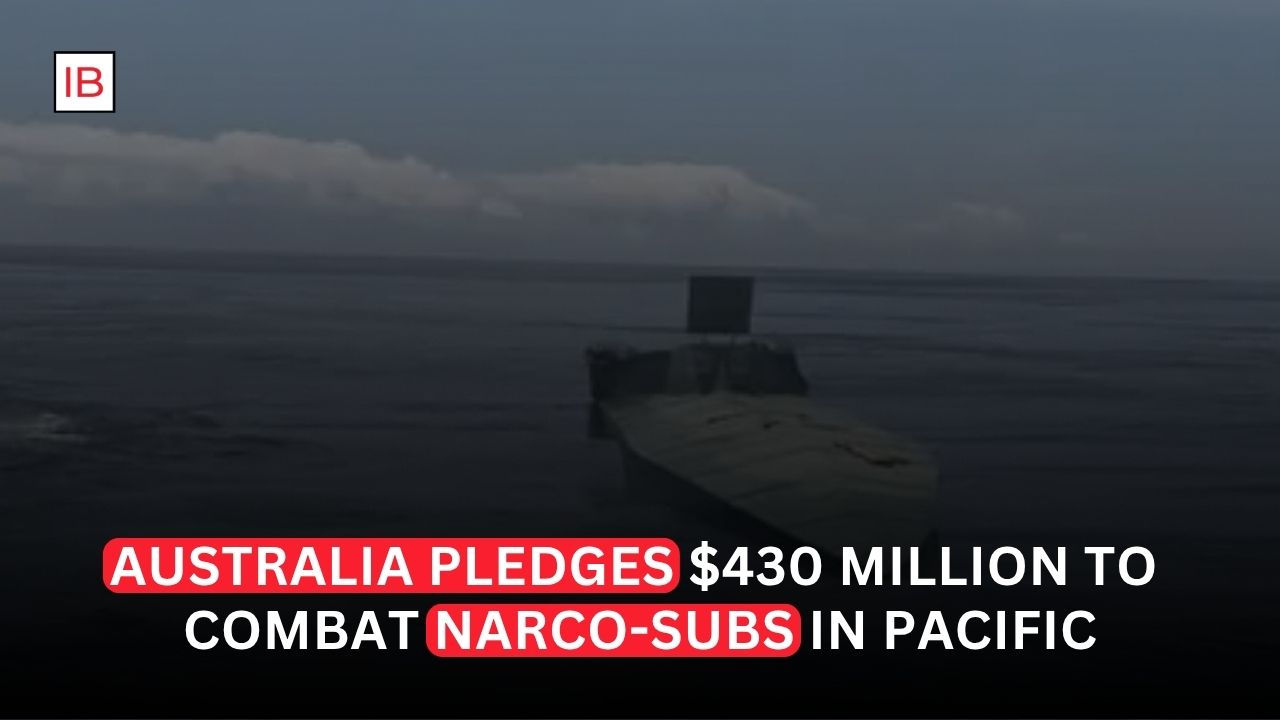
Australia is committing about A$600 million, or roughly US$430 million, to strengthen efforts against drug trafficking across the Pacific, with a major focus on stopping so-called narco-submarines used to move cocaine and other illicit drugs toward Australia and New Zealand.
The announcement comes as Pacific nations confront a sharp increase in transnational drug trafficking. Authorities have intercepted unusually large quantities of cocaine in recent months, while semi-submersible vessels designed to evade detection have increasingly appeared in the region.
Australian Prime Minister Anthony Albanese announced the expanded initiative during the Pacific Islands Forum, presenting the drug trade as a shared regional security challenge rather than a problem that individual island nations can tackle alone.
Narco-Subs Are Becoming a Regional Threat
Narco-submarines are semi-submersible vessels designed to travel long distances while remaining difficult to detect from the air or sea.
At least seven suspected drug-smuggling submarines have been discovered in Pacific waters near Australia over the past 18 months, according to Australian reporting. Several more vessels have washed ashore in Pacific island countries.
The vessels are particularly attractive to trafficking organizations because they can transport enormous quantities of cocaine while presenting a relatively small radar and visual signature.
Their appearance in the Pacific indicates that criminal networks are adapting their routes and methods as authorities increase pressure on traditional trafficking corridors.
Cocaine Seizures Are Surging
The scale of recent drug seizures illustrates why governments are becoming more concerned.
French Polynesian authorities have seized more than 11.5 tonnes of cocaine in the space of a month, while Fiji authorities seized another 2.6 tonnes in January. Officials believe much of the cocaine was ultimately intended for markets in Australia and New Zealand.
The quantities are significant enough to suggest that the Pacific is no longer merely a transit zone.
Criminal organizations are increasingly treating the region as an important corridor into wealthy consumer markets.
Australia Wants More Aerial Surveillance
A major component of the Australian initiative will be increased aerial surveillance.
Aircraft and other monitoring systems can search large areas of ocean far more efficiently than individual patrol vessels.
The objective is to detect suspicious semi-submersible vessels before they reach their destination.
Australia also intends to strengthen coordination with Pacific governments so that information collected through surveillance can quickly be converted into maritime interceptions.
This is important because a narco-sub can cover substantial distances while operating far from major population centers.
Patrol Boats Will Play a Bigger Role
Surveillance alone cannot stop trafficking.
Once a suspicious vessel has been detected, authorities need ships capable of intercepting it.
Australia plans to strengthen at-sea interdiction efforts using Guardian-class patrol boats that it has supplied to Pacific island countries.
These vessels are already part of Australia’s broader Pacific maritime-security strategy.
The expanded anti-drug initiative will give them a more prominent role in combating transnational crime.
Australia Wants Regional Cooperation
The Australian government is emphasizing cooperation rather than simply expanding its own enforcement presence.
Pacific island nations have large maritime territories but often lack the resources needed to monitor them continuously.
Australia can provide aircraft, technology, intelligence and training while regional governments provide local knowledge and enforcement capabilities.
That approach could be more effective than trying to patrol the entire Pacific from Australian bases.
The Drug Trade Is Growing More Sophisticated
The emergence of narco-subs highlights how quickly trafficking organizations can adapt.
When authorities strengthen border controls or increase surveillance around established routes, criminal groups can shift to alternative pathways.
Semi-submersible vessels provide traffickers with a way to bypass conventional maritime monitoring.
Their use also makes traditional customs enforcement more difficult because the vessels can operate hundreds or thousands of kilometers from land.
That is why Australia is increasingly treating drug trafficking as a maritime-security issue.
The Pacific Islands Face Their Own Risks
Pacific island countries are not simply transit points.
Large drug shipments can create local markets and contribute to addiction, organized crime and corruption.
Regional authorities have become increasingly concerned that a growing flow of cocaine and methamphetamine could produce long-term social problems.
The Pacific Islands Forum has consequently elevated the fight against illicit drugs as one of its major priorities, alongside issues such as climate change.
For smaller island nations with limited law-enforcement resources, the consequences can be particularly severe.
Australia Is Targeting the Source Too
The initiative will not be limited to intercepting vessels in the Pacific.
Australia also plans to strengthen cooperation with police forces in South and Central America, where many drug shipments originate.
That reflects a broader strategy: stopping narcotics before they reach Pacific waters may be cheaper and more effective than attempting to intercept every shipment at sea.
Australian authorities therefore want greater intelligence sharing and cooperation with law-enforcement agencies closer to the source of the drugs.
Why the Pacific Matters to Australia
Australia is one of the world’s wealthier consumer markets and has historically faced high demand for cocaine and methamphetamine.
The country’s geographic isolation does not eliminate the threat.
Instead, it forces traffickers to use long maritime routes.
The Pacific therefore becomes strategically important.
Criminal organizations that successfully move narcotics through remote island waters can exploit the enormous distances and limited surveillance capabilities of many Pacific governments.
Maritime Security Is Already a Priority
Australia has spent years strengthening maritime security in the Pacific.
Its Pacific Maritime Security Program has supplied patrol boats and supported aerial surveillance for Pacific island nations, originally focusing heavily on illegal fishing and other maritime crimes.
The same infrastructure can now be used against drug trafficking.
That gives Australia an opportunity to expand an existing security network rather than create an entirely new system.
China Adds a Strategic Dimension
The anti-drug announcement also comes amid increasing strategic competition in the Pacific.
Australia, the United States and China are all seeking greater influence among Pacific island governments.
While the drug initiative is primarily focused on law enforcement, expanded Australian surveillance and maritime capabilities could also strengthen Australia’s broader regional security presence.
That makes cooperation with Pacific nations strategically valuable beyond the immediate fight against narcotics.
Pacific Governments Need Capacity
A major challenge will be ensuring that Pacific nations can operate and maintain the equipment Australia provides.
Patrol boats require trained crews, maintenance and reliable funding.
Surveillance aircraft and intelligence systems require specialist personnel.
Without sustained investment in local capacity, expensive equipment can become underused.
Australia’s challenge will therefore be to turn financial assistance into a durable regional enforcement network.
Criminal Networks Will Adapt
The biggest weakness in any maritime anti-drug strategy is that traffickers can change tactics.
If narco-subs become easier to detect, criminal groups may switch to fishing vessels, cargo ships or other methods.
They may also alter routes.
That means the new program will need to remain flexible.
Investment in intelligence may ultimately prove more valuable than simply buying additional patrol vessels.
Intelligence Could Be the Key
Tracking financial networks, communications and logistics can help authorities identify trafficking organizations before shipments depart.
Information from South American authorities can potentially be combined with Pacific surveillance data to create a much clearer picture of trafficking routes.
That could allow law enforcement to target the organizations behind the shipments rather than merely seize individual loads.
A Major Financial Commitment
The roughly A$600 million commitment represents a significant expansion of Australia’s role in Pacific drug enforcement.
The government is effectively betting that prevention and regional cooperation can reduce the cost of dealing with the consequences later.
But measuring success will be difficult.
A reduction in seizures could mean trafficking is falling—or simply that traffickers have become better at avoiding detection.
Australia will need broader indicators, including arrests, disrupted networks and reductions in drugs reaching consumer markets.
Conclusion
Australia’s pledge of about A$600 million, equivalent to roughly US$430 million, marks a major escalation in the Pacific’s fight against drug trafficking.
The initiative comes after a sharp increase in cocaine seizures and the discovery of multiple suspected narco-submarines operating in waters around the region.
Australia plans to increase aerial surveillance, strengthen maritime interdictions using Guardian patrol boats and improve cooperation with Pacific governments.
It also intends to work more closely with police forces in South and Central America to disrupt trafficking networks before drugs reach the Pacific.
The strategy makes sense in one important respect: the Pacific is simply too large for Australia to patrol alone.
Regional cooperation allows countries to combine Australian technology and resources with local knowledge and enforcement capabilities.
But the program faces a serious challenge.
Criminal organizations are adaptable, and stopping one trafficking route can push smugglers toward another.
The long-term effectiveness of Australia’s investment will therefore depend on intelligence sharing, local training, sustained maintenance of equipment and cooperation between governments.
The growing presence of narco-submarines shows that drug traffickers are already exploiting the Pacific’s enormous maritime distances.
For Australia, the issue is no longer only about intercepting individual shipments.
It is about building a regional security system capable of identifying, tracking and disrupting criminal networks before they can deliver drugs to Australia’s shores.
The A$600 million package is a substantial step in that direction, but its success will ultimately depend on whether the investment creates a lasting regional capability rather than simply producing more patrols and seizures.