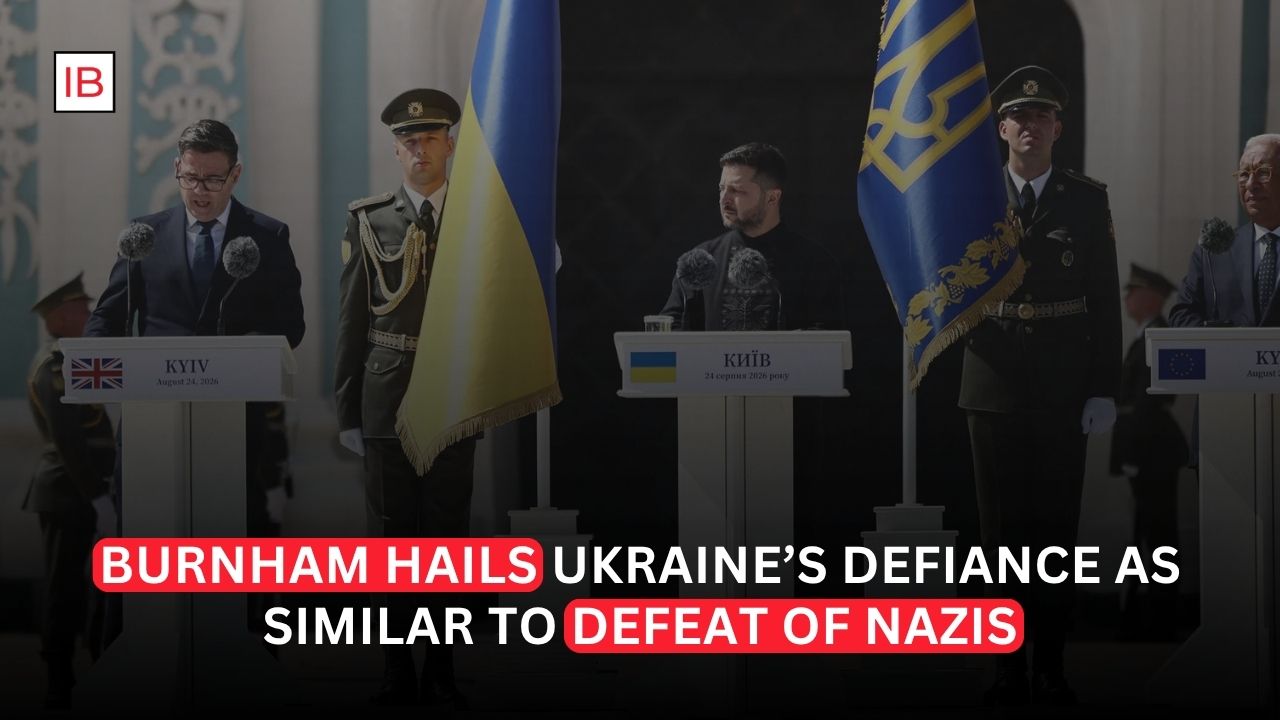
UK Prime Minister Andy Burnham used his first foreign visit as premier to deliver an unusually forceful message of support for Ukraine, comparing the country’s resistance against Russia with Britain’s determination during the Second World War.
Speaking in Kyiv on Ukraine’s 35th Independence Day, Burnham sought to demonstrate that Britain’s commitment to Ukraine will remain firm despite the continuing war and difficult diplomatic efforts to reach a settlement. He also announced further British support for Ukraine’s ability to produce long-range missiles domestically.
The visit was designed to send two messages at once: Britain intends to remain a leading supporter of Ukraine, and European countries are preparing to maintain pressure on Russia while discussions about a possible peace agreement continue.
Burnham Makes Ukraine His First Foreign Destination
Choosing Kyiv for his first international trip was itself a political statement.
Burnham arrived in Ukraine on Aug. 24, the country’s Independence Day, joining President Volodymyr Zelenskyy and other European leaders for commemorations and discussions about the war.
The UK government said Burnham’s visit was intended to demonstrate that British support would continue under his government. Britain has committed about £25 billion in military and non-military assistance to Ukraine, according to Downing Street.
Burnham has repeatedly argued that Ukraine’s security is directly connected to Britain’s own security.
That position places the UK firmly among European governments that believe allowing Russia to achieve its objectives through force would create a broader security threat.
Comparing Ukraine’s Resistance With World War II
Burnham’s comparison with Britain’s fight against Nazi Germany was deliberately powerful.
The historical analogy connects Ukraine’s current struggle with one of the defining moments in British national history: resisting an expansionist power despite enormous military and political pressure.
The comparison is politically useful because it frames Ukraine’s resistance as a broader struggle over national independence rather than simply a territorial dispute.
Burnham’s argument is essentially that Ukraine is defending the principle that a country should be able to determine its own future without being forced into submission by a more powerful neighbor.
However, the analogy is also controversial.
Russia’s invasion, World War II and Britain’s role in defeating Nazi Germany are historically very different conflicts. Critics could argue that comparisons to the Second World War risk simplifying the current diplomatic situation and making compromise more politically difficult.
Ukraine Wants Peace but Rejects Capitulation
President Volodymyr Zelenskyy used Independence Day to reinforce a similar distinction.
Ukraine says it wants peace but will not accept an agreement that amounts to surrender.
Zelenskyy has rejected pressure to give up territory as the price for ending the war, while Russia continues to demand major concessions from Kyiv. Reuters reported that Zelenskyy reiterated Ukraine’s desire for peace while rejecting capitulation.
This creates the central dilemma facing European governments.
They want the war to end, but they also want any settlement to preserve Ukraine’s sovereignty and security.
Those objectives are not necessarily easy to reconcile.
Britain Is Increasing Military Support
Burnham’s visit included a concrete military announcement.
The UK agreed to allow defense company MBDA to release classified information relating to British components used in the SCALP long-range missile.
SCALP is the French version of Britain’s Storm Shadow missile, and both systems incorporate British and French technology.
The release of the information is intended to help France and Ukraine establish local assembly capabilities for the weapon in Ukraine.
This represents a significant shift from simply supplying weapons.
Ukraine would gain greater capacity to manufacture weapons itself.
Why Domestic Missile Production Matters
Ukraine has increasingly relied on long-range weapons to strike military infrastructure and other targets deep inside Russian territory.
Domestic production could reduce its dependence on foreign deliveries.
That matters because foreign weapons supplies are vulnerable to political changes, production limitations and lengthy procurement processes.
If Ukraine can manufacture more of its own long-range systems, it gains greater control over its military planning.
It could also allow European partners to support Ukraine through technology and industrial cooperation rather than relying entirely on shipments from existing stockpiles.
Russia Has Condemned Britain’s Role
Moscow has strongly criticized the UK’s growing military involvement.
Russian officials have accused Britain of escalating the conflict and argued that providing technology for long-range weapons makes the UK an increasingly direct participant in the war.
Kremlin spokesman Dmitry Peskov said British involvement was damaging peace efforts and warned that the transfer of military technology would have consequences.
That response highlights the risk facing Burnham’s government.
Supporting Ukraine strengthens Kyiv’s military position, but it can also increase tensions between London and Moscow.
The Coalition of the Willing
Burnham also co-chaired a meeting of the Coalition of the Willing, a group of countries supporting Ukraine and discussing its long-term security.
France and the UK have played leading roles in coordinating European support.
The coalition’s importance has grown as European governments have become increasingly focused on ensuring that Ukraine has security guarantees even if the current war eventually ends.
The goal is not simply to provide weapons today.
It is to create a framework that could deter another Russian attack in the future.
Europe Is Trying to Maintain Unity
Other European leaders traveled to Kyiv for Independence Day.
European Council President Antonio Costa, Estonian President Alar Karis, Moldovan President Maia Sandu and Luxembourg Prime Minister Luc Frieden were among the leaders present.
Their presence demonstrates that Ukraine continues to receive significant political support from Europe.
That matters because European governments have different economic interests and different levels of exposure to the war.
Maintaining a common position is therefore becoming increasingly important.
The Peace Process Remains Difficult
The diplomatic situation remains complicated.
US-led efforts to reach a peace agreement have not produced a durable settlement, while fighting continues.
Ukraine says it is willing to negotiate but refuses to surrender territory simply to end the war.
Russia’s demands remain substantially different from Kyiv’s position.
That leaves European governments trying to support diplomacy without weakening Ukraine’s negotiating position.
Burnham’s approach appears to be that military strength is necessary to produce a sustainable peace.
Britain Wants a Long-Term Role
Burnham’s government is also positioning Britain as a long-term security partner for Ukraine.
The UK has described the relationship as part of a broader 100 Year Partnership between the two countries.
Downing Street says Britain’s support includes military, economic and diplomatic assistance, as well as cooperation on Ukraine’s future reconstruction.
That suggests London’s strategy extends beyond the current battlefield.
Britain wants a continuing role in Ukraine’s security and reconstruction after the war.
Ukraine’s Own Defense Industry Is Becoming More Important
One of the most important developments is Ukraine’s growing domestic defense industry.
The country has developed significant capabilities in drones and other weapons systems during the war.
Long-range missiles are a more complicated challenge, requiring advanced propulsion, guidance systems and industrial infrastructure.
European technology transfers could help Ukraine develop that capacity faster.
For Ukraine, this could eventually reduce dependence on Western stockpiles.
For European countries, it could create a more integrated defense-industrial relationship with Kyiv.
The Risk of Escalation Cannot Be Ignored
The strategy has an obvious downside.
Long-range weapons capable of striking targets deep inside Russia can increase the pressure on Moscow, but they can also provoke stronger Russian responses.
Moscow has already threatened consequences over Britain’s involvement in Ukrainian strikes.
That means European governments must balance two competing objectives:
- Strengthening Ukraine’s ability to defend itself
- Avoiding uncontrolled escalation with Russia
There is no simple formula for achieving both.
Burnham’s Message Is Bigger Than Ukraine
Burnham’s visit also represents an attempt to define Britain’s post-Brexit role in European security.
The UK is no longer part of the European Union, but it remains one of Europe’s largest military powers.
By taking a leading role in support for Ukraine, Britain can demonstrate that Brexit has not removed it from Europe’s strategic decision-making.
Burnham’s government is therefore using Ukraine policy to reinforce Britain’s position as a major European security actor.
The Historical Comparison Has Political Weight
Burnham’s reference to Nazi Germany was not simply rhetorical.
British political culture has long treated the Second World War as evidence of the country’s willingness to resist aggression even when the cost is high.
By placing Ukraine’s struggle within that historical tradition, Burnham is arguing that Britain should not become tired of supporting Kyiv.
But the comparison also raises questions.
World War II ended with the total defeat of Nazi Germany.
The Ukraine conflict is unlikely to end through an equivalent outcome.
A future settlement will almost certainly require negotiations.
That makes diplomacy as important as military support.
Conclusion
Andy Burnham’s visit to Kyiv was designed to demonstrate that Britain intends to remain firmly behind Ukraine.
His comparison between Ukraine’s resistance and Britain’s historical fight against Nazi Germany placed the conflict in a broader moral and historical framework. At the same time, his government announced practical support by allowing British technology used in SCALP missiles to be declassified so that Ukraine and France can pursue local production.
The strategy carries both opportunities and risks.
Greater Ukrainian weapons production could strengthen Kyiv’s negotiating position and reduce dependence on foreign stockpiles. But deeper British involvement could also increase tensions with Russia and complicate diplomatic efforts.
The central challenge for Burnham is therefore not simply deciding whether Britain supports Ukraine.
That decision has already been made.
The harder question is how Britain can provide enough military and political support to help Ukraine secure a lasting peace without allowing the conflict to expand further.
For Ukraine, the message from Kyiv was equally clear.
Independence Day is not being treated simply as a celebration of the past. It is a declaration that the country intends to remain sovereign despite the enormous pressure created by the war.
Burnham’s presence, alongside other European leaders, reinforced that message.
Whether this political solidarity eventually contributes to a negotiated settlement will depend on battlefield developments, Russian calculations and the willingness of all sides to compromise.
For now, Britain is betting that supporting Ukraine’s ability to resist is the best route toward a peace that Kyiv can actually accept.