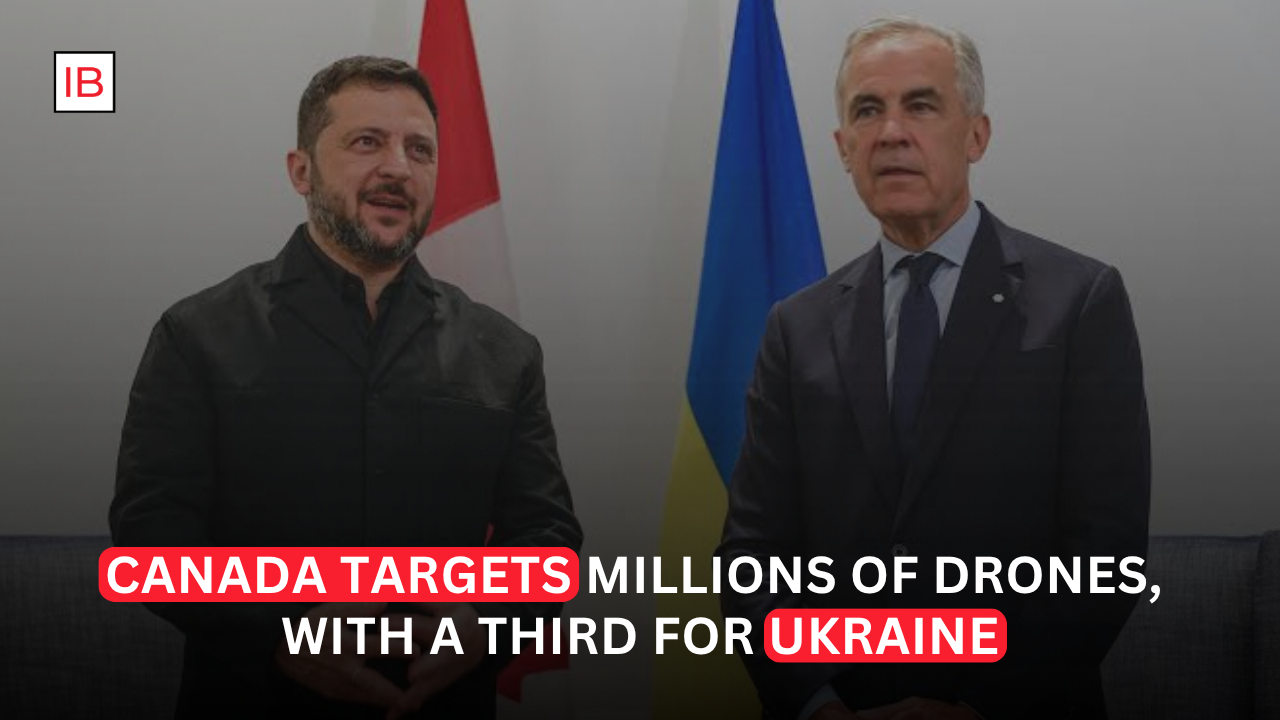
Canada is preparing to dramatically expand its domestic drone industry, with Prime Minister Mark Carney announcing plans to produce millions of drones over the next two years and send roughly one-third of that output to Ukraine as Ottawa deepens its military partnership with Kyiv.
The announcement came during Ukrainian President Volodymyr Zelenskyy’s visit to Canada, where the two leaders discussed Ukraine’s urgent need for air-defense systems, drones and energy support ahead of another difficult winter. Carney said Canada would scale up domestic drone manufacturing as part of a broader effort to strengthen its own defense-industrial base while providing Ukraine with equipment developed and produced in North America.
The plan reflects how dramatically drones have changed modern warfare. Small, relatively inexpensive unmanned aircraft have become essential to reconnaissance, battlefield surveillance, artillery targeting and direct attacks. Ukraine has built one of the world’s most advanced drone industries during its war with Russia, and Kyiv has repeatedly encouraged Western allies to adopt production methods that can deliver large quantities of inexpensive systems rather than relying exclusively on costly conventional weapons.
For Canada, the decision represents more than another military-aid commitment. It is also an attempt to build domestic industrial capacity at a time when NATO countries are reassessing their defense supply chains.
Canada has committed more than C$25.5 billion in assistance to Ukraine since Russia launched its full-scale invasion in February 2022, including about C$8.5 billion in military support, according to the Canadian government. Ottawa has increasingly shifted toward long-term industrial cooperation with Ukraine rather than relying only on shipments from existing military stocks.
The drone initiative is particularly significant because Ukraine needs enormous numbers of unmanned systems. Russia has also expanded its use of drones, including large waves of long-range attack drones against Ukrainian cities and critical infrastructure. Ukraine has responded by developing increasingly sophisticated drones capable of reconnaissance, interception and long-range strikes.
By allocating one-third of future Canadian drone production to Ukraine, Ottawa is effectively tying part of its own defense-industrial expansion to the Ukrainian battlefield. The arrangement could give Canadian manufacturers a major real-world testing environment while providing Ukrainian forces with a more predictable source of equipment.
The timing is important. Ukraine is approaching another winter in which Russia is expected to continue targeting power stations, energy infrastructure and other civilian systems. Ukrainian officials have repeatedly warned that air-defense capacity remains insufficient, particularly against large-scale missile and drone attacks.
Carney also announced a C$350 million Canadian package for air-defense interceptors for Ukraine. The equipment can be purchased through a US mechanism that allows third countries to procure American weapons for Kyiv, including systems such as Patriot interceptors. The package is aimed at strengthening Ukraine’s ability to defend cities and infrastructure from Russian air attacks.
The broader Canadian package also includes nearly C$435 million in new loan guarantees for the European Bank for Reconstruction and Development to support Ukraine’s energy security. That assistance is intended to help Kyiv prepare for winter at a time when repeated Russian strikes have damaged electricity-generation and distribution infrastructure.
The drone commitment also highlights a growing difference between traditional defense procurement and the requirements of modern warfare. A fighter jet or missile-defense system can cost millions of dollars, while many battlefield drones are dramatically cheaper. Their effectiveness comes partly from scale: thousands of systems can be deployed, replaced or upgraded without the enormous expense associated with conventional weapons.
That does not mean drones are replacing traditional military systems. Ukraine still urgently needs sophisticated air-defense missiles, aircraft, artillery and armored equipment. But drones can complement those systems by providing persistent surveillance and lower-cost options for both attack and defense.
For Canada, expanding drone manufacturing could also become an economic opportunity. A domestic industry capable of producing millions of systems would create demand for electronics, sensors, batteries, software and advanced manufacturing. It could eventually give Canadian companies a larger role in the rapidly expanding global market for military drones and counter-drone technology.
The partnership with Ukraine may accelerate that development because Ukrainian forces have extensive combat experience with unmanned systems. Lessons from the battlefield can influence future Canadian designs, particularly in areas such as electronic warfare, navigation, autonomous targeting and resistance to jamming.
The agreement nevertheless carries risks. Rapid production of millions of drones requires secure supply chains and sufficient manufacturing capacity. Canada will also need to ensure that equipment delivered to Ukraine can survive increasingly sophisticated Russian electronic warfare and air defenses.
For Kyiv, however, the benefit is straightforward: more drones mean more options at a time when ammunition and air-defense resources remain under pressure. For Ottawa, the program is simultaneously an act of support for Ukraine and a bet that the wars of the future will demand very different defense-industrial capabilities.
Canada’s decision to commit a significant share of its future drone production to Ukraine therefore marks a deeper stage in the two countries’ defense relationship. Instead of simply transferring weapons already sitting in Canadian inventories, Ottawa is preparing to help build a production pipeline designed around the realities of modern warfare.
As Russia continues its attacks and Ukraine develops increasingly sophisticated unmanned weapons, Canada’s drone strategy could become an important test of whether Western allies can combine industrial expansion with battlefield innovation quickly enough to meet the demands of a prolonged conflict.