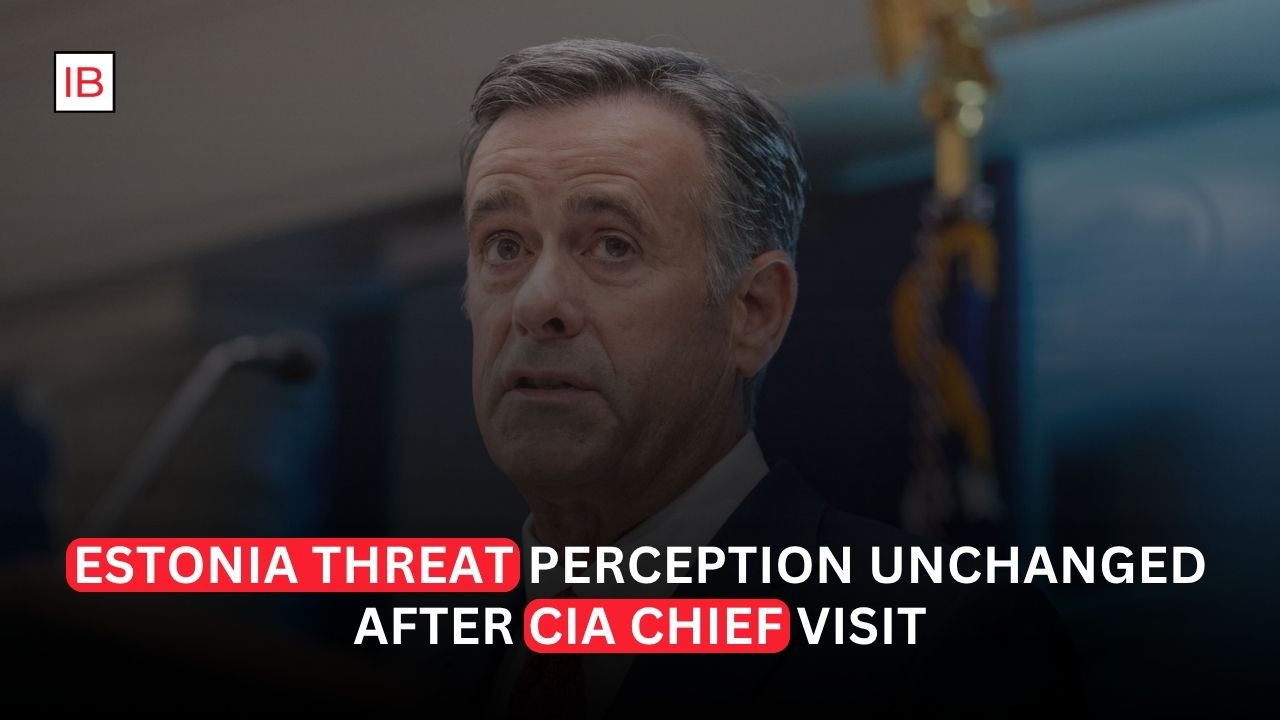
Estonia says its assessment of the security threat facing the Baltic region has not changed following the unannounced visit of CIA Director John Ratcliffe to Moscow. The statement comes as fresh reports suggest that Ratcliffe used his trip to warn Russian officials against escalating tensions with NATO members, particularly Estonia, Latvia and Lithuania.
The unusual diplomatic and intelligence activity has attracted attention across the Baltic states, where governments have spent years preparing for the possibility that Russia could test NATO’s resolve.
For Estonia, however, the message appears to be that the latest developments do not fundamentally alter its existing assessment. The country remains focused on strengthening deterrence, maintaining close cooperation with NATO allies and preparing for a broad range of potential security threats.
CIA Chief’s Surprise Moscow Visit
Ratcliffe’s trip to Moscow on Aug. 25 was not announced in advance.
The Kremlin later confirmed that the CIA director met Russian intelligence officials but said he did not meet President Vladimir Putin. The secrecy surrounding the visit immediately generated speculation about its purpose.
According to reports citing people familiar with the discussions, the meeting was primarily intended to warn Russia against actions that could escalate tensions with NATO allies in the Baltic region.
Estonia, Latvia and Lithuania were reportedly among the countries specifically discussed.
The visit is particularly notable because it represents a rare direct intelligence-level communication between Washington and Moscow at a time when relations remain deeply strained.
Estonia Says Its Assessment Has Not Changed
Despite the significance of Ratcliffe’s reported warning, Estonia has indicated that it does not see the visit as evidence that the immediate security situation has fundamentally changed.
That distinction is important.
A warning from Washington does not necessarily mean that US intelligence has concluded that Russia is preparing an imminent attack on Estonia.
Instead, it can reflect an effort to prevent escalation before it occurs.
Estonian officials have consistently emphasized preparedness because the country’s geographic position makes it particularly sensitive to developments involving Russia.
Why the Baltic States Matter
Estonia, Latvia and Lithuania occupy a strategically important position on NATO’s northeastern flank.
All three countries border Russia or are closely connected to Russia’s western military environment.
Their geography creates unique security challenges.
Estonia shares a land border with Russia, while Lithuania and Latvia also have direct exposure to Russian territory and military activity.
Kaliningrad, the Russian exclave between Poland and Lithuania, adds another strategic complication.
Because all three countries are NATO members, an attack against any one of them would potentially trigger the alliance’s collective-defense commitments.
That makes the Baltic region one of the most sensitive areas in European security.
Russia’s War in Ukraine Changes the Calculation
The Baltic states have closely watched Russia’s war against Ukraine.
For Estonia and its neighbors, the conflict has demonstrated that Moscow is willing to use military force to pursue strategic objectives.
Estonian President Alar Karis recently reaffirmed the country’s strong support for Ukraine and called for urgent assistance to help Kyiv defend itself.
Estonia’s position is therefore not based only on hypothetical scenarios.
Its security policy is shaped by Russia’s demonstrated willingness to conduct a large-scale war in Europe.
NATO Membership Is Estonia’s Main Shield
Estonia’s strongest security guarantee remains NATO membership.
The country’s strategy depends heavily on collective defense.
The principle is straightforward: an attack against one NATO member is treated as a matter for the alliance as a whole.
That means Russia would have to consider the consequences of confronting not only Estonia but the wider NATO alliance.
This is the core of deterrence.
Estonia’s goal is not simply to build enough military power to defeat Russia independently.
Instead, it wants to make any attack appear so costly and risky that Moscow decides against attempting it.
The US Role Is Especially Important
American involvement remains central to that strategy.
The United States is NATO’s most powerful military member and has substantial intelligence, airpower and logistical capabilities.
The fact that Ratcliffe reportedly delivered a direct warning to Moscow regarding the Baltic states therefore carries symbolic importance.
It signals that Washington is paying attention to the region and that actions against NATO members could have consequences.
Estonian officials have also previously emphasized the importance of US support for regional security and transatlantic cooperation.
A Warning Does Not Mean an Attack Is Imminent
This is where some interpretations of the CIA visit can go too far.
The existence of a warning should not automatically be interpreted as evidence that Russia has decided to attack Estonia.
There is currently no public evidence establishing that an invasion of the Baltic states is imminent.
The more cautious interpretation is that Washington wants to communicate boundaries clearly before a crisis develops.
Strategic warnings are often designed precisely to prevent a situation from reaching the point where military action becomes necessary.
Estonia Faces More Than a Conventional Military Threat
The country’s security concerns extend beyond tanks, missiles and troops.
Estonian officials have repeatedly warned about hybrid threats.
These include cyberattacks, attacks on critical infrastructure, election interference, information operations and attempts to exploit migration or energy vulnerabilities.
President Karis has said Europe needs to prepare for increasingly sophisticated hostile influence operations and warned that threats can emerge with little warning.
This broader definition of security is particularly important for a small country.
An adversary does not necessarily need to launch a conventional invasion to create serious disruption.
Cybersecurity Is a Major Concern
Estonia has long been one of Europe’s most digitally connected societies.
That creates economic and administrative advantages but also potential vulnerabilities.
Cyberattacks against government systems, banks, telecommunications networks or infrastructure could cause significant disruption without a conventional military attack.
Russia has previously been accused of conducting cyber and influence operations against European countries.
For Estonia, defending digital infrastructure is therefore part of national defense.
Critical Infrastructure Is Another Vulnerability
Energy networks, telecommunications systems, undersea cables and transportation infrastructure are increasingly treated as strategic assets.
Damage to these systems could disrupt everyday life and create economic pressure.
The Baltic Sea has become particularly important because of its infrastructure and strategic position.
European governments have increased their attention to protecting undersea cables and other critical networks.
The security challenge is complicated because sabotage can be difficult to attribute quickly.
Estonia Has Been Preparing for Years
The country’s current posture did not begin with Ratcliffe’s Moscow visit.
Estonia has spent years increasing defense spending, strengthening its armed forces and developing cooperation with NATO.
The government has also sought stronger regional defense arrangements.
The objective is to ensure that any potential adversary faces immediate resistance rather than encountering a vulnerable state that could be isolated.
Baltic Defense Cooperation
Estonia, Latvia and Lithuania increasingly coordinate their defense planning.
The three countries share similar concerns about Russia and face many of the same geographic challenges.
Joint exercises and regional defense initiatives can improve interoperability and make it more difficult for an adversary to exploit differences between the Baltic governments.
Their cooperation also reinforces the political message that an attack on one Baltic state would not be treated as an isolated event.
Poland and the Nordic Countries Matter Too
The security of the Baltic states is closely linked with Poland and the Nordic region.
Finland and Sweden’s NATO membership has changed the strategic geography of northern Europe.
Finland shares a long border with Russia, while Sweden provides important geographic and military advantages in the Baltic Sea.
Poland has also become one of Europe’s largest defense spenders.
Together, these countries create a stronger regional network around the Baltic states.
The Importance of Deterrence
Deterrence works partly through uncertainty.
Russia must believe that an attack would trigger a powerful response.
That response does not necessarily have to be explained publicly in detail.
Military deployments, exercises, intelligence cooperation and political statements can all contribute to deterrence.
Ratcliffe’s reported message to Moscow therefore fits into a broader strategy.
The objective is to communicate that escalation involving NATO’s Baltic members would cross a serious line.
Why Estonia’s Response Is Restrained
Estonia has little incentive to exaggerate the significance of the CIA visit.
An overly alarmist response could increase public anxiety and potentially amplify Russian information operations.
At the same time, dismissing the issue would be dangerous.
The balanced approach is to acknowledge the warning while maintaining the country’s existing preparedness.
That appears consistent with Estonia’s current position.
The Memory of 2021 Adds Sensitivity
Ratcliffe’s Moscow trip has drawn comparisons with former CIA Director William Burns’s visit to Russia in November 2021.
Burns traveled to Moscow as US intelligence assessed that Russia was preparing for a possible invasion of Ukraine.
Russia launched its full-scale invasion only a few months later.
That historical precedent makes any unannounced CIA director visit to Moscow particularly sensitive.
However, the circumstances are different.
Estonia, Latvia and Lithuania are NATO members, whereas Ukraine was not.
That difference significantly changes the strategic calculation.
NATO Article 5 Changes the Equation
NATO’s collective-defense commitment is the most important difference.
Russia knows that an attack on Estonia would not simply create a bilateral conflict.
It could involve the entire alliance.
That creates a major deterrent.
At the same time, NATO governments must ensure that the commitment is credible.
That is why military readiness, forward deployments and joint exercises are so important.
Russia’s Possible Calculations
Moscow could theoretically attempt to test NATO without launching a traditional invasion.
Potential actions could include cyberattacks, border incidents, airspace violations, sabotage or disinformation campaigns.
Such activities can create ambiguity.
The challenge for NATO is deciding how to respond without allowing a limited incident to escalate into a wider confrontation.
This is one reason Washington may want to communicate its red lines directly.
The Iran Connection
Ratcliffe’s Moscow visit was reportedly not focused exclusively on the Baltic region.
According to reports, he also pressed Russia to reduce military and economic support for Iran.
That suggests the visit may have addressed several elements of the broader US-Russia relationship.
The Baltic issue, however, is particularly sensitive because it directly involves US treaty allies.
Europe Is Increasingly Focused on Self-Defense
The security environment has pushed European countries to rethink defense spending.
Governments that once relied heavily on the assumption of a stable post-Cold War security environment are now investing more in military capabilities.
Estonia has been among the European countries most vocal about the need to strengthen defense.
Its geographical position gives it strong incentives to maintain high readiness.
The Economic Cost of Security
Higher defense spending comes with economic trade-offs.
Governments must balance military investment against healthcare, infrastructure, education and other priorities.
For Estonia, however, policymakers have argued that security spending is necessary because the cost of being unprepared could be far higher.
The same debate is occurring across Europe.
What Investors Are Watching
The situation also matters to financial markets.
A major deterioration in Baltic security could affect European defense companies, energy markets and regional investment sentiment.
Estonia’s economy is small, but the Baltic region is strategically connected to the wider European market.
Any significant military escalation could create broader uncertainty.
At present, however, there is no basis for assuming that the CIA visit itself signals an imminent conflict.
What Comes Next?
The immediate focus will likely remain on intelligence assessments, NATO readiness and Russia’s behavior.
If Moscow avoids provocative actions, the warning may have achieved its purpose.
If incidents increase, European governments could respond by strengthening military deployments and surveillance.
Estonia is likely to continue emphasizing resilience and preparedness rather than reacting dramatically to every development.
Conclusion
Estonia’s message following John Ratcliffe’s surprise Moscow visit is deliberately measured: the country’s threat assessment has not fundamentally changed.
That does not mean Tallinn is unconcerned.
The Baltic states remain among the most security-sensitive members of NATO because of their proximity to Russia and their strategic importance.
Reports that Ratcliffe warned Moscow against escalating tensions with Estonia, Latvia and Lithuania demonstrate that Washington is also taking the issue seriously.
But a warning is not proof that an attack is imminent.
Estonia’s strategy is based on maintaining deterrence, strengthening NATO cooperation and preparing for both conventional and hybrid threats.
Cyberattacks, sabotage, disinformation and pressure on critical infrastructure are all part of the modern security environment.
The biggest lesson from the latest developments is therefore not that Estonia suddenly faces a new threat.
It is that the existing threat remains serious enough for Washington and its European allies to keep communicating clear boundaries to Moscow.
For Estonia, the response is likely to remain the same: strengthen national defense, deepen NATO cooperation and avoid unnecessary panic.
The Baltic security challenge is not disappearing, but neither is Estonia’s determination to prepare for it.