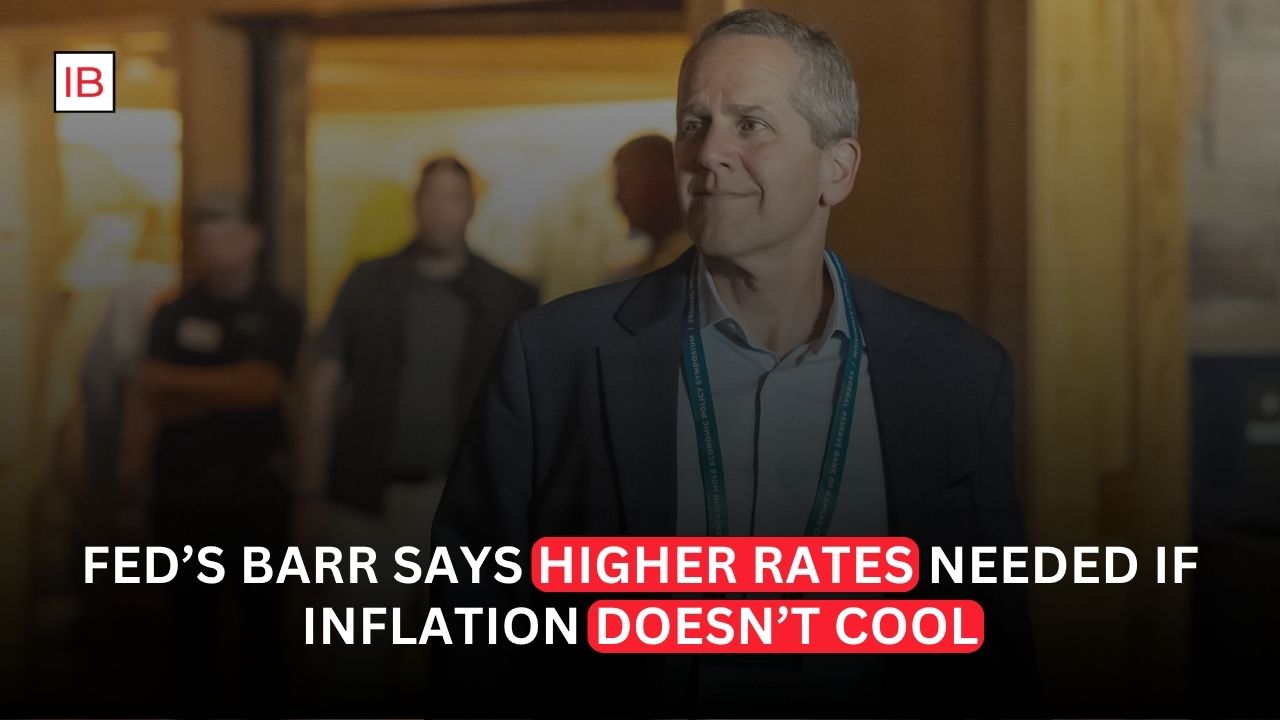
Federal Reserve Governor Michael Barr is warning that US interest rates may need to move higher if inflation fails to make enough progress toward the central bank’s target, adding another hawkish voice to an increasingly uncertain debate over the next move in monetary policy.
Barr said the economy remains relatively solid and the labor market is stable, but inflation is still too high. If price pressures continue to prove persistent, holding rates at their current level may not be sufficient to bring inflation sustainably back to the Federal Reserve’s 2% objective.
The comments are significant because financial markets have increasingly been weighing the possibility that the Federal Reserve could raise borrowing costs rather than cut them in the near term.
Inflation Remains the Central Problem
The Fed’s policy challenge has changed considerably from earlier expectations of steady rate reductions.
Inflation has declined substantially from its post-pandemic peak, but the improvement has slowed. Recent data showed core personal consumption expenditures inflation running around 3.3% annually, well above the Fed’s 2% target.
That leaves policymakers with an uncomfortable choice.
Keeping rates high for longer could eventually bring inflation down, but it also risks weakening economic activity and employment. Cutting rates too quickly could provide support to demand while allowing price pressures to remain elevated.
Barr’s comments suggest he is increasingly concerned about the second risk.
Higher Rates Are Back on the Table
For much of the past year, investors had focused primarily on when the Fed would begin or continue cutting interest rates.
That assumption has been challenged by persistent inflation.
Barr’s warning means that a rate increase cannot simply be dismissed as a theoretical possibility. If inflation remains stubborn, policymakers could decide that monetary policy needs to become more restrictive.
That would represent a major change in market expectations.
It would also demonstrate that the Fed is willing to accept weaker economic activity in exchange for greater confidence that inflation is returning toward 2%.
The Economy Has Not Broken Down
One reason the Fed can consider higher rates is that the US economy has continued to show underlying strength.
Barr pointed to solid economic growth and a stable labor market. Other recent data also indicate that private domestic demand remains relatively strong despite tighter financial conditions.
That matters because monetary policy becomes easier to tighten when policymakers believe the economy can withstand higher borrowing costs.
If growth were already collapsing, another rate increase would carry much greater recession risk.
The Labor Market Is Complicating the Decision
The labor market is not as strong as it was during the post-pandemic recovery, but it has not deteriorated enough to force the Fed into aggressive easing.
Unemployment remains relatively low, while wage growth continues to provide households with purchasing power.
That creates a difficult balance.
The Fed’s mandate includes both price stability and maximum employment. If inflation remains high while employment is still relatively resilient, policymakers have more room to prioritize inflation.
But that room could disappear quickly if hiring weakens significantly.
Oil Prices Add Another Risk
Energy markets are creating another inflation concern.
Renewed geopolitical tensions involving Iran have pushed crude prices higher, with Brent recently moving above $92 a barrel. The rise has contributed to a global bond selloff and increased expectations for tighter monetary policy.
Higher oil prices affect inflation directly through gasoline and energy costs.
They can also raise transportation and production expenses across the economy.
If the increase becomes persistent, the Fed could face renewed pressure to respond.
Bond Markets Are Already Reacting
US Treasury yields have risen sharply as investors reassess the outlook for inflation and monetary policy.
The 10-year Treasury yield recently moved above 4.75%, reaching its highest level in roughly 19 months, while the two-year yield climbed to about 4.35%.
Short-term yields are particularly sensitive to expectations for Fed policy.
When traders increase the probability of a rate hike, two-year yields typically respond first because they reflect expectations for the path of short-term interest rates.
The recent market move therefore shows that investors are taking the possibility of tighter policy seriously.
September Meeting Has Become Critical
The Federal Open Market Committee’s September meeting is now one of the most closely watched events in global markets.
Investors are trying to determine whether policymakers will hold rates steady, cut them or raise them.
Recent market pricing has moved sharply toward the possibility of a hike, with one report putting the probability at roughly two-thirds.
That expectation could change quickly with incoming inflation and employment data.
The Fed is unlikely to commit itself far in advance if the economic outlook remains uncertain.
Fed Officials Are Sending a More Hawkish Message
Barr is not alone in warning that higher rates may be necessary.
Fed Chair Kevin Warsh recently indicated that additional increases could be required if inflation remains persistently above target. He also argued that current financial conditions may not be restrictive enough to bring inflation down decisively.
Other officials have also emphasized that policymakers cannot assume inflation will automatically continue falling.
That increasingly hawkish communication has altered the market narrative.
Political Pressure Makes the Situation More Sensitive
The Fed’s policy debate is occurring against a highly political backdrop.
President Donald Trump has repeatedly pushed for lower interest rates, creating tension between the administration’s desire for cheaper borrowing and the central bank’s responsibility to control inflation.
That makes any potential rate hike politically controversial.
The Fed nevertheless needs to maintain credibility that monetary policy is being determined by economic conditions rather than short-term political demands.
The Independence Question Matters
Central-bank independence becomes especially important when monetary policy conflicts with government preferences.
The federal government benefits from lower interest rates because they can reduce borrowing costs.
Households and businesses also generally prefer cheaper credit.
But if rates are kept artificially low while inflation remains elevated, the long-term economic consequences can be more damaging.
Investors therefore pay close attention not only to what Fed officials say about rates, but also to whether the institution appears willing to act independently.
Higher Rates Would Hit Consumers
A rate increase would eventually affect consumers through borrowing costs.
Credit cards, auto loans and mortgages would become more expensive or remain expensive for longer.
Households carrying significant debt would face greater pressure.
Savings accounts and other interest-bearing assets, however, could provide higher returns.
The overall effect would therefore differ across households depending on their debt and savings positions.
Businesses Would Face More Pressure
Companies would also feel the impact.
Higher interest rates increase financing costs and raise the hurdle rate for investment projects.
Businesses considering expansion, acquisitions or new facilities could delay decisions.
Highly leveraged companies would be particularly exposed.
That could eventually weaken hiring and investment.
The Fed therefore has to weigh inflation benefits against the possibility that tighter financial conditions eventually produce a sharper slowdown.
Housing Remains Vulnerable
The housing market would be another major transmission channel.
Mortgage rates are influenced by Treasury yields and expectations for Fed policy.
If markets begin pricing in sustained rate increases, mortgage borrowing costs could rise further.
That could keep potential buyers on the sidelines and place additional pressure on housing affordability.
At the same time, homeowners with existing fixed-rate mortgages would be relatively insulated.
The Dollar Could Strengthen
Higher US interest rates could also support the dollar.
Higher yields make dollar-denominated assets more attractive to international investors.
A stronger dollar can help reduce the cost of imported goods and therefore provide some assistance with inflation.
But it can also create difficulties for US exporters by making American goods more expensive overseas.
The exchange-rate effect is therefore another factor policymakers must consider.
Markets Could Become More Volatile
The possibility of a rate hike has already increased uncertainty across financial markets.
Stocks, bonds and currencies are adjusting to a monetary-policy outlook that is less predictable than investors expected earlier in the year.
Growth-sensitive technology stocks could be particularly vulnerable because higher discount rates reduce the present value of future earnings.
That is especially relevant at a time when investors have assigned high valuations to companies connected to artificial intelligence and technology infrastructure.
Fiscal Policy Adds Another Complication
The Fed is also operating in an environment of large federal deficits and rising government borrowing.
Higher Treasury issuance can push long-term yields upward even without a Fed rate increase.
That creates a distinction between short-term monetary policy and broader financial conditions.
The Fed controls its policy rate, but it does not directly control the long-term cost of government borrowing.
Investors are therefore watching both inflation and fiscal developments.
A Rate Hike Is Not Guaranteed
Barr’s comments should not be interpreted as a promise that the Fed will raise rates.
The central bank remains data dependent.
If inflation begins cooling more convincingly, policymakers could keep rates unchanged.
If the labor market deteriorates substantially, the argument for easing would become stronger.
The critical issue is therefore whether inflation remains high enough to justify additional restraint.
The Fed Faces an Asymmetric Risk
The central bank’s biggest concern may be that inflation becomes embedded again.
If businesses and households begin expecting higher prices to persist, inflation can become harder to eliminate.
That could force the Fed into a much more aggressive tightening cycle later.
Policymakers may therefore prefer to act earlier rather than risk having to raise rates dramatically after inflation expectations become unanchored.
Markets May Be Underestimating the Risk
The recent shift in rate expectations demonstrates how quickly financial markets can change.
Investors spent much of the previous cycle positioning for lower rates.
Now, the possibility of higher rates has become a meaningful part of the outlook.
If inflation data remain unfavorable, markets could move further in that direction.
That would put additional upward pressure on Treasury yields and borrowing costs.
September Could Set the Tone for Autumn
The September Fed meeting will provide an important test of how serious the inflation problem has become.
A hike would signal that policymakers believe existing monetary conditions are insufficient.
A hold could indicate that officials prefer to wait for additional evidence.
A cut would be difficult to reconcile with a persistent inflation problem unless employment conditions deteriorate sharply.
Whatever the decision, the accompanying projections and comments will probably matter as much as the rate itself.
Conclusion
Michael Barr’s warning that higher interest rates could be necessary if inflation does not cool adds to a growing shift in the Federal Reserve’s policy debate.
The central bank is no longer operating in an environment where rate cuts are the obvious next step.
Inflation remains above the Fed’s 2% target, while the economy and labor market have retained enough strength to give policymakers room to maintain or increase monetary restraint.
Energy prices have made the situation more complicated.
Brent crude has moved above $92 a barrel amid renewed geopolitical tensions, increasing the risk that inflation could remain elevated for longer.
Financial markets have responded accordingly.
The US 10-year Treasury yield has climbed above 4.75%, while expectations for a September rate increase have risen substantially.
Still, a hike is far from certain.
The Fed will have to evaluate incoming inflation, employment and spending data before deciding whether the economy requires more restraint.
The central bank’s challenge is to prevent inflation from becoming entrenched without unnecessarily damaging employment and economic growth.
That balance is becoming harder to maintain.
If inflation continues to surprise on the upside, Barr’s warning could prove to be more than rhetoric.
Higher rates would then become a genuine policy response rather than simply a risk discussed by Fed officials.
For consumers, businesses and investors, that would mean the era of expecting steadily cheaper money may be ending.
The immediate focus will now turn to the data ahead of the September meeting and whether they give the Fed enough confidence that inflation is finally moving sustainably toward its target.