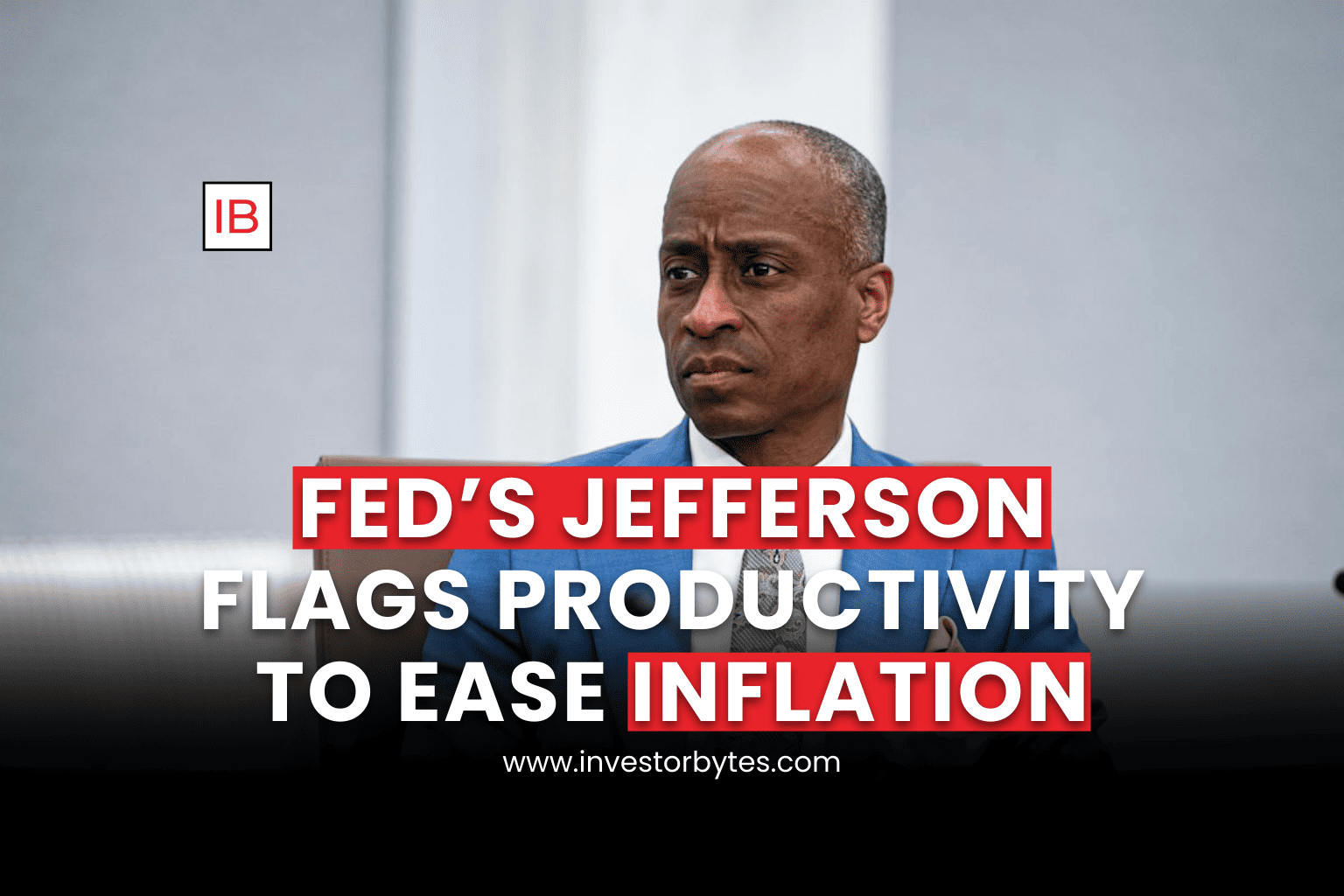
In a significant address at the Brookings Institution on February 6, 2026, Federal Reserve Vice Chair Philip Jefferson outlined a “cautiously optimistic” vision for the U.S. economy, specifically highlighting the role of supply-side productivity as a primary driver of future disinflation.
Jefferson’s remarks underscored a belief that the “stalling” of disinflation in late 2025 was a transitory byproduct of tariffs, rather than a failure of monetary policy. He argued that as these one-time price adjustments pass through, the underlying economy remains healthy and poised for a return to the Fed’s 2% objective.
The Productivity Advantage: AI and Efficiency
A central theme of Jefferson’s speech was the acceleration of productivity, fueled largely by the AI-driven business boom.
Historical Comparison: He noted that business-sector productivity has risen at an average annual rate of 2.2% since 2020, significantly outpacing the 1.5% average of the previous business cycle.
Inflation Anchor: Jefferson argued that strong productivity growth allows for strong real wage gains without exerting upward pressure on prices, effectively expanding the “speed limit” of the U.S. economy.
Impact of Tariffs: While acknowledging that inflation (core PCE) ended 2025 near 3%, he attributed this “stickiness” to tariffs on imported goods. He expects this pressure to fade throughout 2026, allowing the disinflationary process to resume.
Monetary Policy: The “Neutral” Range
Following three interest-rate cuts in late 2025, Jefferson suggested that the Fed has reached a critical junction in its rate-cutting cycle.
| Metric | Current Status (Feb 2026) | Fed Outlook / Action |
| Fed Funds Rate | Broadly in the “Neutral Range” | Policy is “well-positioned” for two-sided risks. |
| GDP Growth | 2.2% (Projected for 2026) | Growth remains resilient and “above trend.” |
| Unemployment | 4.4% | Market is in a “curious balance” of low-hiring, low-firing. |
| Inflation (PCE) | 2.9% – 3.0% (Estimated) | Committed to the 2% target via steady adjustments. |
The Labor Market: A “Curious Balance”
Jefferson described the current employment landscape as a “low-hire, low-fire” environment, which he views as a stabilizing force.
Gradual Cooling: The labor market is no longer “overheated,” but it remains robust enough to support consumer spending.
Downside Risks: While downside risks to employment remain, Jefferson expects the unemployment rate to hold relatively steady at 4.4% throughout the year.
Data-Dependent Path: He emphasized that the “extent and timing” of any future rate cuts will depend entirely on incoming data, signaling a “proceed slowly” approach as rates approach their long-term neutral level.
“Projected strong productivity growth may be a source of further help in bringing inflation down to our 2% target… I see signs that the job market is stabilizing and that sustainable economic growth will continue.” — Philip Jefferson, Feb 6, 2026