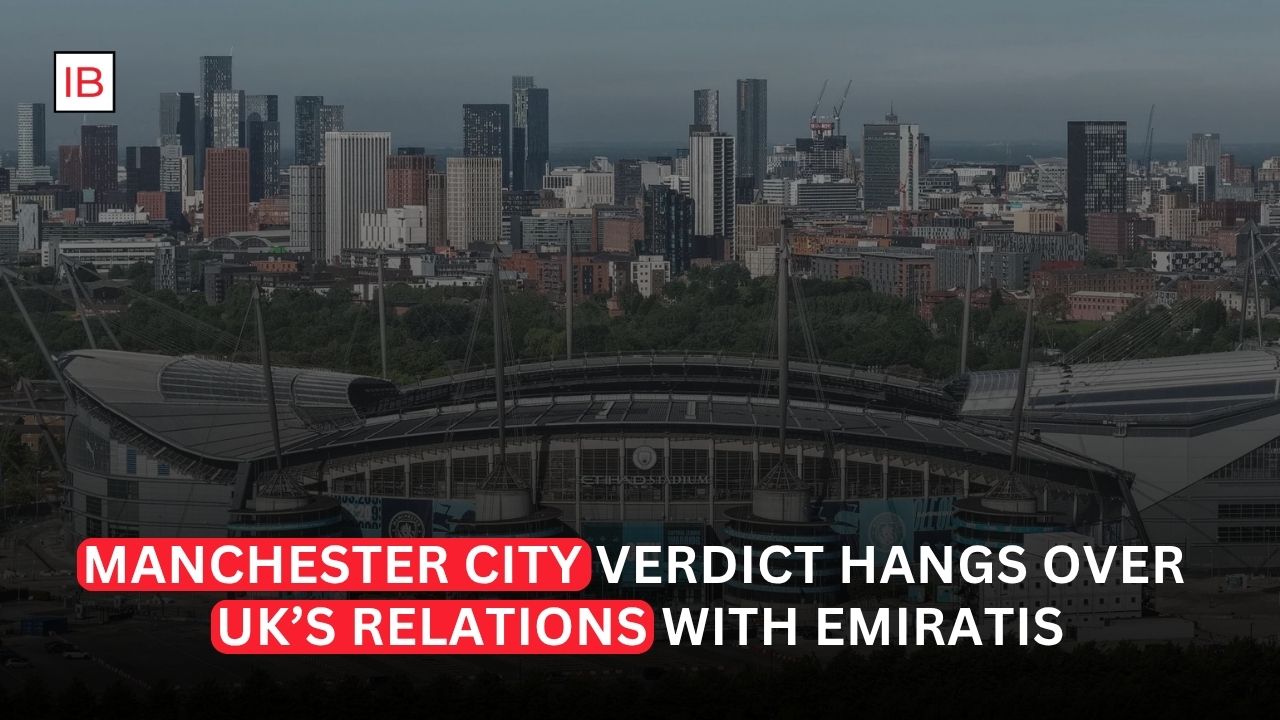
The long-running financial case involving Manchester City is no longer simply a football story. With a verdict still pending over allegations that the club breached Premier League financial rules, the case has acquired a wider political and diplomatic dimension because of the club’s ownership links to Abu Dhabi.
Manchester City has consistently denied wrongdoing, while the Premier League’s independent process remains confidential. Premier League chief executive Richard Masters said this week that the delay has lasted longer than expected but that the process must be allowed to continue.
That creates an awkward situation for the UK.
The country wants to maintain strong relations with the United Arab Emirates, an important investor, trading partner and Gulf ally. At the same time, the Premier League needs to demonstrate that its financial rules apply equally to powerful clubs regardless of who owns them.
The eventual verdict could therefore carry consequences well beyond the football pitch.
The Case Has Been Hanging Over Manchester City for Years
The Premier League charged Manchester City in February 2023 following a lengthy investigation into the club’s finances.
The original case involved 115 alleged breaches covering several seasons. Reports have subsequently described additional allegations, taking the total number of alleged breaches even higher.
The accusations concern areas including financial reporting, sponsorship revenues, player and manager payments and cooperation with the Premier League’s investigation.
City has rejected the allegations.
An independent commission held a lengthy hearing between September and December 2024, but almost two years later, there is still no public verdict. The delay has increasingly become a story in itself.
Why Abu Dhabi Makes the Case Politically Sensitive
The unusual part of Manchester City’s situation is the connection between the football club and Abu Dhabi.
The club has been majority owned since 2008 by an entity associated with Sheikh Mansour bin Zayed Al Nahyan, a member of the UAE’s ruling family.
Manchester City’s transformation since the takeover has been extraordinary.
The club moved from being a major English team without consistent dominance to becoming one of the most successful clubs in modern European football.
That success required enormous investment.
The financial case is therefore closely connected to questions about how that investment was structured and whether Manchester City complied with football’s financial regulations.
The UK Has Much More at Stake Than Football
The UAE is an important economic partner for Britain.
The two countries have developed extensive relationships involving:
- Investment
- Financial services
- Energy
- Infrastructure
- Technology
- Defense
- Real estate
- Trade
British governments have actively sought Gulf investment.
That creates an obvious sensitivity around any dispute involving one of the UAE’s most prominent global assets.
Manchester City is not owned directly by the UAE government in the simple sense of a state department owning a football team. But its Abu Dhabi ownership gives the case a geopolitical dimension that an ordinary Premier League disciplinary dispute would not have.
The Government’s Position Is Different From the Premier League’s
This distinction is crucial.
The Premier League’s job is to enforce its rules.
The British government’s job is to manage Britain’s broader national interests and foreign relationships.
Those responsibilities can sometimes pull in different directions.
If an independent commission finds Manchester City guilty of serious financial violations, the Premier League may need to impose meaningful sanctions to protect the credibility of its competition.
But a severe punishment could create political sensitivity with Abu Dhabi.
That does not mean the British government would or should interfere.
It means the government has an interest in how the wider relationship develops.
The Case Has Already Had a Diplomatic Dimension
The sensitivity is not entirely theoretical.
Earlier reporting has indicated that UK officials discussed the Manchester City charges in the context of Britain’s relationship with the UAE. The British government has previously resisted releasing certain correspondence, citing concerns about the potential impact on bilateral relations.
That demonstrates why the verdict is being watched outside football.
The key question is not whether British ministers decide Manchester City’s guilt.
They should not.
The question is whether the eventual outcome creates political consequences regardless of who delivers the verdict.
A Guilty Verdict Would Create a Difficult Situation
If Manchester City were found guilty of significant breaches, the Premier League would face pressure to impose a serious punishment.
Possible consequences could include financial penalties, sporting sanctions or other measures depending on the commission’s findings and the applicable rules.
The problem for City would not simply be losing points or money.
A serious ruling could challenge the legitimacy of some of the financial foundations behind the club’s transformation.
It could also generate years of appeals and further legal disputes.
But an Acquittal Would Not End the Debate
There is another possibility.
Manchester City could ultimately be cleared of the major allegations.
That would allow the club to argue that its critics had overstated the case.
But even then, the long-running controversy would not disappear automatically.
The case has already generated enormous public debate about financial regulation, state-linked ownership and the ability of football authorities to police the richest clubs.
The verdict would settle legal questions.
It would not necessarily settle the political or reputational ones.
The Premier League Has a Credibility Problem to Solve
The extraordinary length of the case is itself damaging.
Richard Masters has acknowledged that the process has taken longer than expected while insisting that confidentiality and due process must be respected.
There is a legitimate argument for patience.
Complex financial cases involving thousands of documents cannot be rushed simply because supporters want an answer.
But there is also a legitimate argument that regulators lose authority when major cases remain unresolved for years.
Football clubs need to know what the rules mean.
Fans need to believe that rules are enforced.
Investors and sponsors need predictable governance.
The longer the case remains unresolved, the harder that becomes.
Manchester City Is Not the Same Club It Was When the Charges Were Filed
Another complication is that football has moved on.
When the Premier League announced the charges in 2023, Pep Guardiola was still Manchester City’s manager and the club was at the height of its dominance.
Since then, the club has entered a new era.
Guardiola has left after a decade in charge, and former Chelsea manager Enzo Maresca has taken over.
That means the eventual punishment, if there is one, could affect a club very different from the one that originally faced the allegations.
Players have changed.
Managers have changed.
Competitive conditions have changed.
But the historical financial questions remain.
The Case Is Also About the Future of Football Regulation
The Manchester City dispute comes at a time when football’s financial rules are changing.
From the 2026/27 season, the Premier League has moved from its previous Profit and Sustainability Rules toward a Squad Cost Ratio system.
The new framework limits football-related spending as a percentage of revenue, with the Premier League setting its limit at 85%, compared with UEFA’s 70% threshold.
That shift shows that the league is trying to develop a more straightforward framework for controlling spending.
But the City case concerns alleged conduct under the previous system.
That creates a difficult question:
Can the Premier League credibly enforce new financial rules while still leaving its biggest historical case unresolved?
The UAE Has Become Too Important for Britain to Ignore
The broader relationship makes the situation even more complicated.
The UAE is one of Britain’s important sources of international investment.
Abu Dhabi-linked capital has interests across global markets and major UK assets.
Britain has also sought closer cooperation with Gulf states on investment, energy and security.
The UAE is therefore not simply a foreign government connected to a football owner.
It is an important economic and strategic partner.
That raises the diplomatic stakes surrounding any dispute involving Abu Dhabi-linked interests.
Manchester City Has Become Part of Abu Dhabi’s Global Image
There is also a softer-power dimension.
Manchester City has become one of the most recognizable sporting brands in the world.
Its success has given Abu Dhabi enormous international visibility.
The club has won multiple Premier League titles and the Champions League, transforming its global reputation.
That makes any regulatory action against the club more politically sensitive than an ordinary fine against a smaller football team.
The club’s success is itself an important part of its owner’s international profile.
The Sportswashing Debate Will Return
Any serious verdict could revive the debate over so-called sportswashing — the use of major sporting investments to improve or reshape perceptions of a country or government.
Critics have argued that Gulf ownership of major European sports properties can provide soft power and reputational benefits.
Supporters of such investment argue that ownership, investment and sporting success should not automatically be treated as evidence of political wrongdoing.
The Manchester City case does not resolve that debate.
But a major ruling could intensify it.
Britain Faces a Delicate Balancing Act
The UK therefore faces two competing priorities.
Protect football regulation
The Premier League must be able to investigate powerful clubs and enforce financial rules.
Protect strategic relationships
Britain also wants to maintain close ties with the UAE and continue attracting investment.
These priorities do not necessarily conflict.
The cleanest solution is for the independent football process to operate without political interference.
If the evidence supports a finding, the Premier League should act.
If it does not, City should be cleared.
The difficulty is that whatever the outcome, the diplomatic consequences may remain.
The Biggest Risk Is the Appearance of Interference
Perhaps the most important issue for Britain is perception.
If Manchester City receives special treatment because of its ownership, confidence in football regulation would suffer.
If British officials were seen to pressure regulators because of concerns about UAE relations, the damage could extend beyond football.
On the other hand, if Britain were seen as deliberately targeting an Abu Dhabi-owned club because of political disagreements with the UAE, that could damage diplomatic relations.
That is why institutional independence matters.
The strongest protection for both sides is a transparent and credible legal process.
Abu Dhabi Also Has Reasons to Keep Relations Stable
The relationship is not one-sided.
The UAE has strong economic interests in Britain.
British financial expertise, universities, technology companies and investment opportunities remain valuable to Emirati capital.
That gives Abu Dhabi incentives to prevent a football dispute from becoming a broader diplomatic confrontation.
The UAE can separate the legal process from the wider relationship — provided it believes the process is fair.
The Verdict Could Arrive Into a Changed Political Environment
The longer the case continues, the more its eventual timing matters.
A ruling could arrive during a period when Britain is actively negotiating investment and strategic partnerships with Gulf states.
That could increase the sensitivity.
But delaying a verdict indefinitely would create its own problem.
Regulators cannot postpone difficult decisions simply because the political timing is inconvenient.
The credibility of the system ultimately depends on reaching a conclusion based on evidence.
Manchester City Has Already Demonstrated Its Ability to Fight Financial Cases
City has previously challenged UEFA financial sanctions successfully.
In 2020, the Court of Arbitration for Sport overturned a two-season UEFA ban after finding some allegations time-barred or insufficiently proven, while still finding that the club had failed to cooperate fully with the investigation and imposing a €10 million fine.
That history is relevant because any Premier League verdict is unlikely to be the final chapter.
Whatever the independent commission decides, legal challenges could follow.
That means the dispute may continue long after the initial judgment.
The Financial Stakes Could Be Huge
The consequences of the Premier League case could potentially involve much more than a fine.
If serious sporting sanctions were imposed, they could affect:
- League standings
- European qualification
- Club revenues
- Sponsorships
- Player recruitment
- Transfer strategy
- Investor confidence
- Manchester City’s long-term planning
The club’s enormous commercial scale means that even seemingly modest sporting penalties can have large financial consequences.
The Broader Football Industry Is Watching
Other Premier League clubs have a direct interest in the outcome.
If Manchester City is found guilty, rival clubs may argue that past sporting results should be reconsidered.
If the club is cleared, City can argue that years of criticism were unjustified.
Either result could affect how clubs approach financial regulation.
The case therefore has implications for the competitive structure of English football.
Why This Matters to Britain’s Investment Strategy
Britain has spent years trying to attract international capital.
Gulf investors have become increasingly important in that strategy.
But attracting capital also requires strong institutions.
That creates a paradox.
Britain needs to remain open to foreign investment while ensuring that foreign-owned companies and assets remain subject to British rules.
The Manchester City case is a test of that principle.
The message Britain ultimately sends will matter to investors.
If ownership does not exempt an asset from regulation, Britain can demonstrate institutional confidence.
If political relationships appear to influence enforcement, investors may draw a different conclusion.
The Most Important Issue Is Not Manchester City
The deeper issue is whether Britain can separate investment from influence.
Foreign investment can be economically beneficial.
But when a major foreign investor controls a globally important institution, questions about political influence naturally arise.
The answer cannot be to reject foreign investment.
Nor can it be to allow investors special treatment.
The sustainable approach is clear rules applied consistently.
Manchester City’s case provides an unusually visible test of whether that principle works in practice.
What Happens After the Verdict?
The eventual decision will probably trigger another stage rather than end the dispute.
If City is found liable, the club could challenge the findings or sanctions.
If City is cleared, the Premier League and rival clubs may face pressure to explain the outcome.
Either way, the relationship between football regulation and foreign investment will remain under scrutiny.
The case could therefore continue influencing British football and politics for years.
Conclusion
Manchester City’s unresolved financial case has become much larger than a dispute over football accounting.
The club faces allegations of serious breaches of Premier League financial regulations, which it denies. The independent process has already taken far longer than expected, with the Premier League acknowledging the frustration surrounding the delay.
But because Manchester City is closely associated with Abu Dhabi ownership, the eventual verdict could have consequences for Britain’s relationship with the UAE.
A guilty verdict could force the Premier League to demonstrate that even the most powerful clubs are subject to its rules.
An acquittal could strengthen City’s position but would not erase years of controversy.
The UK government’s biggest challenge is to avoid allowing diplomatic considerations to undermine the independence of the football process.
At the same time, Britain has a strong incentive to protect its relationship with the UAE, given the country’s importance as an investor and strategic partner.
That is why the eventual Manchester City verdict will be watched not only by football fans, but also by investors, diplomats and policymakers.
The real test is whether Britain can remain open to powerful foreign investment while proving that money and political connections do not place anyone above the rules.
And that is a much bigger question than what happens to Manchester City’s points, trophies or balance sheet.