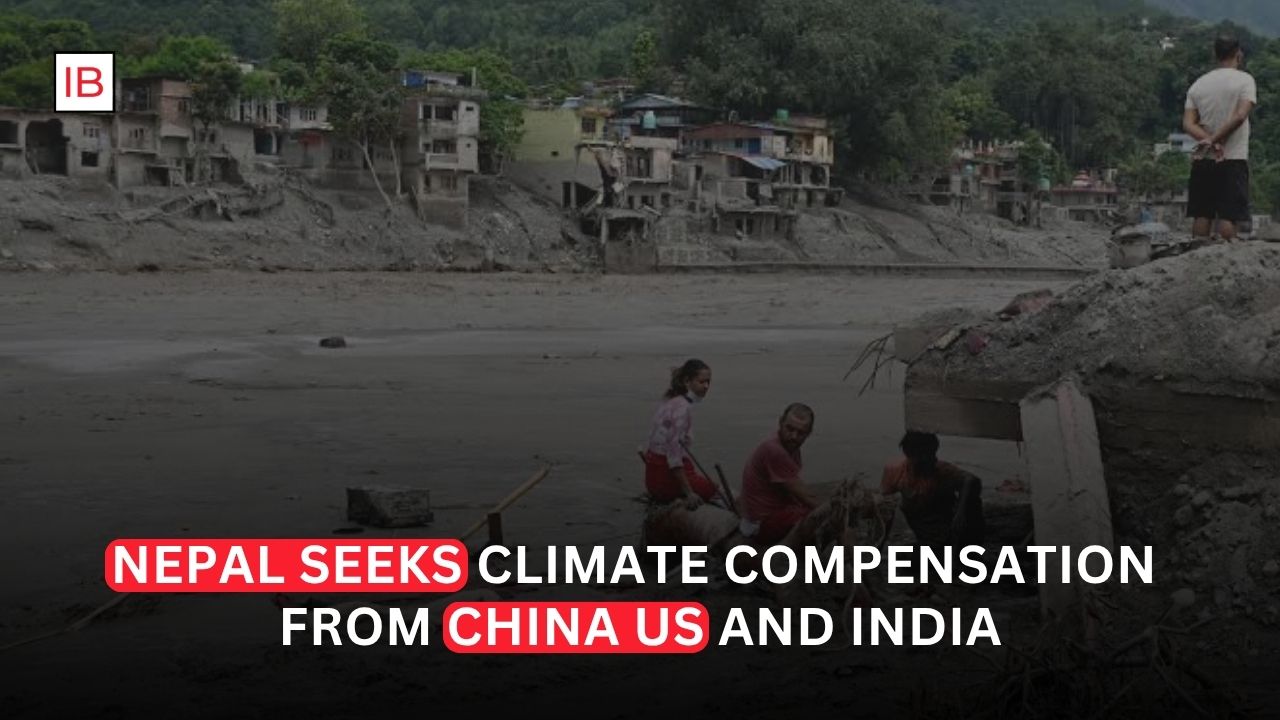
Nepal is seeking climate compensation from China, the United States and India after a catastrophic Himalayan disaster killed more than 1,000 people and left thousands missing. The demand marks a significant shift in Nepal’s approach to international climate finance, with the government arguing that countries responsible for a large share of global greenhouse-gas emissions should help pay for losses suffered by nations that contribute very little to global warming.
Nepal’s Foreign Minister Shisir Khanal has argued that assistance following the disaster should be treated as a matter of climate justice rather than traditional humanitarian charity. He said Nepal contributes less than 0.1% of global greenhouse-gas emissions but is facing increasingly severe consequences from climate change, including glacier retreat, extreme rainfall, floods and other mountain disasters.
The immediate trigger for the demand was a devastating flood in the Himalayan region after a glacier and rock collapse generated a massive surge of water, mud and debris. The disaster destroyed homes, roads and bridges, disrupted communities and damaged critical infrastructure. Rescue operations have been complicated by difficult terrain, unstable slopes and continuing risks in mountain valleys. Reuters reported that Nepal’s death toll had reached at least 1,114, with nearly 4,000 people still missing as of Sept. 2.
The economic damage is also substantial. Nepal’s hydropower sector has suffered major losses, with around 431 megawatts of generating capacity affected, representing roughly 10% of the country’s electricity-generation capacity. The disruption has forced Nepal, normally an electricity exporter, to halt some exports and increase reliance on imports from India. The disaster could therefore have consequences well beyond immediate humanitarian needs, affecting investment, electricity revenues and economic growth.
Nepal’s argument reflects a broader debate over the principle of loss and damage. Developing countries have long argued that wealthy and highly industrialized economies accumulated much of their wealth through fossil-fuel use while poorer countries now face disproportionate climate risks. Nepal is using the latest catastrophe to push that argument directly toward some of the world’s largest current greenhouse-gas emitters.
China, the United States and India are among the countries Nepal has identified because of their large emissions and economic influence. However, securing direct compensation from individual countries would be politically and legally difficult. Climate negotiations have generally focused on multilateral financing mechanisms rather than assigning specific disaster costs to particular nations.
Nepal has formally approached the Fund for Responding to Loss and Damage, seeking financial assistance following the floods. The fund was created under the international climate framework to help vulnerable developing countries respond to economic and non-economic losses caused by climate-related disasters.
The scale of the disaster strengthens Nepal’s case for greater international support. UN officials have warned that the Himalayan region faces escalating risks from glacial floods as rising temperatures accelerate glacier melting and weaken natural barriers. Scientists have identified dozens of dangerous glacial lakes across Nepal, China and India, while experts warn that the number and severity of hazards could increase as warming continues.
For Nepal, the challenge is not limited to obtaining emergency money. The country also needs long-term investment in early-warning systems, climate-resilient infrastructure, disaster insurance and safer planning for hydropower and settlements. Reuters estimates that reconstruction after the recent disaster could cost between $4 billion and $5 billion, highlighting the enormous financial burden facing a relatively small economy.
The compensation demand could also add pressure to climate diplomacy involving India and China, which share the Himalayan region with Nepal. All three countries face interconnected risks involving glaciers, rivers, hydropower and extreme weather. Greater regional cooperation on monitoring, early warnings and disaster preparedness may become increasingly important.
Nepal’s campaign ultimately highlights a difficult question at the center of global climate politics: who should pay when vulnerable countries suffer catastrophic losses from a warming planet they did little to create? Whether Kathmandu receives direct compensation remains uncertain, but its demand adds urgency to the growing international debate over climate responsibility and loss and damage.