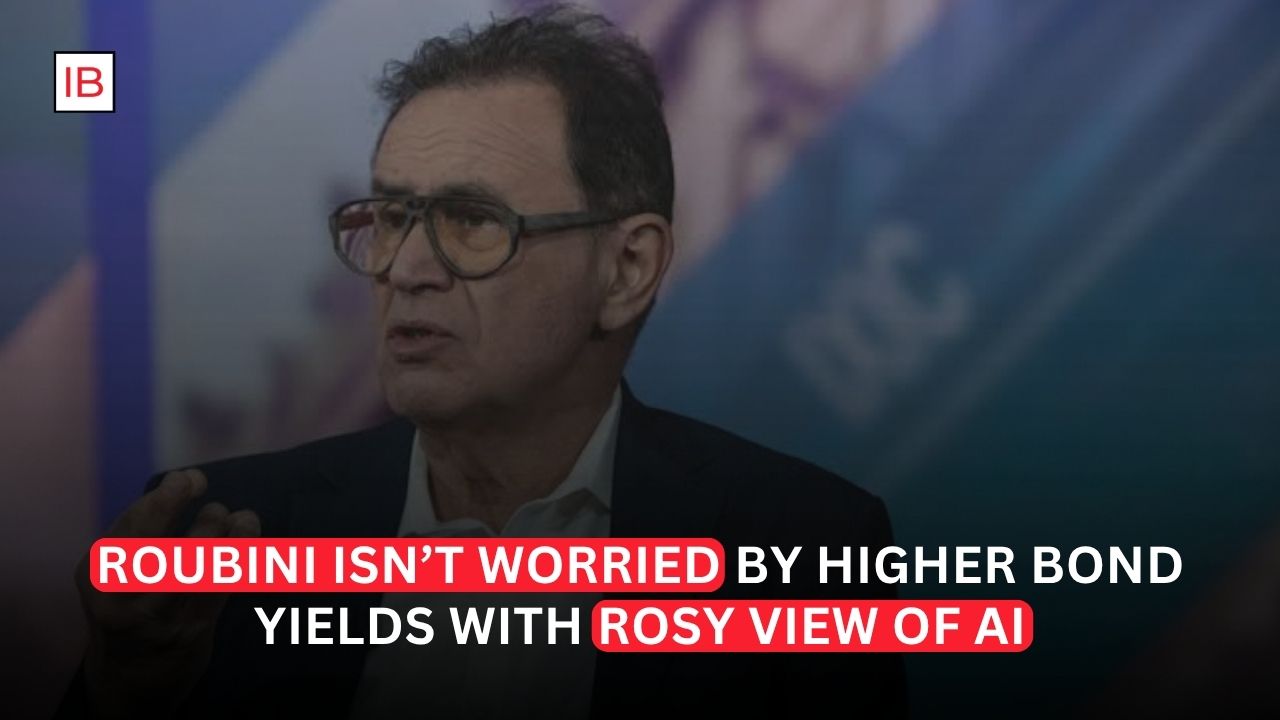
Economist Nouriel Roubini is taking a more optimistic view of the recent surge in global bond yields, arguing that higher borrowing costs do not necessarily signal an approaching economic crisis.
Instead, Roubini believes a significant part of the increase in yields is being driven by stronger investment, rising productivity expectations and the enormous capital requirements of the artificial intelligence boom.
His argument comes as bond markets around the world have experienced a sharp selloff. The US 10 year Treasury yield recently approached 4.8%, while yields have also climbed substantially in Japan, Germany, the UK and France. Investors are increasingly concerned about government borrowing, inflation, energy prices and the growing supply of corporate debt.
AI Investment Is Changing the Bond Market
The AI boom is creating an unusually large demand for capital.
Technology companies and hyperscalers are spending enormous amounts on data centers, computing equipment, semiconductors and electricity infrastructure. Much of that investment is increasingly being financed through debt.
That creates competition for available capital and can naturally push real interest rates higher.
Roubini argues that this distinction matters. If bond yields rise because investors expect stronger economic growth and higher productivity, the consequences can be very different from a yield increase caused by runaway inflation or fears over government debt.
Recent market analysis supports the idea that AI investment is contributing to higher borrowing demand. Large technology companies have become increasingly active in corporate bond markets as they finance their infrastructure expansion.
Higher Yields Do Not Always Mean Bad News
For years, investors have generally treated rising bond yields as a threat to stocks. Higher yields increase the discount rate applied to future corporate earnings, potentially making growth stocks less attractive.
Roubini argues that this relationship is not always negative.
When yields rise because investors expect stronger growth, corporate profits can increase alongside borrowing costs. That can allow equity markets to remain resilient even as government bond yields move higher.
The recent performance of technology shares illustrates the unusual environment. AI related companies have continued attracting investment despite higher long term interest rates, partly because investors expect substantial future productivity gains.
The same dynamic could eventually support broader economic growth if AI improves business efficiency, reduces production costs and increases the economy’s potential output.
The US Has an Advantage
Roubini sees a particularly favorable structural outlook for the United States because of its position at the center of the AI investment cycle.
The US hosts many of the world’s largest technology companies and is attracting massive amounts of capital toward AI infrastructure. If those investments produce meaningful productivity gains, potential economic growth could rise significantly.
Roubini argues that an economy capable of growing faster can carry a larger debt burden more easily because government revenues can expand alongside economic output.
That does not eliminate America’s fiscal challenges. The US federal debt has surpassed $40 trillion, while annual deficits remain extremely large. Interest expenses have also become a major budget burden.
But stronger potential growth could improve the long term fiscal picture compared with economies facing weak demographics and limited productivity growth.
Real Yields Are the Critical Signal
One of the most important elements of the argument is the distinction between nominal yields and real yields.
A rise in nominal yields caused by accelerating inflation would generally be negative for markets. Investors would demand greater compensation for losing purchasing power, while central banks could respond with tighter monetary policy.
A rise in real yields caused by stronger investment demand is different.
In that scenario, businesses are willing to borrow because they see profitable opportunities ahead. Investors demand higher returns because productive assets are becoming more valuable.
Recent analysis of the bond selloff suggests that rising expectations for the economy’s neutral interest rate, known as R star, may also be contributing to higher yields. AI investment and government borrowing are both increasing demand for capital.
Fiscal Risks Have Not Disappeared
Roubini’s optimism does not mean the bond market is free of danger.
Large government deficits remain a major concern, particularly if investors begin to believe that public debt is becoming difficult to stabilize.
Higher energy prices are another risk. The renewed conflict involving Iran has pushed oil and European natural gas prices higher, creating additional inflation pressure and complicating the outlook for central banks.
If inflation expectations become unanchored, higher yields could quickly become a negative signal rather than a reflection of stronger growth.
That distinction will be crucial for investors.
Markets Face a New Economic Regime
The recent bond selloff suggests that markets may be moving away from the ultra low interest rate environment that dominated much of the period following the global financial crisis.
Higher government borrowing, stronger private investment and increased spending on AI infrastructure could keep interest rates structurally higher.
That does not necessarily mean the economy is heading toward recession.
For Roubini, the more important question is why yields are rising. If the increase reflects stronger productivity, higher investment and better long term growth prospects, investors may be able to absorb higher borrowing costs.
The opposite would be true if yields rise because of inflation, fiscal instability or a loss of confidence in government finances.
AI Could Redefine the Growth Story
The AI boom is therefore becoming central not only to technology markets but also to the global interest rate outlook.
Massive spending on data centers and computing infrastructure is increasing demand for capital today. The potential payoff is a more productive economy tomorrow.
That creates an unusual situation in which higher bond yields and strong equity performance can coexist.
Investors will still need to watch inflation, government debt and corporate leverage closely. But if AI delivers the productivity gains that its biggest supporters expect, today’s elevated yields could ultimately be interpreted as a consequence of stronger economic opportunity rather than a warning of financial instability.
The bond market is signaling that capital is becoming more valuable. Roubini’s argument is that this may not be something investors should fear. It could instead be evidence that the next phase of technological investment is reshaping the global economy.