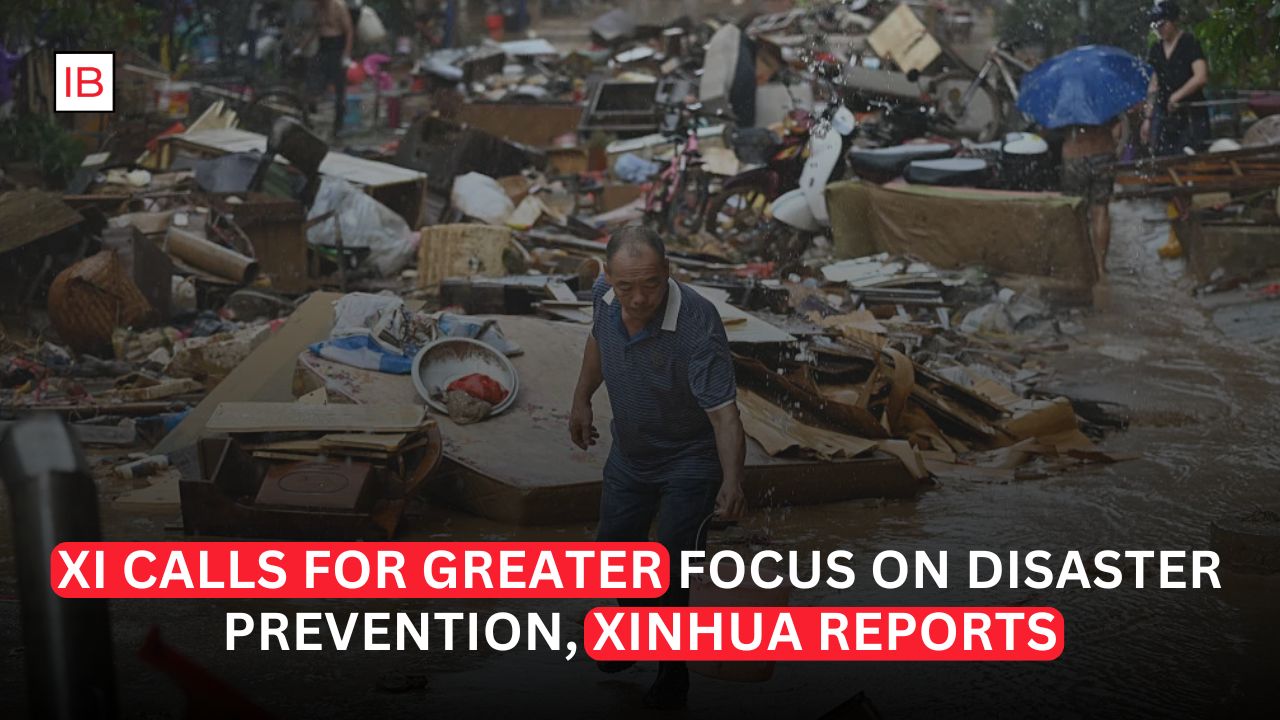
Chinese President Calls for Stronger Early Warning and Risk Control as Extreme Weather Tests Emergency Systems
Chinese President Xi Jinping is urging authorities to place greater emphasis on preventing disasters before they occur, as severe weather and flooding continue to test China’s emergency-response systems across multiple regions.
The call comes amid a period of intense weather activity in China, including heavy rainfall, flooding and the effects of Typhoon Dolphin. Recent disasters have forced evacuations, disrupted transportation and damaged infrastructure, underscoring the importance of early warnings and preparations.
Xi’s message signals a shift toward treating disaster prevention as a central part of national security and public administration rather than relying primarily on rescue and relief efforts after disasters strike.
Prevention Becomes a Central Priority
China has traditionally maintained extensive emergency-response systems designed to mobilize personnel and resources quickly when floods, typhoons, landslides and other disasters occur.
But Xi’s latest emphasis puts greater weight on reducing risks before emergencies develop.
That includes improving monitoring systems, strengthening early warnings and identifying vulnerable areas in advance.
The objective is to give local governments and residents more time to respond when dangerous weather is approaching.
Extreme Weather Is Testing China’s Preparedness
The focus on prevention comes as China faces another challenging summer weather season.
Typhoon Dolphin brought torrential rainfall to eastern and central parts of the country after making landfall in Zhejiang.
More than 1 million people were evacuated ahead of the storm, while authorities in Zhejiang, Shanghai, Fujian and Jiangsu raised emergency responses and established shelters.
The storm later weakened, but its remnants continued producing heavy rain across large parts of China.
Beijing and several provinces experienced severe rainfall, with authorities warning about floods and geological disasters.
Flooding Remains a Major Challenge
Flooding is among China’s most persistent natural-disaster risks.
The country has extensive river systems, large urban populations and major agricultural regions that can be affected by heavy rainfall.
Recent flooding in Henan demonstrates how quickly conditions can deteriorate.
A levee breach along the Beiru River in Jiaxian County required nearly two days of emergency repair work before it was successfully sealed.
Authorities also evacuated hundreds of residents in another part of Henan after a riverbank breach created additional risks.
Early Warning Systems Become More Important
One of the most important elements of Xi’s prevention-focused approach is improving warning systems.
Authorities increasingly rely on weather forecasting, satellite monitoring and digital technologies to identify dangerous conditions.
China has also been using advanced artificial-intelligence weather models to improve forecasts and prepare for extreme rainfall and flooding.
Better forecasting can help officials make decisions before disaster conditions become critical.
That can include closing roads, suspending construction, evacuating residents and moving emergency equipment into vulnerable areas.
Evacuation Can Reduce Losses
Recent typhoon preparations demonstrate the value of preventive evacuation.
Before Typhoon Dolphin reached eastern China, authorities relocated more than 900,000 residents in Wenzhou and established more than 1,000 emergency shelters.
Similar precautionary measures were taken elsewhere.
Although evacuations can disrupt economic activity and impose costs on governments and businesses, they can significantly reduce the risk of casualties when severe weather strikes densely populated areas.
Local Governments Face Greater Pressure
Xi’s approach also places greater responsibility on local governments.
Provincial and municipal authorities are expected to monitor potential hazards, maintain emergency infrastructure and act quickly when warnings are issued.
This can involve inspecting rivers and reservoirs, checking flood defenses and preparing emergency supplies.
Authorities must also ensure that warnings reach residents in time.
The effectiveness of China’s disaster-management system therefore depends not only on national policy but also on how well local governments implement preventive measures.
Infrastructure Is a Critical Part of Prevention
Flood-control infrastructure is particularly important.
Levees, reservoirs, drainage systems and urban flood defenses can determine how severe the consequences of extreme rainfall become.
Recent events have highlighted vulnerabilities in some areas.
The Henan levee breach required extensive emergency work, while heavy rainfall elsewhere has caused flash flooding and landslides.
Strengthening infrastructure before disasters occur could reduce the need for emergency repairs and rescue operations later.
Climate Risks Are Becoming More Complicated
The emphasis on prevention also reflects concerns about increasingly unpredictable weather.
China has experienced a series of severe weather events this year, while scientists and meteorological authorities have linked some of the increasing risks to climate change and changing atmospheric patterns.
Reuters reported that July natural disasters influenced by earlier typhoons caused 318 deaths or disappearances and economic losses of about 57.15 billion yuan, higher than the previous year.
That increases pressure on policymakers to improve resilience.
Economic Costs Are Significant
Natural disasters can impose major costs on the Chinese economy.
Flooding can damage factories, roads, railways, agricultural land and electricity infrastructure.
Business interruptions can spread beyond affected regions because China’s manufacturing and logistics networks are highly interconnected.
A major flood in one province can therefore affect supply chains and production elsewhere.
Preventive investment can reduce these losses.
Although building stronger infrastructure and maintaining emergency systems requires significant spending, the cost may be lower than repeatedly rebuilding damaged facilities.
Agriculture Is Particularly Vulnerable
Heavy rainfall and flooding can also threaten agricultural production.
China remains a major agricultural producer, and extreme weather can destroy crops, damage irrigation systems and disrupt transportation.
Early warnings can give farmers more time to protect equipment, move livestock and harvest crops where possible.
Longer-term measures such as improved drainage, flood-resistant infrastructure and better land management can further reduce agricultural losses.
Urban Areas Face New Risks
China’s rapid urbanization has created additional challenges.
Large cities contain millions of people and extensive infrastructure within relatively small areas.
Heavy rainfall can overwhelm drainage systems and cause rapid flooding.
Beijing experienced widespread disruption during recent heavy rains, with hundreds of bus routes suspended and tourist sites closed.
Urban disaster prevention therefore requires more than emergency rescue.
Cities must invest in drainage, flood-control systems, transportation resilience and emergency communications.
Technology Can Improve Disaster Management
China is increasingly turning to technology to strengthen disaster preparedness.
Artificial intelligence, satellite imagery, weather models, sensors and digital communication networks can help authorities identify risks more quickly.
These technologies can also improve coordination among government agencies.
The goal is to create a system in which information about a potential disaster moves rapidly from forecasting agencies to emergency authorities and eventually to the public.
Emergency Response Remains Essential
A prevention-first strategy does not mean abandoning rescue and relief operations.
Major disasters can still occur despite preparation.
China therefore continues to maintain large emergency-response capabilities, including rescue personnel, medical teams and disaster-relief resources.
The recent Henan flooding, for example, required authorities to deploy rescue forces and coordinate evacuations after river defenses were breached.
Prevention and response must therefore work together.
Government Funding Will Be Important
Building resilience requires sustained investment.
China has already allocated emergency disaster-relief funding during the latest severe weather events, while central and local authorities have mobilized resources for affected regions.
The longer-term challenge will be ensuring that enough funding is directed toward prevention rather than simply emergency recovery.
That could mean greater investment in flood defenses, weather monitoring, drainage systems and resilient infrastructure.
Disaster Management Is Becoming a National-Security Issue
Xi’s emphasis also reflects the broader role that disaster management plays in China’s national-security strategy.
Natural disasters can disrupt economic activity, threaten food and energy supplies and damage critical infrastructure.
For a country as large and economically important as China, maintaining resilience against extreme weather is therefore increasingly viewed as part of maintaining overall stability.
Looking Ahead
Xi Jinping’s call for a stronger focus on disaster prevention comes at a critical time for China, as severe rainfall, flooding and typhoon-related disruptions continue to challenge the country’s emergency systems.
The recent impact of Typhoon Dolphin showed the scale of the challenge. More than 1 million people were evacuated before the storm reached eastern China, while heavy rainfall later affected Beijing, Henan, Hubei and other regions.
Xi’s message puts prevention at the center of China’s disaster-management strategy.
That means improving early-warning systems, strengthening flood defenses, inspecting vulnerable infrastructure and making sure local authorities can act before dangerous conditions become emergencies.
The need for such measures is becoming increasingly clear.
A levee breach in Henan recently required nearly two days of repairs, while flooding and mudslides in other regions caused casualties and disruptions.
For China, the economic argument for prevention is also becoming stronger.
Extreme weather can damage factories, agriculture, transportation networks and urban infrastructure, creating billions of yuan in losses.
Investing in resilience before disasters occur could therefore reduce both human and economic costs.
Technology is likely to play a growing role.
AI-powered weather forecasting, satellite monitoring and digital warning systems could help authorities identify risks earlier and coordinate evacuations more effectively.
But technology alone will not solve the problem.
China will also need stronger infrastructure, better local preparedness and sustained funding for disaster prevention.
The broader challenge is adapting to a world in which extreme weather can produce increasingly complex risks for densely populated cities and highly interconnected economies.
For Xi’s government, preventing disasters before they happen could become as important as responding to them afterward.
The latest directive therefore represents more than a response to the current flood season. It points toward a broader effort to build a more resilient China, where early warnings, stronger infrastructure and coordinated preparation reduce the human and economic consequences of natural disasters.