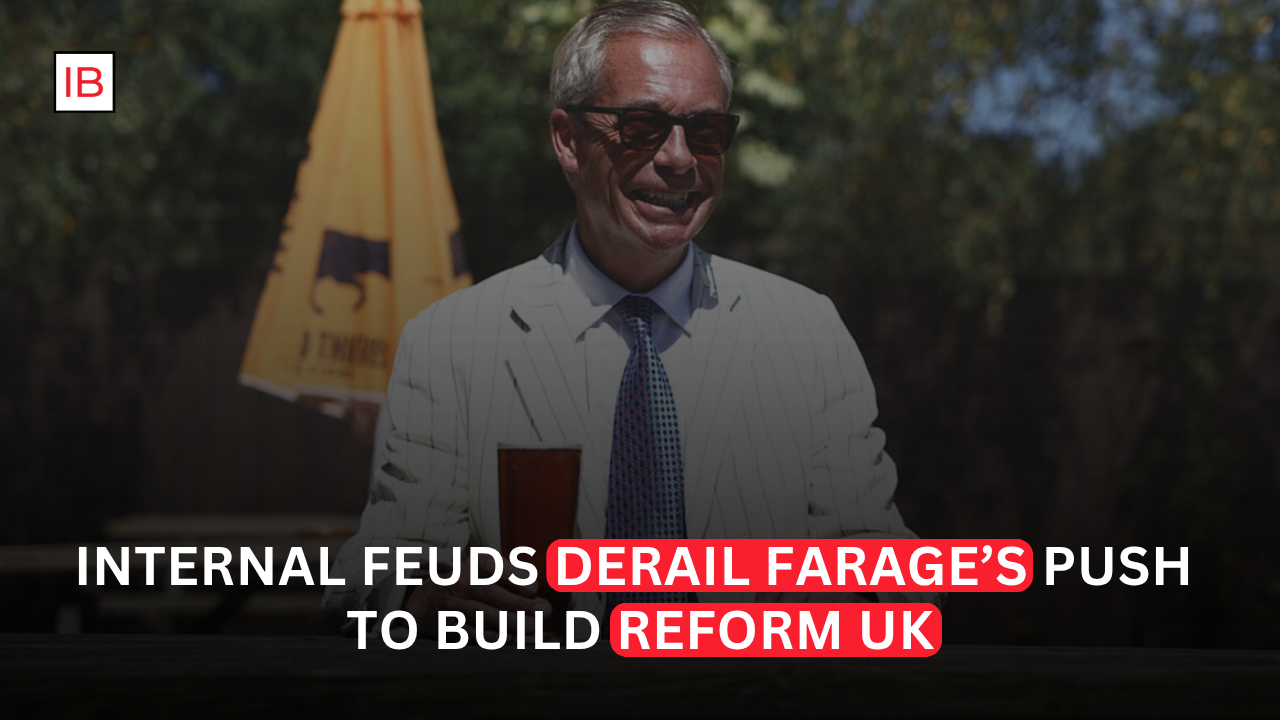
Nigel Farage has spent years building Reform UK around a straightforward political proposition: Britain’s political establishment is failing, and his party can replace it.
But turning a protest movement into a government-ready political machine is much harder than winning elections or dominating headlines.
That is the problem Reform UK now faces.
The party has gained significant political momentum, but internal disputes, clashes between senior figures, questions surrounding Farage’s finances and disagreements over strategy are distracting attention from the much harder task of preparing a credible alternative government.
Farage recently won the Clacton by-election with 63% of the vote, successfully returning to Parliament after triggering the contest himself. Yet the result did not eliminate the political problems surrounding him. The main Westminster parties did not contest the election, while novelty candidate Count Binface won a surprisingly large share of the vote.
The bigger issue is therefore not whether Farage can win a safe seat.
It is whether he can turn Reform into a disciplined national party capable of winning power and then governing.
From Protest Movement to Governing Party
Reform’s biggest advantage has historically been its ability to channel frustration.
Immigration, dissatisfaction with mainstream parties, living costs and distrust of Westminster have provided fertile ground for Farage’s political message.
That works particularly well for opposition politics.
A protest party does not need to have every policy fully developed.
It needs to identify what voters dislike and offer a clear alternative.
Government is different.
A governing party needs detailed policies, competent ministers, internal discipline, financial credibility and a clear understanding of how its promises would actually be implemented.
That transition appears to be where Reform is struggling.
Farage Remains the Party’s Central Asset
There is no realistic way to discuss Reform UK without discussing Farage.
His political brand is considerably larger than the party itself.
He has spent decades building recognition around Brexit, immigration and opposition to Britain’s political establishment.
That gives Reform something most new parties lack: a nationally recognized leader capable of attracting media attention almost instantly.
His recent Clacton victory reinforced his personal electoral strength.
But it also exposes a potential weakness.
If Reform’s support is heavily dependent on Farage, the party may struggle to demonstrate that it has an institutional identity beyond him.
A political movement built around one personality can grow quickly.
It can also become unstable when senior figures disagree with that personality.
Internal Feuds Are Becoming a Strategic Problem
The latest disputes inside Reform are not simply personality clashes.
They raise questions about how the party would function in government.
Senior activist Tim Montgomerie was suspended after publicly criticizing Farage, including questioning his absence from the Clacton election count and accusing him of dominating the party. Deputy leader Richard Tice defended the suspension, arguing that internal disagreements should be handled privately.
That episode illustrates the tension inside Reform.
The party wants to present itself as a serious alternative government.
At the same time, disagreements among senior figures are increasingly becoming public.
That is dangerous because voters may tolerate internal arguments within established parties.
For a party promising to replace the political establishment, however, chaos can undermine its central selling point.
The Tim Montgomerie Dispute Matters
Montgomerie is not an irrelevant outsider.
His background and links to Britain’s conservative and Christian-right political networks made his involvement part of Reform’s effort to attract voters beyond Farage’s traditional base.
His suspension therefore sends a broader message.
It suggests that Reform has limited tolerance for internal dissent when criticism reaches the leadership.
That may produce short-term discipline.
But there is a trade-off.
A party preparing for government needs people willing to challenge bad ideas before those ideas become government policy.
Silencing internal criticism can create unity on the surface while weakening decision-making underneath.
Zia Yusuf Has Become Another Source of Tension
Home affairs spokesperson Zia Yusuf has also attracted controversy.
His outspoken political messaging has generated disagreements inside and outside Reform, adding to the impression that the party’s communications strategy is not always tightly controlled.
The problem is particularly serious because immigration is one of Reform’s central political issues.
When senior figures make provocative statements, the party risks allowing individual personalities to define its message rather than the leadership deliberately setting policy.
For a protest movement, controversy can generate attention.
For a government-in-waiting, it can create unnecessary liabilities.
Reform’s Biggest Challenge Is Credibility
The central question is no longer whether Reform can attract angry voters.
It clearly can.
The question is whether voters who want change believe Reform can actually run the country.
That requires more than slogans.
A serious governing party needs answers on:
- Taxation
- Healthcare
- Education
- Defense
- Infrastructure
- Energy
- Welfare
- Immigration
- Public-sector reform
- Economic growth
- Foreign policy
Reform has increasingly been producing policies in these areas.
But the party still faces skepticism about whether some of its proposed savings and spending plans are realistic.
The Welfare Plan Shows the Difficulty
Reform recently proposed cutting around £50 billion from Britain’s welfare bill, including restrictions on benefits for foreign nationals and major changes to disability support.
The scale of the proposal demonstrates the party’s willingness to make radical changes.
But it also raises the obvious question:
Can the savings actually be achieved?
Large spending reductions require detailed administrative plans.
They can create legal challenges.
They can generate political resistance.
And they can produce unintended consequences.
A party that wants to govern must explain not only what it wants to cut but how the system would work afterward.
The Education Strategy Has Similar Problems
Reform has also attacked university courses it considers economically unproductive while promoting apprenticeships and vocational education.
The party has proposed financial incentives for businesses to take on young workers, funded partly through changes to education support.
There is a legitimate argument for expanding vocational education.
Britain does have longstanding debates about university costs, skills shortages and graduate employment.
But dismissing broad categories of university study is not the same thing as building a coherent education strategy.
A government needs to answer questions about research funding, universities’ financial stability, workforce skills and Britain’s international competitiveness.
The rhetoric is easier than the policy implementation.
The Conservatives Are Watching Closely
Reform’s internal problems are especially important because the Conservative Party still exists as a competing force on the right.
For much of the recent political cycle, Conservatives feared Reform would permanently replace them.
Now some Conservative politicians see Reform’s internal disputes as evidence that its rise may not be unstoppable.
Recent reporting suggests Conservative morale has improved as Reform’s momentum has weakened and its internal disagreements have become more visible.
That creates a dangerous situation for Farage.
He needs to take votes from the Conservatives while also preventing the Conservatives from recovering enough support to challenge him.
If Reform looks chaotic while the Conservatives rebuild their organization, some voters may return to the traditional right.
Reform Also Faces Competition From the Right
The party is not operating in an empty political space.
Restore Britain, associated with Rupert Lowe, is attempting to compete for voters further to the right.
That creates another strategic complication.
Farage wants Reform to become the dominant force on Britain’s right.
But the more Reform moves toward hardline positions, the more space it can potentially create for competitors.
If it moderates, it risks losing some of its existing supporters.
If it becomes more radical, it risks limiting its appeal to centrist or traditional Conservative voters.
That is a difficult electoral balance.
Andy Burnham Changes the Calculation
Reform’s strategy is also being affected by Labour’s new leadership under Andy Burnham.
Farage’s political model has traditionally benefited from dissatisfaction with mainstream parties.
If Labour becomes more electorally competitive among working-class and economically frustrated voters, Reform’s path becomes harder.
The party cannot assume that anti-establishment voters will automatically choose Reform.
Voters can change their minds.
If Labour improves its economic message or rebuilds support among former Conservative voters, Reform’s electoral ceiling could become lower than its current expectations.
Farage’s Clacton Victory Was Not the End of His Problems
The Clacton result gave Farage a parliamentary victory.
But it did not resolve the controversies that contributed to his decision to trigger the election.
A standards investigation concerning his financial affairs was reopened around the time of the by-election. Farage has faced scrutiny over a £5 million gift from crypto entrepreneur Christopher Harborne.
The political significance goes beyond the investigation itself.
Reform has built much of its identity around attacking established political elites and presenting itself as cleaner and more authentic than traditional parties.
That makes financial controversies particularly damaging.
The party’s supporters may remain loyal.
But undecided voters may judge Reform by a higher standard precisely because it claims to represent political change.
The Party Needs Institutions, Not Just Personalities
Farage’s political strength is obvious.
But governing Britain requires an enormous institutional structure.
A government needs:
- Ministers
- Civil servants
- Policy teams
- Legal advisers
- Treasury expertise
- Foreign-policy specialists
- Local government coordination
- Parliamentary organization
- Communications teams
Reform must therefore build a machine capable of functioning without Farage personally managing every major political dispute.
That is much harder than running an election campaign.
The Shadow Cabinet Is a Test
Reform has begun assembling a team of prominent figures, including former Conservative politicians such as Suella Braverman and Robert Jenrick.
This is an attempt to demonstrate that the party has people capable of holding government portfolios.
But bringing experienced politicians into Reform creates another problem.
They bring their own political identities.
That can produce internal competition.
Farage must balance experienced figures who can make the party look credible against the risk that those figures develop independent power bases.
A successful political leader needs strong ministers.
But a leader who depends too heavily on personal control can create resentment.
That tension is already becoming visible.
The Party’s Biggest Weakness May Be Organization
Winning national elections requires more than national polling.
Parties need local organizations, candidates, volunteers, fundraising networks and constituency infrastructure.
Reform has expanded rapidly.
Rapid growth can produce weak internal systems.
Candidates may have limited political experience.
Local organizations can be inconsistent.
Policy positions may change quickly.
Communications can become decentralized.
These are manageable problems for a young opposition party.
They become much more serious when the party expects to form a government.
Farage’s Central Dilemma
Farage faces a difficult choice.
He can maintain tight personal control over Reform to prevent internal divisions from becoming public.
That may create discipline.
But it can also discourage talented people from challenging him.
Alternatively, he can allow more internal debate.
That could improve policy development and make the party more institutionally mature.
But it could also expose disagreements and weaken the party’s public image.
The answer probably requires controlled disagreement rather than complete conformity.
A governing party needs debate.
It simply needs to keep that debate from becoming destructive public warfare.
Reform Cannot Rely Forever on Anti-Establishment Anger
The party’s political energy has largely come from dissatisfaction.
But anger has a limited shelf life.
At some point voters want to know what happens after the protest succeeds.
If Reform becomes the expected governing party, it will inherit responsibility for the very problems it currently attacks.
That changes the political equation.
It is easy to criticize Britain’s NHS.
It is harder to run it.
It is easy to promise lower taxes.
It is harder to balance the budget.
It is easy to demand lower immigration.
It is harder to design a system that businesses, courts and voters can accept.
This is the transition Reform has not yet fully demonstrated it can make.
The Conservative Split Could Decide the Future
The biggest strategic question on Britain’s right is whether Reform and the Conservatives eventually cooperate or continue competing.
A divided right can allow Labour to win seats even if combined Reform and Conservative support is larger.
That is one reason speculation about electoral pacts remains important.
But neither party has an obvious incentive to surrender territory.
Reform wants to replace the Conservatives.
Conservatives want to survive.
Farage therefore needs to decide whether defeating the Conservatives is still more important than defeating Labour.
That strategic choice could define the next election.
What Reform Needs to Do Next
If Farage genuinely wants to prepare Reform for government, the priorities are relatively clear.
1. Establish policy discipline
Major policy announcements should be fully costed and internally agreed before becoming public.
2. Build a stronger parliamentary team
MPs need clear responsibilities and professional policy support.
3. Reduce personality-driven conflict
Internal disagreements should be handled through functioning party structures.
4. Expand local organization
A national party requires constituency-level strength.
5. Improve financial transparency
Questions around donations and funding must be answered clearly.
6. Demonstrate economic credibility
Tax and spending promises need independent scrutiny and realistic assumptions.
7. Define its relationship with the Conservatives
Constant competition on the right may make it harder to win government.
The Bigger Question Is Whether Reform Can Mature
Reform’s rise has been impressive because it has done something new political parties often struggle to achieve: it has converted widespread dissatisfaction into electoral support.
But that success creates a new test.
Can the party mature without losing the political energy that made it successful?
That is far more difficult than maintaining an outsider identity.
Once a party becomes a serious contender for government, voters begin examining it differently.
They want to know who will run the Treasury.
Who will run the NHS?
Who will negotiate with foreign governments?
Who will manage national security?
Who will deal with a financial crisis?
Who will take responsibility when something goes wrong?
These questions cannot be answered by Farage alone.
Conclusion
Nigel Farage’s biggest problem is no longer getting attention.
It is converting attention into political competence.
Reform UK has established itself as a major force in British politics, and Farage’s recent Clacton victory demonstrates that his personal electoral appeal remains powerful.
But internal disputes are distracting the party at exactly the moment when it needs to demonstrate that it can operate as a government-in-waiting.
The suspension of Tim Montgomerie, controversies involving senior figures such as Zia Yusuf, disputes over policy and continuing scrutiny of Farage’s finances all create the same underlying problem: Reform is still behaving more like a movement fighting for attention than a political organization preparing to run a country.
That does not mean Reform’s political rise is over.
Farage remains one of Britain’s most recognizable political figures, and dissatisfaction with traditional parties provides fertile ground for his movement.
But the party’s next stage will require something different.
It needs organization, discipline, credible economics and a professional policy machine.
Most importantly, it needs to demonstrate that disagreement can occur without turning into factional warfare.
The irony is that Reform’s biggest opportunity and biggest weakness are now the same thing.
Its outsider identity helped it grow.
But if it wants to govern, it cannot remain permanently outside the political system.
Farage must turn Reform from a vehicle for protest into an institution capable of governing.
If he succeeds, the party could become a long-term force in British politics.
If internal feuds continue to dominate the agenda, the Conservatives may get another chance to recover — while Labour benefits from a divided opposition.
The Clacton victory proved that Farage can still win elections.
The harder test is whether he can build a party that is capable of winning — and then governing — Britain.