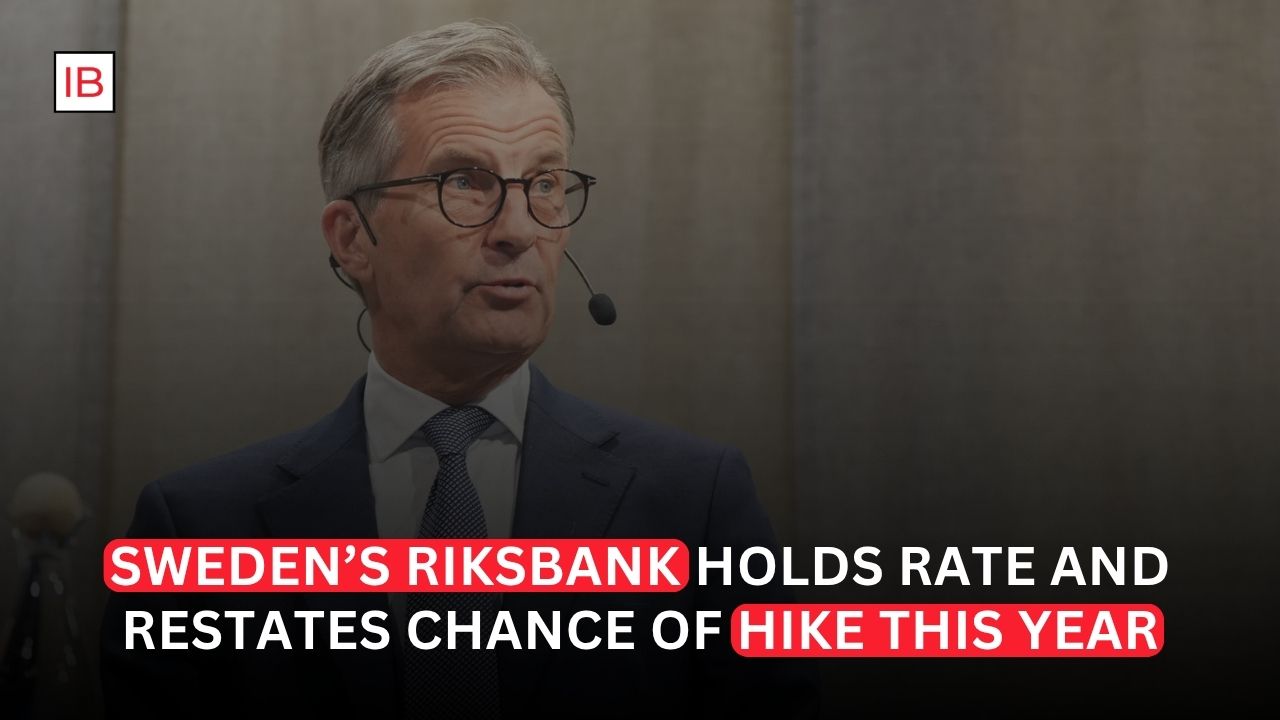
Sweden’s central bank kept its benchmark interest rate unchanged at 1.75% while maintaining the possibility of raising borrowing costs later this year, signaling that policymakers remain concerned about inflation risks despite subdued price pressures.
The Riksbank’s decision was widely expected. The central bank has now kept the policy rate at 1.75% after cutting it from much higher levels during the previous easing cycle. The latest decision leaves Swedish policymakers in a difficult position: economic activity remains relatively weak, but inflation risks have increased because of higher energy costs and global supply disruptions.
The Riksbank’s stance is therefore more complicated than a simple pause.
Policymakers are not signaling that another rate increase is imminent. Instead, they are keeping the option available if inflation begins to rise more persistently. The central bank’s June forecast had already indicated that the probability of a rate increase later in 2026 had risen compared with its earlier assessment.
That message remains important for financial markets because investors had been expecting Swedish borrowing costs to stay relatively low.
The policy rate of 1.75% is well below the levels seen during the global inflation surge. The Riksbank began cutting rates in 2024 as inflation eased and eventually brought the rate down to 1.75% in September 2025. Since then, policymakers have held it steady while monitoring whether inflation and economic growth would justify further moves.
The central bank now faces a different risk.
Energy prices have become a major source of uncertainty as conflict and supply disruptions in the Middle East continue to affect global commodity markets. Higher oil and fuel prices can feed directly into household costs while also increasing expenses for companies.
If those increases remain temporary, the Riksbank can look through them.
If they spread into wages, services and broader consumer prices, policymakers may have to tighten monetary policy.
That distinction is central to the bank’s current strategy.
Swedish inflation remains relatively contained. Consumer prices measured by CPIF were 1.3% higher in July from a year earlier, while headline CPI inflation was only 0.7%. Those figures remain below the Riksbank’s 2% inflation target.
At first glance, that would argue against raising rates.
But central banks do not respond only to current inflation. They also have to consider where prices are heading.
The Riksbank has warned that supply disruptions caused by the Middle East conflict could increase inflationary pressure. In its June assessment, the central bank said underlying inflation was low and economic activity was weaker than normal, but the supply shocks had increased the risk that inflation could become too high.
That explains why policymakers are keeping the possibility of a hike alive even though inflation is currently below target.
Economic growth is another reason for caution.
Sweden’s economy has been recovering, but the recovery remains uneven. The Riksbank previously reduced its 2026 growth forecast to 2.2% from 2.5%, while lowering its 2027 forecast to 2.3% from 2.6%.
A rate increase would make borrowing more expensive for households and businesses and could weaken demand at a time when policymakers are still trying to support economic recovery.
This creates a difficult balancing act.
If the Riksbank raises rates too early, it could unnecessarily weaken an economy that is only gradually recovering. If it waits too long and energy-driven inflation becomes embedded, it may eventually need to raise rates much more aggressively.
For now, policymakers appear to prefer waiting for clearer evidence.
That approach is also consistent with the Riksbank’s previous communication. Governor Erik Thedéen has indicated that inflation was not excessively high and that policymakers had time to assess developments before deciding whether further tightening was necessary. Analysts have consequently viewed the threshold for a 2026 hike as relatively high.
The biggest variable remains the global energy market.
Sweden is particularly sensitive to developments in Europe because energy prices affect both consumers and industrial companies. A prolonged period of elevated oil and gas prices could put upward pressure on inflation across the region.
The Riksbank therefore has to watch developments beyond Sweden’s borders.
The European Central Bank and other central banks are facing similar problems. Policymakers must determine whether energy-driven inflation represents a temporary shock or the beginning of a broader inflation cycle.
The answer will influence currency and bond markets as well.
For the Swedish krona, expectations of higher interest rates could provide support because investors may demand more Swedish assets if the Riksbank becomes more hawkish.
Swedish government bond yields could also rise if markets begin pricing a greater probability of a rate increase.
But the opposite could happen if economic data deteriorates and inflation remains weak.
That is why the Riksbank’s communication is likely to remain closely watched between now and its next meetings.
The central bank’s September meeting will be particularly important because policymakers will have additional data on inflation, employment, household spending and economic activity.
A sustained rise in inflation would strengthen the argument for tightening.
Weak growth combined with low inflation would make a hike much harder to justify.
The labor market is another concern. Sweden continues to experience relatively high unemployment, which limits domestic wage pressure and reduces the need for immediate monetary tightening.
At the same time, stronger household purchasing power could support consumption and eventually increase domestic demand. The Riksbank previously noted that household consumption had continued to increase at a solid pace while purchasing power strengthened.
That means the Swedish economy is not simply weak.
There are signs of recovery, but policymakers remain uncertain about how durable it will be.
The central bank’s rate path also suggests that any tightening would probably be gradual rather than aggressive. Its June forecast showed the policy rate rising only modestly over the following quarters, with the projected rate reaching around 1.82% in the fourth quarter of 2026.
That is consistent with a central bank that wants to retain flexibility rather than commit itself to a tightening cycle.
For investors, the key message is therefore not that a rate hike is coming.
It is that the Riksbank is no longer comfortable assuming rates can remain unchanged indefinitely.
The inflation outlook has become more uncertain, particularly because of energy prices and geopolitical risks.
If the Middle East conflict continues to disrupt energy supplies, the inflation outlook could deteriorate quickly. A temporary rise in fuel prices would be easier to ignore, but persistent increases could eventually spread across the economy.
That would force the Riksbank to reconsider its current stance.
For Swedish households, the prospect of higher rates could affect mortgages and consumer borrowing. Sweden has a large household mortgage market, making monetary-policy changes particularly important for household finances and consumption.
For businesses, higher rates would increase financing costs but could also help stabilize prices and the currency if inflation begins accelerating.
The central bank therefore has to balance competing interests.
For now, the decision to hold at 1.75% reflects the fact that inflation remains low and economic activity is not strong enough to justify immediate tightening.
But the continued warning about a possible hike shows that the Riksbank is preparing for a different scenario.
If inflation pressures intensify, policymakers are willing to act.
The most important question for markets is whether that scenario actually develops.
If energy prices stabilize and inflation remains close to or below the target, Sweden could keep rates unchanged for longer.
If higher energy costs begin feeding into broader prices, however, the Riksbank could become one of the more hawkish central banks in the region.
For now, Sweden’s monetary policy remains on hold, but the direction is no longer completely one-way.
The Riksbank has made clear that 1.75% is not necessarily the final destination for 2026.