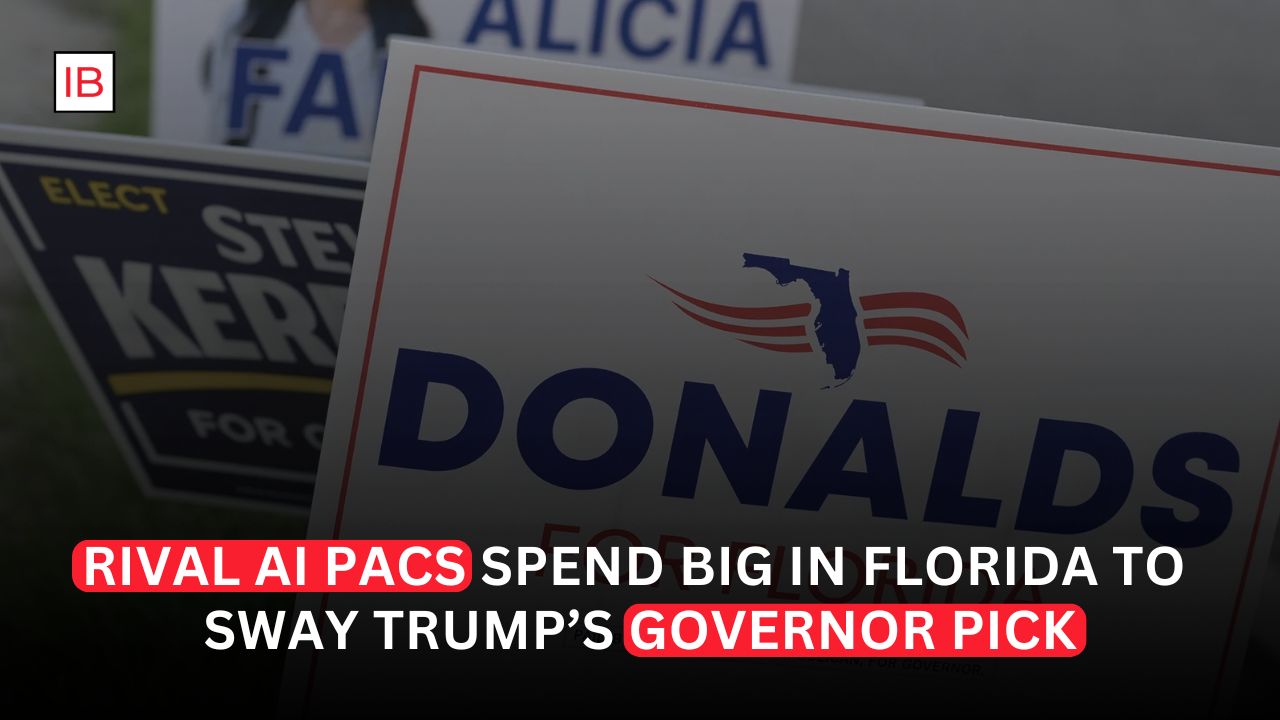
Artificial intelligence is becoming a surprisingly important force in Florida’s 2026 governor’s race, with rival political action committees backed by competing interests in the AI industry spending heavily to influence who emerges from the Republican primary.
The fight reflects a much broader political battle over how rapidly AI infrastructure should expand, how much regulation companies should face and who should control the economic benefits of the technology.
Florida is particularly important because the state’s next governor will have significant influence over permitting, electricity, land use and data-center development. The Republican primary is scheduled for Aug. 18, 2026, with Rep. Byron Donalds widely viewed as the frontrunner.
AI Money Is Entering State Politics
Artificial intelligence has rapidly become a new political battleground.
Super PACs representing competing sides of the AI debate are spending money on state races, seeking candidates who will either accelerate AI development or impose stronger restrictions on the industry.
Florida is one of the most consequential battlegrounds because it combines rapid population growth, large electricity demand and ambitious plans for technology infrastructure.
The state’s next governor could therefore have a meaningful say over whether massive data centers receive faster approvals or face additional scrutiny.
Byron Donalds Is the Central Figure
Republican Rep. Byron Donalds entered the race with President Donald Trump’s endorsement, giving him a substantial advantage over his primary opponents.
Recent polling has shown Donalds far ahead of the Republican field. A July poll from the James Madison Institute put him at 49% among Republican primary voters, compared with 18% for Lt. Gov. Jay Collins, 8% for former House Speaker Paul Renner and 4% for businessman James Fishback.
That lead makes Donalds an obvious target for groups trying to shape Florida’s future AI policy.
But the race isn’t simply about which candidate wins.
It is increasingly about what kind of AI policy the winner takes into office.
Data Centers Are the Core Issue
The AI industry’s political interest in Florida is closely connected to data centers.
Training and operating advanced AI models requires enormous computing capacity.
That means companies need:
- Data centers
- Electricity
- Water and cooling systems
- Fiber networks
- Land
- Transmission infrastructure
- Faster permitting
Florida has become an attractive market for technology investment, but rapid data-center expansion has also created concerns over energy consumption, environmental impacts and the effect of large industrial projects on local communities.
Candidates therefore face a difficult political calculation.
Supporting AI infrastructure can attract investment and create jobs.
But moving too aggressively can generate opposition from voters concerned about electricity costs, development and environmental pressure.
The Political Divide Is Becoming Clearer
AI policy is no longer a niche technology issue.
Candidates around the country are increasingly taking positions on artificial intelligence as voters become more concerned about automation, employment and the effects of AI infrastructure.
In Florida, that debate is particularly sharp because AI infrastructure has become intertwined with the state’s economic-development strategy.
One side argues that Florida should compete aggressively for data centers and AI investment.
The other side wants greater scrutiny to ensure communities aren’t forced to absorb the costs.
That creates a natural opening for competing AI-backed political groups.
Why Trump Matters
Trump’s endorsement of Donalds has effectively made the Republican primary a test of Trump’s influence over Florida politics.
Donalds is already campaigning as a strong ally of the president, while other Republicans are trying to establish their own identities.
That matters to AI companies because the federal government under Trump has also placed substantial emphasis on maintaining US leadership in artificial intelligence.
A governor who aligns closely with that agenda could make Florida an even more attractive destination for AI infrastructure.
But Trump’s influence does not automatically settle the policy debate.
Florida voters still care about electricity bills, insurance costs, housing and the broader cost of living.
AI investment has to compete with those issues for political attention.
AI Spending Is About More Than Campaign Ads
The industry’s political spending should not be viewed simply as an attempt to elect a particular candidate.
There is a much larger economic interest involved.
The winner of Florida’s governor’s race could influence:
Permitting: How quickly data-center projects receive approval.
Energy: How new electricity demand is handled.
Infrastructure: Whether taxpayers or private companies bear the cost of expansion.
Regulation: How AI companies are supervised at the state level.
Economic development: Whether Florida prioritizes technology investment over competing uses of land and energy.
These decisions can affect billions of dollars in future investment.
The Economics Are Complicated
AI infrastructure can create substantial economic benefits.
Data centers require construction workers, engineers, electricians and other specialized labor.
They also generate demand for power infrastructure and supporting businesses.
And successful AI companies can bring high-paying jobs and investment into a state.
But the benefits aren’t automatically distributed evenly.
A data center can create enormous economic value while simultaneously increasing electricity demand for nearby households and businesses.
That is why the political debate increasingly focuses on who pays for infrastructure and who receives the economic benefits.
Florida Has Already Become a Test Case
The state is effectively becoming a laboratory for the AI infrastructure debate.
Florida’s Republican candidates are being forced to balance two competing objectives:
Become a national AI hub.
Protect residents from the costs associated with becoming one.
That tension will likely become more important as AI companies require increasingly large amounts of electricity.
The winner may ultimately need to support AI development while demanding that companies contribute more directly to the infrastructure required to support their operations.
Democrats Have a Different Opportunity
The Republican primary is receiving most of the attention, but the general election could produce a different debate.
Former Republican congressman David Jolly is running as a Democrat and is attempting to rebuild Democratic competitiveness in Florida.
The challenge is significant.
An Associated Press report noted that Donalds has raised more than $100 million, compared with roughly $10 million for Jolly, illustrating the Republican frontrunner’s enormous financial advantage.
Still, AI policy could give Democrats an opening if concerns about energy costs, environmental effects or corporate influence become more prominent among independent voters.
The Bigger Political Question
The Florida race demonstrates how quickly AI has moved from a technology-sector issue into mainstream politics.
The industry is no longer simply lobbying Washington.
It is becoming involved in state elections where governors can directly influence the physical infrastructure required to operate AI systems.
That makes Florida particularly important.
The state’s next governor could help determine whether Florida becomes one of America’s most aggressive AI infrastructure hubs—or whether development proceeds under substantially tighter conditions.
The immediate contest is between Republican candidates, but the larger battle is between competing visions of Florida’s AI economy: one focused on speed and investment, and another focused on regulation, infrastructure costs and the interests of local communities.
And with AI-backed PACs spending heavily to influence the outcome, Florida’s governor’s race is becoming an early test of just how much political power the AI industry is prepared to deploy to shape the rules of its own expansion.