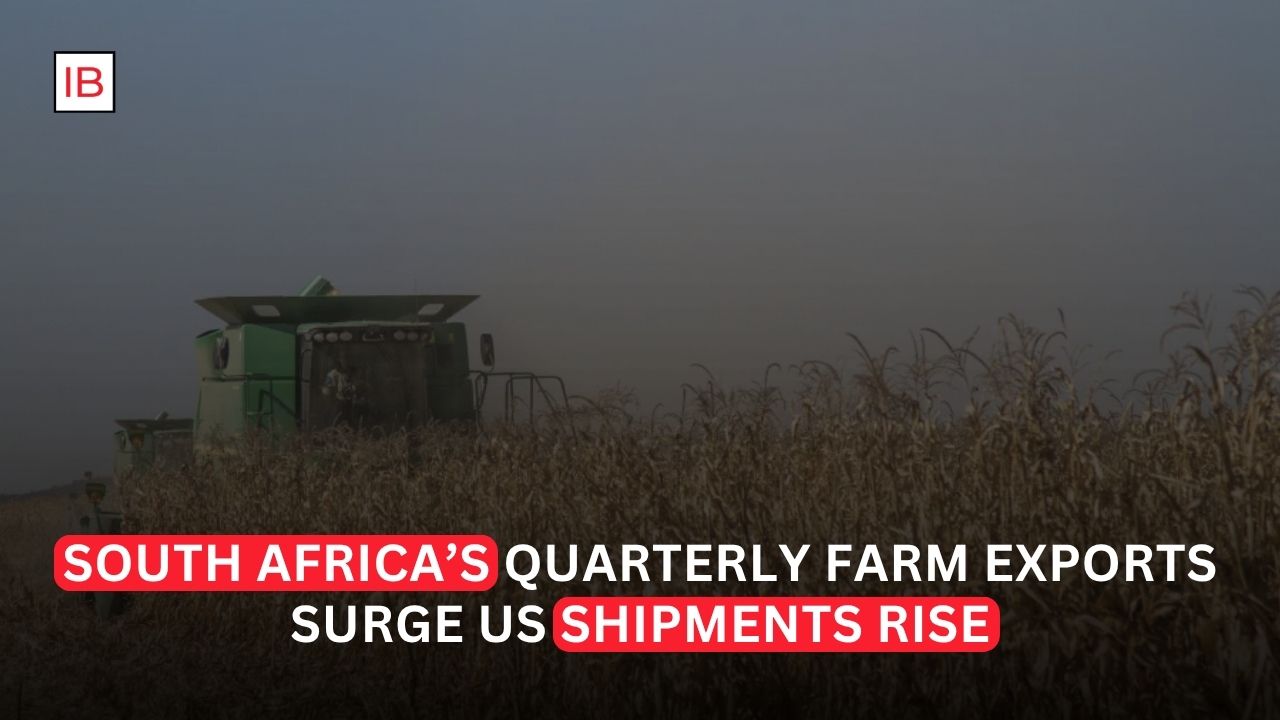
South Africa’s agricultural exports strengthened in the first quarter, helped by improved port performance and increased shipments to the United States, highlighting the resilience of one of the country’s most important sources of foreign exchange and rural employment. The gains came as exporters faced growing uncertainty over US trade policy and the prospect of significantly higher tariffs.
Agricultural exports rose 10% year over year to about $3.36 billion in the first quarter, according to industry data cited by Bloomberg. Shipments to the United States increased 14% to approximately $202 million, giving South African producers an important boost at a time when access to the American market was becoming increasingly uncertain.
The increase in US-bound shipments was particularly significant because South African exporters were preparing for the possibility of a 30% US tariff after a temporary 90-day reprieve. The prospect of higher duties created an incentive for companies to accelerate shipments while favorable trading conditions remained in place.
Wandile Sihlobo, chief economist at the Agricultural Business Chamber of South Africa, warned that the future of the US market would depend heavily on whether Pretoria could secure favorable trading terms with Washington. The United States is an important destination for specific South African agricultural industries, even though it accounts for only a relatively small share of the country’s overall farm exports.
The first-quarter performance also reflected improvements in South Africa’s domestic logistics network. Agricultural exporters have faced years of problems at ports and on railways, increasing transportation costs and reducing the competitiveness of South African products. Better port performance provided some relief during a period when producers were expanding output of export-oriented crops.
South Africa’s agricultural industry has increasingly relied on products such as citrus, avocados, nuts, grapes, wine and other high-value horticultural goods to drive export growth. The country recorded a record $13.7 billion in agricultural exports in 2024, marking the sixth consecutive year of growth, as farmers expanded production and sought additional international markets.
The United States accounted for roughly 4% of agricultural shipments in the first quarter, while African markets remained the largest destination at about 45%. The European Union accounted for approximately 23%, with Asia and the Middle East representing another 16%. The geographic spread of exports gives South African agriculture some protection against weakness in any single market, although individual industries can remain heavily exposed to particular destinations.
American demand is particularly important for South African citrus, wine, fruit juice and grape producers. The United States has become an important outlet for Southern Hemisphere produce because its growing season differs from South Africa’s, allowing exporters to supply American consumers during periods when domestic production is limited.
That relationship came under pressure as Washington moved toward higher tariffs on South African goods. Producers warned that duties could make some agricultural products uncompetitive in the US market, particularly where profit margins are already being squeezed by transport costs, labor expenses and global competition.
The tariff threat also increased pressure on South Africa to diversify its export destinations. Agriculture officials and industry groups have increasingly promoted opportunities in Africa, Asia, the Middle East and other emerging markets. Expanding those markets could reduce dependence on the United States while providing additional outlets for South Africa’s growing agricultural production.
The importance of diversification became even clearer as South African agricultural exports continued to expand. In the first quarter, African countries absorbed the largest share of exports, demonstrating the importance of regional trade. Neighboring markets provide logistical advantages and are increasingly important for products including maize, fruit, wine and processed agricultural goods.
At the same time, South Africa’s agricultural trade balance remained positive. Farming imports increased 19% to about $1.94 billion during the first quarter, leaving the sector with an agricultural trade surplus of roughly $1.42 billion.
The export performance also provides an important source of employment. Although agriculture represents only around 2% of South Africa’s gross domestic product, it supports large numbers of jobs, particularly in rural communities where alternatives can be limited. Strong export demand therefore has effects well beyond the farms and companies directly involved in international trade.
However, the strong first-quarter numbers do not guarantee continued growth. Tariffs, global trade tensions, port efficiency and weather conditions remain major risks. South Africa’s agricultural producers are also competing against exporters from countries with sophisticated logistics networks and preferential access to major consumer markets.
The United States will remain a particularly important test. Strong shipments during the first quarter demonstrate that American consumers continue to demand South African agricultural products, but higher trade barriers could alter the economics of that relationship quickly.
For South Africa, the challenge is therefore twofold: preserve access to established markets such as the United States while simultaneously developing new customers around the world. Continued investment in ports, railways and roads will also be essential if farmers are to convert rising production into sustainable export growth.
The first-quarter figures show that South African agriculture has considerable momentum, but they also underline how exposed that momentum is to international trade policy. With Washington reconsidering its tariff relationship with Pretoria, the sector’s next phase of growth may depend as much on diplomacy and market diversification as on what happens in South Africa’s fields.