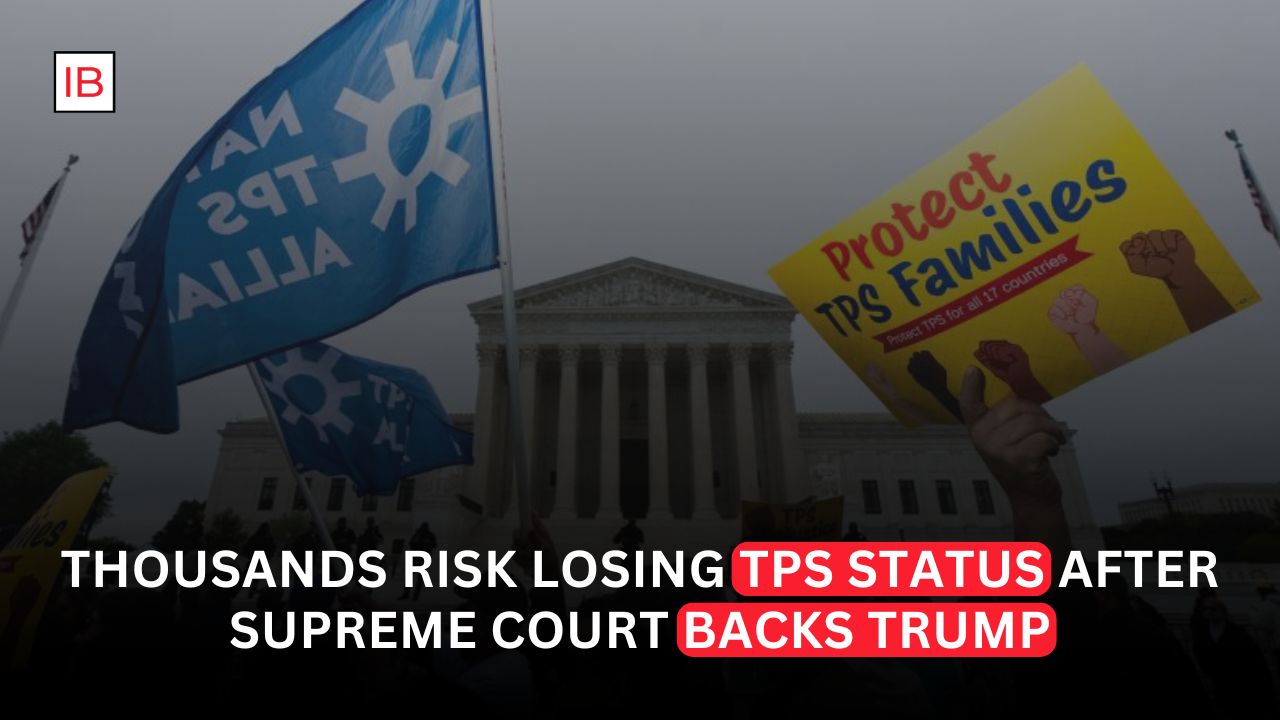
A landmark Supreme Court ruling has dramatically reshaped the future of Temporary Protected Status in the United States, clearing the way for the Trump administration to strip deportation protections from hundreds of thousands of immigrants while sharply curtailing the ability of federal courts to review those decisions.
The Supreme Court’s Ruling
In a 6-3 decision issued on June 25 in Mullin v. Doe, the justices sided with the Trump administration, allowing it to move forward with ending TPS designations for Haiti and Syria. The ruling paused earlier orders from federal courts in Washington, D.C., and New York that had blocked the administration from terminating protections for citizens of both countries. Crucially, the Court also found that the Homeland Security Secretary’s decisions on TPS terminations are largely not subject to judicial review, weakening immigrants’ ability to challenge future terminations in court.
The ruling is estimated to affect roughly 350,000 Haitians and about 6,000 Syrians living and working legally in the U.S. under the program. Former Homeland Security Secretary Kristi Noem had determined that conditions in both countries no longer met the threshold for TPS protection, even as the State Department continues advising Americans against traveling to either nation, citing gang violence in Haiti and ongoing danger in Syria.
What TPS Is and Why It Matters
Congress created Temporary Protected Status in 1990 to provide short-term humanitarian relief for immigrants who cannot safely return to their home countries due to armed conflict, natural disasters, or other extraordinary conditions. The designation allows recipients to live and work legally in the U.S., though it does not provide a path to permanent residency or citizenship. Haitians first received TPS protection in 2010 following the devastating earthquake that killed more than 200,000 people.
Importantly, the Supreme Court’s decision did not immediately terminate TPS status for either country. Instead, the case was remanded back to the district courts to issue implementing orders — a process that typically takes about a month — meaning the practical end of protections has played out gradually rather than instantly.
Confusion and Legal Whiplash on the Ground
In the weeks following the ruling, the situation for TPS holders has remained turbulent. More than 300,000 Haitians were initially set to lose their status and work permits, but a federal appeals court panel for the D.C. Circuit temporarily blocked the administration from immediately revoking those protections, denying the government’s request to lift a lower court’s postponement. USCIS has since extended employment authorization documents tied to both designations multiple times as courts sort out next steps, though DHS has warned TPS holders they have only a limited window before their legal status formally lapses.
A Wider Ripple Effect
Beyond Haiti and Syria, the ruling’s impact is being felt across numerous other pending legal challenges involving TPS terminations for countries including Ethiopia, Honduras, Nepal, Nicaragua, and Venezuela. Several federal judges had previously paused those terminations, but the Supreme Court’s determination that courts have limited authority to review the administration’s decisions makes it considerably harder for immigrants from these countries to prevail in ongoing litigation. The Trump administration has already terminated TPS designations for ten countries, collectively affecting more than a million people, and legal advocates warn the ruling gives the administration broad latitude to continue dismantling the program’s remaining protections.
A handful of countries — including El Salvador, Sudan, Ukraine, and Lebanon — still have active TPS designations that remain valid for now, based on prior DHS actions rather than court-ordered protections, though decisions on their status are expected in the coming months.
What Comes Next
Immigration attorneys say the coming weeks will be critical as lower courts finalize implementing orders and more TPS designations face review. With work permits extended incrementally and outcomes unsettled for hundreds of thousands of people, uncertainty remains the defining feature of the TPS landscape for now.