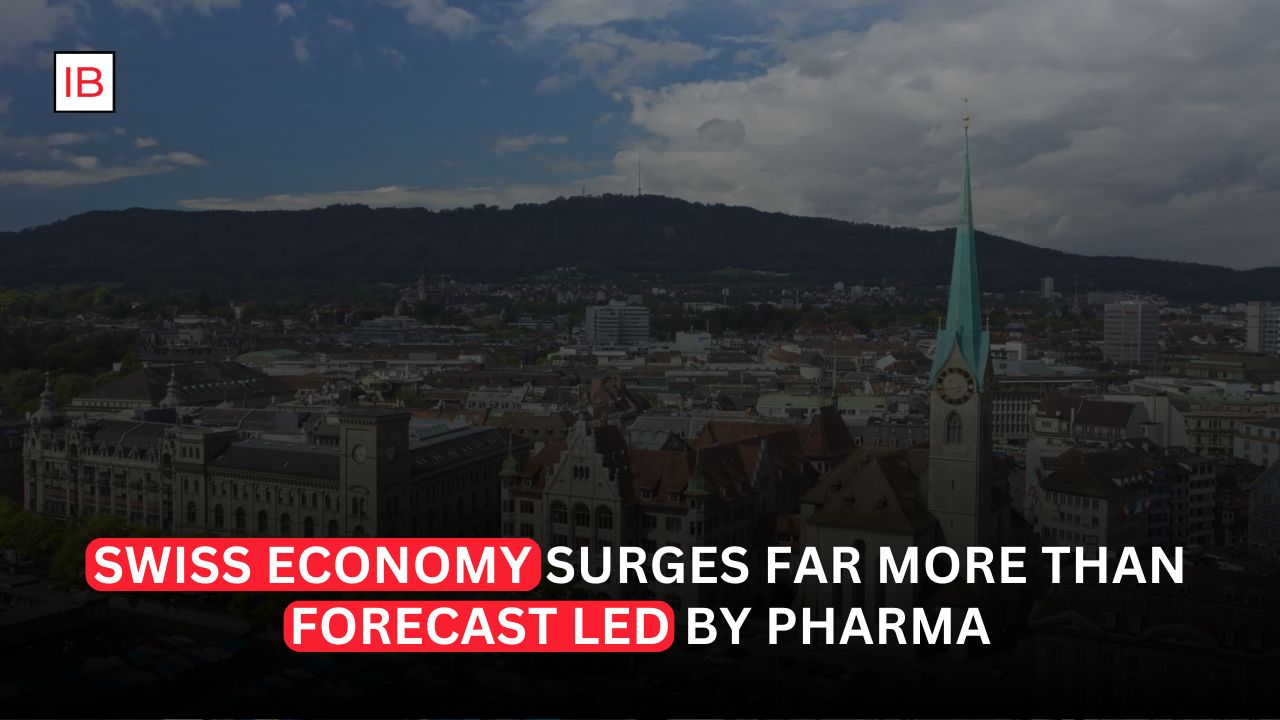
Switzerland’s economy is showing considerably more resilience than expected, with growth reaching its strongest pace in about five years even as the Middle East conflict has pushed energy and transport costs sharply higher.
That creates an interesting contradiction: the Swiss economy is accelerating while one of its biggest external risks is getting worse.
The latest Swiss National Bank business-cycle survey found solid second-quarter growth, particularly in services and construction, although manufacturers reported only moderate turnover growth. Companies also said the closure of the Strait of Hormuz was materially increasing their purchase prices through higher energy and transport costs.
Services and Construction Are Doing the Heavy Lifting
The Swiss economy is not being carried equally by every sector.
Services and construction have been relatively strong, while manufacturing has been less impressive. That distinction matters because Switzerland has a large export-oriented industrial base that is particularly exposed to global trade conditions.
The SNB’s regional network reported that companies remained confident about turnover growth, although expectations had become less optimistic than earlier in the year.
So the headline growth figure is encouraging, but the underlying picture is less uniformly strong.
Energy Prices Are the Main Threat
Switzerland imports most of its energy, making it vulnerable when global oil and transport costs jump.
The Strait of Hormuz disruption has increased the cost of imported intermediate goods, according to the SNB’s survey of companies. Businesses expect their selling prices to rise too, but by less than their purchase costs.
That creates a margin squeeze.
Companies essentially have three choices:
- Absorb higher costs
- Raise prices
- Cut production or investment
If businesses absorb the shock, profits suffer.
If they pass it to customers, inflation rises.
If they reduce activity, economic growth weakens.
None is particularly attractive.
Why Switzerland Has Been Resilient
Switzerland has several structural advantages.
Its economy is heavily concentrated in high-value industries such as:
- Pharmaceuticals
- Chemicals
- Precision manufacturing
- Financial services
- Technology
- Medical equipment
These sectors are less dependent on energy than many traditional heavy industries.
That gives Switzerland some protection from an energy shock compared with economies that rely heavily on energy-intensive manufacturing.
But the Manufacturing Sector Is a Warning Sign
This is where the bullish interpretation needs to be challenged.
The SNB’s own survey says manufacturing turnover growth was only moderate and that some companies were already seeing the Middle East situation dampen the recovery.
So strong overall GDP growth does not necessarily mean Swiss industry is thriving.
The services economy can remain resilient while manufacturers face rising input costs and weaker international demand.
That divergence could become more important if the energy disruption persists.
Inflation Risks Are Rising
The energy shock is already affecting companies’ inflation expectations.
The SNB reported that short-term inflation expectations have risen noticeably, although medium-term expectations have increased only slightly. Wage expectations remain relatively moderate.
That distinction is important.
A temporary energy shock does not necessarily create persistent inflation.
But if higher energy costs start feeding into wages, rents, services and broader pricing decisions, the inflation problem becomes much harder for policymakers to ignore.
The SNB Has a Difficult Balance
Switzerland’s monetary policy environment is unusual.
The economy is showing strength, but external inflation risks are increasing.
At the same time, Switzerland’s traditionally strong currency can restrain imported inflation and hurt exporters.
The Swiss National Bank therefore has to balance:
Growth
against
Inflation
against
The Swiss franc
against
External demand
That makes a simple “strong growth = tighter monetary policy” interpretation too simplistic.
Earlier Forecasts Were More Cautious
Switzerland’s government expert group had previously cut its 2026 growth forecast to 0.9%, citing the Middle East crisis, higher energy prices and weaker global growth. It expected 1.6% growth in 2027.
The stronger-than-expected current performance therefore gives the economy some breathing room.
But it does not eliminate the risks behind that forecast.
The government specifically warned that the Iran crisis was clouding the outlook and that uncertainty remained high.
Switzerland May Be Benefiting From Its Economic Mix
One reason Switzerland can withstand an energy shock better than expected is that its most valuable industries are not necessarily the most energy-intensive.
A pharmaceutical company, bank or software company does not face the same direct energy exposure as a steel mill or chemical producer.
That does not make Switzerland immune.
Higher electricity, transportation and logistics costs eventually spread through the economy.
But the initial hit can be smaller.
The Bigger Question Is Duration
The biggest variable now isn’t simply how high energy prices rise.
It is how long they stay elevated.
A short-lived spike can be absorbed.
A prolonged disruption around Hormuz would be different.
The SNB says companies are already seeing higher purchase prices because of energy and transport costs.
If that continues for months, the current growth resilience could deteriorate.
The sequence could look like:
Higher oil prices → higher business costs → weaker margins → higher consumer prices → weaker demand → slower investment.
That is the risk investors should focus on.
Switzerland Is Not Out of the Woods
The strongest argument against celebrating the growth number too much is that the data describe the past quarter, while the energy shock is an ongoing event.
GDP can remain strong for a period because businesses and households continue spending.
The effects of higher energy and transportation costs may arrive with a lag.
That means today’s strong growth does not necessarily tell us what the Swiss economy will look like later in 2026.
What Investors Should Watch
Energy Costs
A prolonged oil-price surge would increase pressure on Swiss companies.
Manufacturing Orders
Export-oriented manufacturers will reveal whether external demand is holding up.
Corporate Margins
The key question is whether companies can pass higher input costs to customers.
Inflation Expectations
A sustained rise would make the SNB’s policy challenge harder.
Swiss Franc
A stronger franc could partially offset imported energy inflation but hurt exporters.
Business Confidence
The SNB’s observation that expectations have already moderated is worth watching closely.
The Bigger Picture
Switzerland’s latest growth performance is a useful reminder that economies do not respond uniformly to geopolitical shocks.
The Middle East conflict is creating a significant energy and transportation problem across Europe, yet Switzerland’s relatively defensive economic structure has helped it absorb the shock so far.
But the headline number hides an important weakness.
Manufacturing is not keeping pace with services and construction, while companies are already reporting higher input costs.
So the more interesting story isn’t simply that Swiss growth has reached a five-year high.
It is whether Switzerland can maintain that momentum while energy costs remain elevated.
If the disruption fades, Switzerland could emerge from the shock in relatively good shape.
If it persists, today’s strong GDP number could prove to be the high-water mark before higher costs begin hitting margins, inflation and demand.