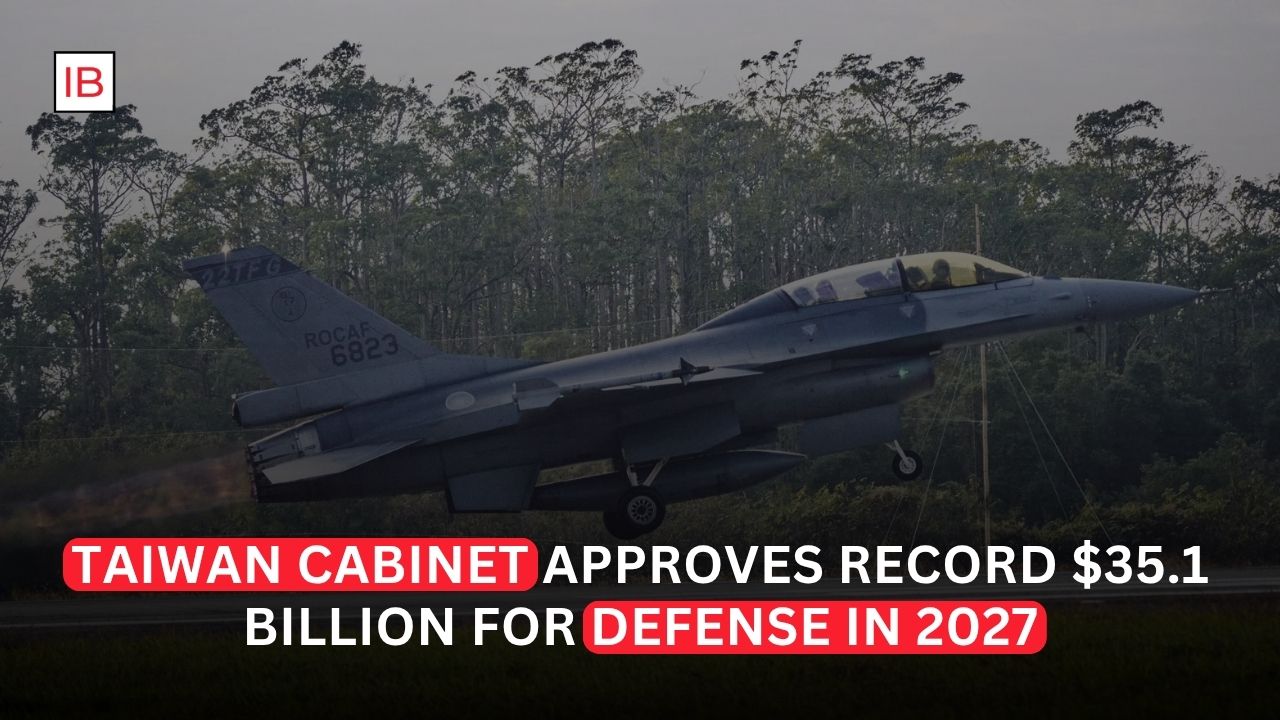
Taiwan has approved a record defense budget for 2027, marking another major increase in military spending as the island seeks to strengthen its ability to deter China and respond to growing pressure from Beijing.
The cabinet approved defense spending of NT$1.1225 trillion, equivalent to about $35.1 billion, as part of its proposed 2027 budget. The figure represents more than 3% of Taiwan’s gross domestic product and takes defense spending above the NT$1 trillion threshold for the first time.
The decision reflects Taiwan’s increasingly urgent focus on military preparedness.
China claims Taiwan as part of its territory and has significantly increased military and political pressure around the island in recent years. Chinese military aircraft and naval forces operate around Taiwan frequently, while Beijing has also expanded the use of coast guard vessels and other forms of pressure that stop short of open conflict.
Taiwan’s government argues that stronger defenses are necessary to discourage an attack and ensure that the island can resist if deterrence fails.
President Lai Ching-te has made military modernization one of the central priorities of his administration. Earlier this week, he described the planned increase in defense spending as an investment in peace and said Taiwan needed to demonstrate its determination to defend itself.
The spending increase also reflects pressure from Washington.
The United States has repeatedly urged Taiwan to take greater responsibility for its own defense, much as Washington has pushed European allies to increase military spending. Lai has embraced that message, arguing that Taiwan must strengthen its capabilities rather than depend entirely on outside assistance.
The proposed budget would help finance a range of military modernization programs.
Drones and missiles are expected to receive additional funding, alongside programs aimed at strengthening Taiwan’s broader asymmetric-defense capabilities. The strategy is designed around the reality that Taiwan faces a much larger potential adversary and therefore needs systems capable of imposing high costs on any attempted attack.
Drones are becoming particularly important.
Recent conflicts have demonstrated how relatively inexpensive unmanned systems can be used for surveillance, targeting and attacks. Taiwan has been trying to expand its domestic drone industry and develop larger quantities of systems that could be deployed during a conflict.
The government previously encountered resistance from lawmakers over some of these programs. Taiwan’s parliament only recently approved this year’s budget after months of political deadlock, although funding for a major drone program was retained.
Missile capabilities are another priority.
Taiwan has been developing and acquiring systems designed to threaten ships, aircraft and other military assets. The objective is not necessarily to match China’s military force system for system, but to create enough defensive capability that an attack becomes prohibitively costly and difficult.
That approach is increasingly described as asymmetric warfare.
Instead of attempting to build a military capable of overwhelming China directly, Taiwan is concentrating on technologies and strategies that exploit vulnerabilities in a much larger force.
Submarines are another major component of the modernization strategy.
Taiwan is developing its own indigenous submarine program as part of a broader effort to strengthen its ability to protect surrounding waters. Submarines could play an important role in any attempt to prevent a blockade or challenge Chinese naval forces.
The timing of the budget is particularly significant because Taiwan has just completed its annual Han Kuang military exercises.
Those drills included scenarios involving a potential Chinese blockade and other forms of military pressure. Beijing criticized the exercises, describing them as provocative and accusing Taipei of increasing tensions.
For Taiwan, however, the exercises demonstrate the importance of preparing for scenarios beyond a conventional invasion.
A blockade could be particularly damaging to an economy that depends heavily on maritime trade. Taiwan therefore needs capabilities capable of maintaining access to international waters and protecting critical infrastructure.
The defense budget also includes money for the Coast Guard and veterans, reflecting the broader definition of national security being adopted by Taipei.
The Coast Guard has an increasingly important role because China has used its own coast guard in operations around Taiwan. Such activity can create pressure without crossing the threshold into conventional military confrontation.
That makes the distinction between military and civilian security forces increasingly blurred.
Taiwan’s budget increase nevertheless faces a major political obstacle.
The island’s parliament is controlled by opposition parties, while Lai’s Democratic Progressive Party does not hold a majority. The opposition has repeatedly said it supports strengthening Taiwan’s defense but does not want to provide the government with what it describes as unrestricted spending authority.
That could create another difficult budget battle.
Taiwan’s parliament delayed approval of the 2026 budget for months. Lawmakers eventually passed the budget only last week, after cutting NT$48 billion from the government’s original proposal. Funding for the key drone program was nevertheless approved in full.
The political dispute matters because defense modernization requires long-term planning.
Weapons systems, submarines, missiles and drone programs cannot be developed or purchased effectively if funding is constantly delayed or changed.
The government therefore needs parliamentary support not only for the size of the budget but also for predictable multiyear funding.
That is particularly important as Taiwan tries to expand its domestic defense industry.
Building more weapons locally could reduce dependence on foreign suppliers and make Taiwan more resilient during a crisis. It could also create a domestic industrial base capable of producing replacement equipment and ammunition if access to international markets were disrupted.
But developing an independent defense industry is expensive.
Taiwan must balance military spending against other priorities, including healthcare, infrastructure, social welfare and economic development.
The argument for higher defense spending has nevertheless become stronger as China’s military capabilities expand.
Beijing has invested heavily in missiles, aircraft, naval vessels, cyber capabilities and other systems that could be used against Taiwan.
China has also developed the ability to conduct large-scale military exercises around the island, giving its forces experience in coordinating operations that could potentially support a blockade or invasion.
Taiwan’s strategy is therefore shifting toward greater readiness.
The goal is not simply to possess more weapons.
It is to make the military capable of responding quickly, maintaining command and communications under attack, protecting critical infrastructure and sustaining operations during a prolonged crisis.
That requires investment in everything from ammunition and drones to air defenses, communications networks and reserve forces.
The record budget also sends a message to Taiwan’s allies.
By spending more than 3% of GDP on defense, Taipei is demonstrating that it is willing to make significant financial sacrifices for its own security.
That could strengthen Taiwan’s argument for continued US military support and cooperation.
Washington is Taiwan’s most important security partner, although the United States does not maintain formal diplomatic relations with Taipei.
The possibility of American military assistance is therefore central to Taiwan’s defense planning.
Higher domestic spending may help reassure Washington that Taiwan is prepared to contribute substantially to its own defense rather than relying entirely on US support.
But spending more does not automatically guarantee greater security.
The effectiveness of the budget will depend on how quickly Taiwan can turn money into operational capability.
Procurement delays, shortages of skilled personnel, bureaucratic problems and political disagreements could reduce the impact of higher spending.
Taiwan also faces a difficult question over the balance between expensive conventional systems and cheaper asymmetric weapons.
Large platforms can provide important capabilities, but they can also become vulnerable targets in a conflict involving China’s much larger military.
Drones, mobile missile systems, mines and dispersed weapons can potentially survive longer and impose significant costs on an attacking force.
That makes Taiwan’s spending choices at least as important as the headline budget number.
The increase also has economic implications.
A defense budget of more than $35 billion represents a substantial allocation of national resources. Defense contractors, electronics manufacturers, drone developers, shipbuilders and other technology companies could benefit from increased government demand.
Taiwan’s world-leading technology sector could also become increasingly connected to national security.
Companies specializing in semiconductors, communications, sensors and artificial intelligence have technologies that could have military applications.
That could create a growing domestic defense-technology ecosystem.
At the same time, Taiwan must be careful not to allow defense spending to undermine the economic strength that supports its security.
Its semiconductor industry remains critical to the global economy and is also strategically important because Taiwan’s technology supply chains give other countries a powerful incentive to preserve stability in the region.
The larger strategic picture is therefore complicated.
Taiwan is trying to make itself harder to attack while avoiding actions that could unnecessarily accelerate tensions with China.
Beijing, meanwhile, continues to insist that Taiwan is part of China and has refused to rule out the use of force.
The result is an increasingly militarized environment around the Taiwan Strait.
For investors and businesses, the risks extend beyond military confrontation.
Even without a war, prolonged tensions can affect shipping routes, insurance costs, technology supply chains and investment decisions across Asia.
A serious crisis around Taiwan would have global consequences because the island plays such an important role in semiconductor manufacturing.
The record defense budget is therefore not simply a domestic spending decision.
It is part of a broader effort to reshape Taiwan’s security position in an increasingly unstable Asia-Pacific region.
The proposed NT$1.1225 trillion allocation shows how far Taiwan’s priorities have shifted.
Defense spending has moved above 3% of GDP and crossed a psychological threshold of NT$1 trillion.
Whether the final budget survives parliamentary negotiations remains uncertain.
But the direction is clear.
Taiwan is committing substantially more resources to drones, missiles, submarines, maritime security and military modernization as it attempts to strengthen deterrence against China.
The real test will be whether those resources translate into a more resilient defense force.
For Taipei, the objective is not simply to spend more.
It is to convince Beijing that the costs and risks of military action would be too high.
And increasingly, Taiwan is betting that a combination of domestic military investment, asymmetric capabilities and stronger international partnerships offers its best chance of preserving peace.