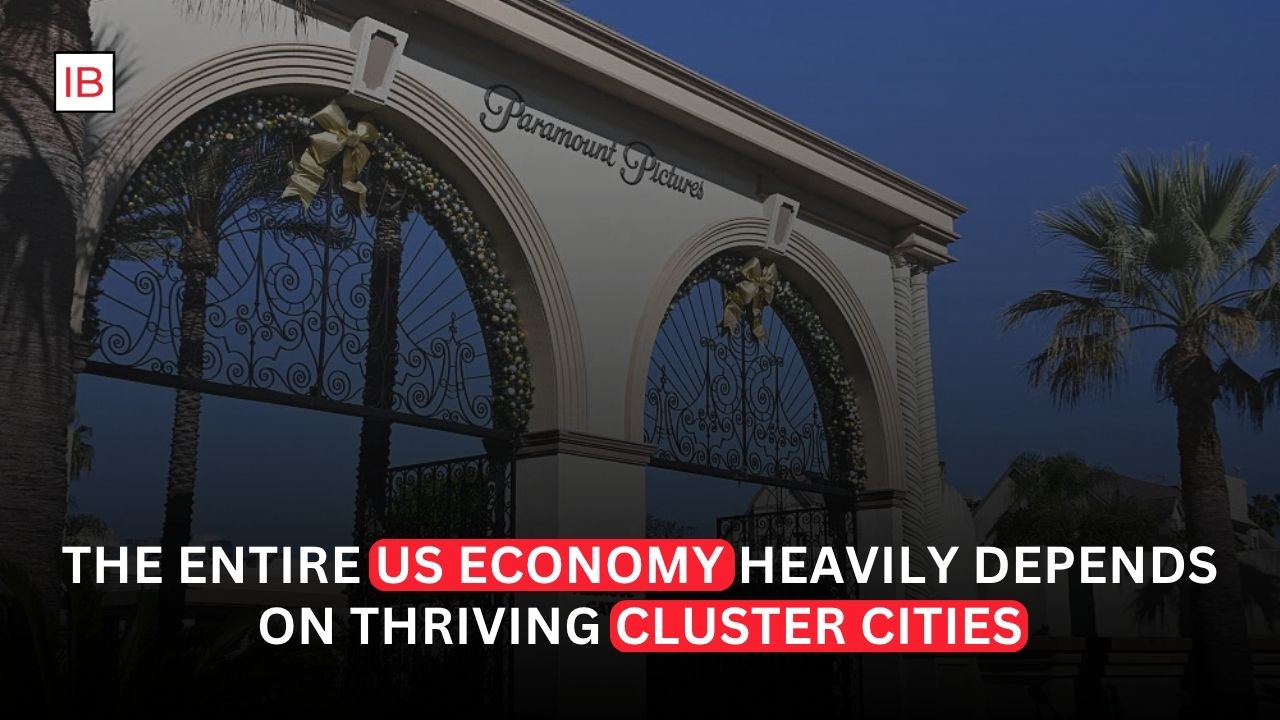
The US economy depends on more than factories, banks or government spending. Some of its most important economic advantages come from three industries that are often discussed separately: Silicon Valley’s technology sector, Wall Street’s financial system and Hollywood’s entertainment industry.
Each represents a different form of American economic power. Technology creates new products and businesses, finance moves capital toward those opportunities, and entertainment turns American culture into a global commercial export. Together, they form an ecosystem that is difficult for competitors to reproduce.
Silicon Valley Creates the Future
Technology remains one of the most important sources of US productivity growth.
Companies concentrated around Silicon Valley have helped commercialize personal computing, the internet, smartphones, cloud computing and artificial intelligence. The economic effect extends far beyond technology companies themselves.
A successful technology platform creates demand for data centers, semiconductor manufacturing, software developers, advertising, logistics and professional services.
Artificial intelligence could represent another major productivity shock. Companies are investing enormous sums in computing infrastructure and AI systems because they expect automation and better decision-making to generate substantial economic returns.
But Silicon Valley’s importance is not simply about producing profitable companies. It is about creating technologies that other industries can use.
Wall Street Turns Ideas Into Capital
Technology requires capital.
Building semiconductor plants, training large AI models or expanding a software company can require billions of dollars before a business becomes profitable.
Wall Street provides the mechanisms that connect investors with those opportunities.
Banks underwrite debt and equity offerings. Investment funds provide capital to growing companies. Public markets allow successful businesses to raise additional money and give investors a way to participate in their growth.
That financial infrastructure is one reason the US has been able to fund enormous amounts of private investment.
The system is imperfect, and financial markets can clearly become speculative. But eliminating or severely weakening the country’s capital markets would create another problem: innovative businesses would have fewer ways to finance expansion.
Hollywood Sells More Than Movies
Hollywood is often dismissed as entertainment rather than an economic sector with strategic importance.
That misses its global reach.
American films, television programs, music and other forms of popular culture have been exported around the world for decades.
Streaming has expanded that reach.
The US entertainment industry generates direct revenue through production, distribution and licensing, but it also promotes American brands, tourism and cultural influence.
Hollywood therefore functions partly as an export industry and partly as a mechanism of soft power.
Its influence is difficult to measure in GDP statistics because the value of cultural familiarity can extend far beyond the original entertainment product.
The Three Industries Reinforce Each Other
The strongest argument for these industries is not that any one of them is indispensable by itself.
It is that they reinforce one another.
Silicon Valley produces technology.
Wall Street provides capital to scale it.
Hollywood and the wider entertainment industry provide global distribution, storytelling and cultural influence.
The same pattern appears elsewhere in the economy.
Technology companies advertise through entertainment platforms. Financial firms finance media businesses. Hollywood uses increasingly sophisticated software, cloud infrastructure and AI tools.
The boundaries between industries are becoming less distinct.
Finance Needs Innovation
Wall Street also depends on Silicon Valley.
Financial institutions increasingly use artificial intelligence, cloud computing, cybersecurity systems and data analytics.
Fintech companies have challenged traditional banks by offering faster payments, automated investment services and new forms of lending.
This competition forces established financial institutions to modernize.
The result can be higher productivity and lower costs for consumers and businesses.
But it also creates risks.
A financial system that relies heavily on complex technology becomes more vulnerable to cyberattacks, software failures and concentration among a small number of technology providers.
Technology Needs Financial Markets
The relationship works in the opposite direction as well.
Many technology companies would not have reached their current scale without venture capital, private equity and public markets.
Startups require investors willing to accept high failure rates in exchange for the possibility of enormous returns.
That risk-taking culture has historically been one of America’s competitive advantages.
A country can have excellent universities and talented engineers without necessarily producing globally dominant technology companies.
It also needs a financial system capable of funding experimentation.
Hollywood Needs Technology
Entertainment has undergone an even more dramatic technological transformation.
Streaming platforms have changed how movies and television are distributed.
Artificial intelligence is beginning to influence visual effects, editing, animation and content recommendation.
Gaming has also become a major part of the entertainment economy, blending software development, storytelling and digital commerce.
American entertainment companies therefore increasingly operate partly like technology businesses.
The distinction between Hollywood and Silicon Valley is becoming harder to maintain.
America’s Real Competitive Advantage
The broader lesson is that America’s economic strength comes partly from the interaction of institutions.
Universities generate research and skilled workers.
Entrepreneurs create companies.
Venture capital funds early-stage businesses.
Public markets provide capital for expansion.
Technology companies develop new tools.
Entertainment companies distribute American culture globally.
The government provides infrastructure, legal institutions and research funding.
No single component explains America’s economic position.
The ecosystem does.
China Is Building Its Own Ecosystem
The challenge from China makes this particularly important.
China has invested heavily in technology, manufacturing, artificial intelligence and financial infrastructure.
It has also developed powerful entertainment and digital platforms of its own.
That means the US cannot assume that technological leadership will automatically remain American.
Competition increasingly involves entire economic ecosystems rather than individual companies.
The country that combines capital, technology, talent, manufacturing and cultural influence most effectively will have a significant advantage.
The Risk of Overregulation
That creates a difficult policy question.
Silicon Valley, Wall Street and Hollywood have all produced legitimate problems.
Technology companies have faced criticism over privacy, competition and market concentration.
Wall Street has a history of financial crises, excessive leverage and conflicts of interest.
Hollywood has faced labor disputes, concentration and questions about the economic treatment of creative workers.
These problems require regulation.
But regulation can also become counterproductive if policymakers treat entire industries as inherently harmful.
The goal should be to control genuine risks without destroying the incentives that make the industries productive.
Capital Must Keep Moving
One of the most important requirements is maintaining deep and liquid capital markets.
If American investors become unwilling or unable to finance risky businesses, companies may seek capital elsewhere.
That could weaken the country’s ability to commercialize new technologies.
This is especially important for AI and advanced manufacturing, where investment requirements are enormous.
The US needs enough capital to fund both today’s profitable companies and tomorrow’s uncertain ones.
Talent Matters Even More
Capital alone is insufficient.
Technology companies need engineers and researchers.
Financial institutions need quantitative specialists and experienced managers.
Entertainment companies need writers, directors, actors, designers and producers.
The US has historically attracted international talent across all three industries.
Immigration policy therefore has economic consequences.
Restricting the flow of highly skilled workers can make it harder for American companies to maintain their advantage, particularly when competitors are actively trying to attract the same talent.
The AI Transformation
Artificial intelligence could strengthen the relationship between all three sectors.
Technology companies are building the models and infrastructure.
Banks are financing AI investment and incorporating AI into their operations.
Hollywood is exploring AI-generated imagery, digital production and automated workflows.
The economic impact could eventually extend to almost every industry.
But AI also creates difficult questions about employment, intellectual property and the distribution of profits.
The US will need policies that encourage innovation while allowing workers and institutions to adapt.
America Cannot Rely on Culture Alone
There is also a weakness in the argument for these industries.
Technology, finance and entertainment do not replace manufacturing, energy, agriculture or physical infrastructure.
An economy needs all of them.
A country that becomes too dependent on financial engineering and intangible assets can become vulnerable to economic shocks.
Likewise, technological leadership cannot compensate indefinitely for inadequate infrastructure or weak industrial capacity.
The strongest economy is therefore not one dominated by Silicon Valley, Wall Street or Hollywood.
It is one in which these sectors complement a productive physical economy.
The Bigger Economic Picture
The United States has an unusual ability to combine innovation, capital and cultural influence.
That combination has helped American businesses scale globally.
A new technology can be invented in California, financed in New York and distributed worldwide through an entertainment or consumer platform.
The process can generate intellectual property, high-paying employment, tax revenue and export income.
Competitors can imitate individual parts of the model.
Reproducing the entire ecosystem is much harder.
Conclusion
The US economy needs Silicon Valley, Wall Street and Hollywood because each represents a different source of economic power.
Silicon Valley provides technological innovation and productivity gains.
Wall Street supplies the capital required to turn promising ideas into large companies.
Hollywood and the broader entertainment industry export American culture while generating substantial commercial activity around the world.
The important point, however, is not that these industries should be protected from criticism.
All three have serious weaknesses.
Technology companies can become excessively concentrated. Financial markets can encourage dangerous speculation. Entertainment businesses can exploit workers and struggle with changing consumer habits.
The answer is not to dismantle them.
The more productive approach is to preserve competition, enforce sensible rules and ensure that these industries continue creating value.
America’s advantage comes from the connections between them.
A technology startup can raise venture capital, eventually access public markets and use global media to build its brand. A Hollywood studio can depend on cloud computing, advanced software and AI while raising capital through financial markets. A bank can use technology developed by Silicon Valley to improve its operations and serve millions of customers.
That interconnected system is difficult to reproduce.
It also explains why economic policy should focus on the entire ecosystem rather than treating individual sectors in isolation.
The United States still possesses enormous advantages in technology, finance, education, entrepreneurship and culture.
But none of those advantages is permanent.
China and other competitors are investing heavily in their own technological capabilities, financial institutions and cultural industries.
Maintaining American leadership will therefore require continued investment in research, infrastructure, talent and capital markets.
The US does not need to choose between Silicon Valley, Wall Street and Hollywood.
It needs all three—and, just as importantly, it needs the manufacturing, energy, education and infrastructure systems that allow them to function together.