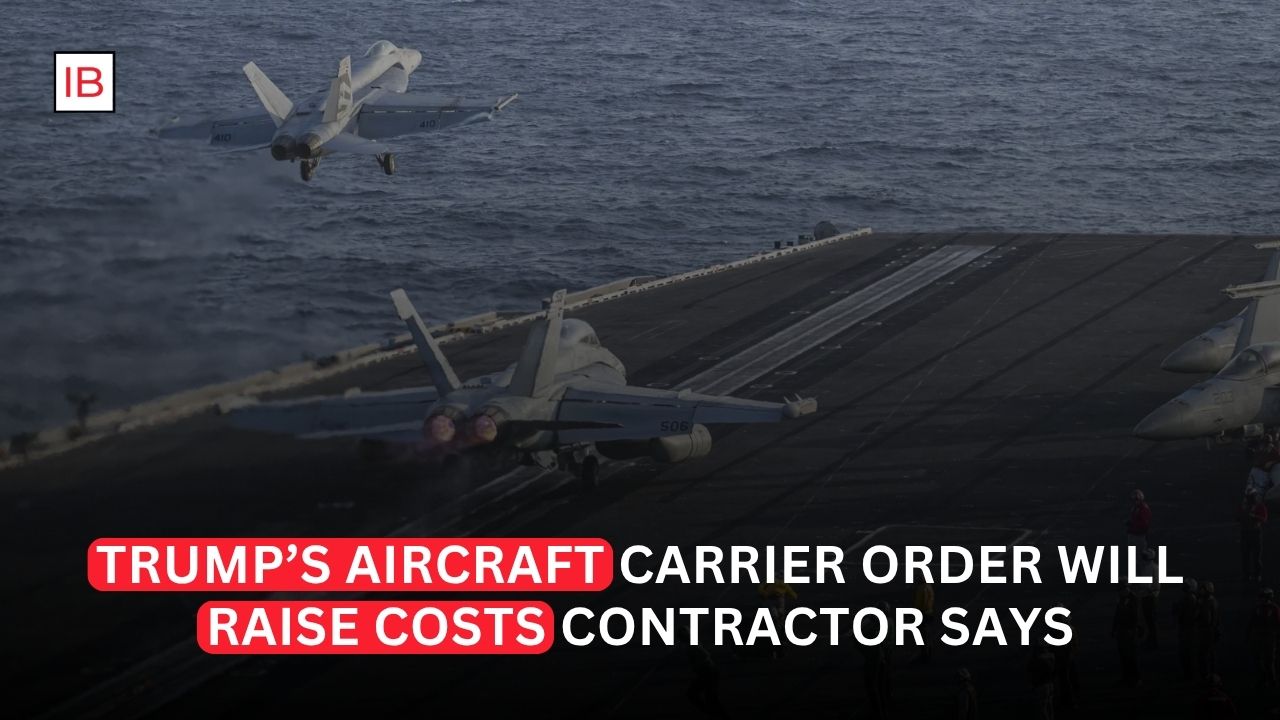
President Donald Trump’s push to change the technology used on future US aircraft carriers is likely to increase costs and create additional complications for the Navy, according to the contractor involved in producing the system the administration wants to replace.
Trump has ordered the Pentagon to return to traditional steam-powered catapults on future aircraft carriers, reversing the Navy’s adoption of the Electromagnetic Aircraft Launch System, or EMALS. The decision affects the Ford-class program and comes as Washington is simultaneously seeking to accelerate naval shipbuilding and expand the size of the US fleet.
The reversal is significant because EMALS was developed specifically to replace the aging steam technology that has been used on US aircraft carriers for decades.
Trump has repeatedly criticized the electromagnetic system, arguing that it is overly complicated and expensive. His latest directive orders the Navy to develop a plan to replace EMALS with steam catapults on the USS Doris Miller, the fourth Ford-class carrier, despite the fact that work on the ship is already well underway.
That timing is at the center of the cost concerns.
General Atomics, the company responsible for EMALS and the aircraft-carrier arresting system, has warned that changing the design after production has already begun could create substantial additional expenses and schedule problems. The company has urged the administration to reconsider the decision.
The problem is not simply the price of the replacement equipment.
Changing a major aircraft-carrier system after construction has started can require redesigning surrounding structures, electrical systems, mechanical components and installation processes. Engineers may also need to remove equipment that has already been installed or modify areas of the ship that were designed around EMALS.
That can create a chain reaction throughout the construction process.
Aircraft carriers are among the most complicated machines ever built. Their systems are closely integrated, meaning that changing one major component can affect dozens of other systems.
The Navy is already dealing with significant cost growth and delays in the Ford-class program.
According to a Congressional Research Service report, the estimated procurement cost of the USS Doris Miller stands at about $15.2 billion, while the Enterprise, the third carrier in the class, is estimated at roughly $14.2 billion. The Ford-class program has also faced repeated schedule and technical challenges since the first ship was ordered.
Adding another major redesign could make those problems harder to manage.
The administration argues that the traditional steam system is more reliable and better understood.
Trump has been criticizing EMALS for years. His objections date back to his first presidency, when he repeatedly argued that steam catapults were simpler and more dependable. He has continued making the argument since returning to office.
But the Navy’s experience with EMALS is more complicated than Trump’s criticism suggests.
The electromagnetic system was developed to improve aircraft launch operations and provide more precise control over the force used to launch different types of aircraft. It is also designed to reduce stress on aircraft compared with older steam technology.
The system has now been used operationally on the USS Gerald R. Ford, the lead ship of the class.
According to reporting on the system, EMALS has conducted tens of thousands of launches and is also being used by France on its aircraft carrier program.
That raises a difficult question for the Navy.
If the electromagnetic system is already operational and production infrastructure exists, does replacing it actually improve military capability enough to justify the disruption?
The answer is far from obvious.
The administration’s broader objective is to increase America’s ability to build and maintain warships.
Trump has ordered the creation of a fifth public shipyard and called for additional measures to increase shipbuilding capacity. The administration has also authorized limited use of overseas shipyards for certain US Navy construction in an effort to accelerate production.
Those initiatives reflect concerns that America’s naval-industrial base cannot produce ships quickly enough to meet the country’s strategic requirements.
The US Navy faces a growing challenge from China, whose naval fleet has expanded rapidly in both size and capability.
Aircraft carriers remain a central element of American military power because they allow the US to project airpower without relying entirely on land bases.
But carriers are also extraordinarily expensive.
The Navy therefore needs to balance the desire for more ships with the reality that each additional carrier requires enormous amounts of money, specialized labor and years of construction.
That makes cost control especially important.
A decision that increases the price of an individual carrier could ultimately reduce the number of ships the Navy can afford.
The Trump administration has nevertheless made naval expansion a major priority.
The president has proposed dramatically increasing defense spending and has called for a larger fleet. At the same time, he has promoted the development of a new class of large surface combatant, known as the Trump-class battleship.
The Congressional Budget Office has estimated that the first ship in that program could cost about $23.4 billion, although the estimate is highly uncertain because the design remains under development.
The combination of new ship programs, expanded carrier construction and additional shipyard investment could place enormous pressure on the defense budget.
That makes the aircraft-carrier catapult decision more than a technical dispute.
It is part of a much broader debate over how the United States should spend its growing defense resources.
Supporters of Trump’s approach argue that the Navy needs proven systems rather than technologies that have experienced reliability problems.
Critics counter that reverting to older technology could lock the Navy into systems that are heavier, more manpower-intensive and less flexible than modern electromagnetic alternatives.
There is also a manpower issue.
Steam catapults require large amounts of machinery and support infrastructure. EMALS was designed in part to reduce some of those burdens and improve operating efficiency.
The Navy is already struggling with personnel demands.
Adding systems that require additional sailors could therefore create costs that do not immediately appear in the price of the equipment itself.
Those costs could include training, maintenance, spare parts and long-term operating expenses.
The debate is therefore about lifecycle cost rather than simply procurement cost.
A cheaper system to purchase is not necessarily cheaper to operate over several decades.
Aircraft carriers are expected to remain in service for roughly half a century, making long-term reliability and maintenance crucial considerations.
The decision also creates uncertainty for the industrial base.
General Atomics has invested heavily in EMALS technology and production. A major reduction in future orders could affect the company’s workforce and manufacturing capabilities.
If the Navy eventually decides to return to electromagnetic systems, rebuilding that industrial capacity could be difficult.
That creates a strategic risk.
Military technology often requires decades of investment. Abrupt changes in procurement policy can weaken the industrial base that produces advanced systems, even if the immediate decision is intended to reduce costs.
There is also a question of schedule.
The USS Doris Miller is already being built around the Ford-class design. Any major redesign could delay construction and potentially push back delivery.
The Navy’s existing carrier program has already experienced delays.
The lead carrier, USS Gerald R. Ford, took years longer than initially expected to reach operational capability, while later ships have also faced cost and schedule pressures.
A delay to one carrier can have consequences for the broader fleet because the Navy plans deployments and maintenance cycles years in advance.
If ships arrive late, existing carriers may have to remain in service longer or deployment schedules may become more difficult to manage.
That is particularly important now because the US Navy is already under intense operational pressure.
The USS Abraham Lincoln, for example, has been deployed for an unusually long period during the ongoing conflict involving Iran. Reports about difficult conditions aboard the carrier have increased scrutiny of the Navy’s ability to sustain prolonged deployments.
The Navy therefore needs both more ships and more reliable ships.
The challenge is achieving those objectives without allowing costs and schedules to spiral.
Trump’s carrier decision could make that task harder in the short term.
The administration’s argument is that replacing EMALS with steam will ultimately produce a more dependable carrier.
But even if that proves true, the transition could be expensive.
The contractor’s warning is therefore important because it highlights a basic problem with changing a major technology after construction has already begun: the cost of redesigning a system can be much higher than the cost of simply choosing between two technologies at the beginning of a program.
For taxpayers, the ultimate question is whether the additional expense produces a meaningful improvement in military capability.
For the Navy, the question is whether the benefits of a familiar steam system outweigh the disruption of abandoning a technology that has already taken years and billions of dollars to develop.
For the defense industry, the decision signals that political leadership can rapidly change the direction of major procurement programs.
And for America’s strategic planners, the episode illustrates a broader dilemma.
The United States wants to build more warships faster, but accelerating production requires consistency, predictable funding and stable designs.
Changing major technologies after construction begins works against those goals.
The administration may still conclude that the long-term advantages of steam catapults justify the transition.
But the immediate costs are becoming increasingly difficult to ignore.
America’s aircraft carriers are already among the most expensive military platforms in the world. Adding redesign costs, potential delays and additional manpower requirements could make the fleet even more expensive.
As Washington pushes for a larger Navy, the central challenge will not simply be building more ships.
It will be building them at a price and pace that the United States can sustain.