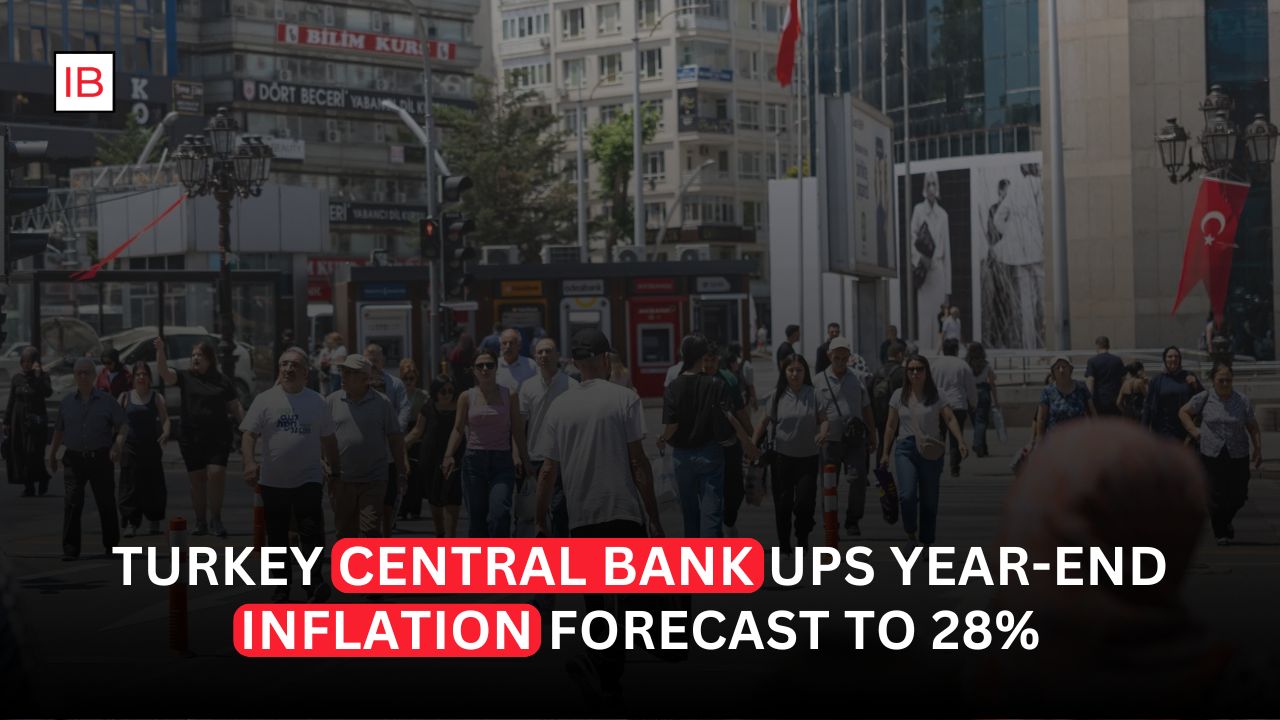
Turkey’s central bank has raised its 2026 year-end inflation forecast to 28%, a fresh indication that the country’s battle against persistent price pressures is proving harder than policymakers had hoped.
The Central Bank of the Republic of Türkiye (CBRT) increased its forecast by 2 percentage points, with Governor Fatih Karahan pointing to elevated energy prices and geopolitical developments as important factors behind the revision.
The change is significant because Turkey has spent the past several years trying to restore credibility to its monetary policy and bring inflation down from extremely high levels.
A higher forecast does not necessarily mean inflation will end the year at exactly 28%. It does, however, show that policymakers now see a slower disinflation process than previously expected.
Energy Prices Are Making the Problem Harder
One of the biggest challenges facing Turkey is the increase in energy costs.
Higher oil and other energy prices raise costs throughout the economy. Transportation becomes more expensive, businesses face higher operating costs and households have less disposable income.
Turkey is particularly vulnerable to energy-price shocks because it relies heavily on imported energy.
The central bank has already identified higher energy prices and geopolitical developments as important reasons for previous upward revisions to its inflation outlook. Its latest inflation report said higher import prices, energy costs, food inflation and administered-price adjustments had all contributed to a higher inflation trajectory.
The latest move to 28% suggests that those pressures remain significant.
The Forecast Has Changed Dramatically
The 28% projection looks especially striking when compared with the assumptions policymakers were working with earlier.
At the beginning of 2026, the central bank had expected inflation to decline much more rapidly. Its January inflation report projected a year-end range of 15% to 21%, with an interim target of 16%.
That outlook subsequently deteriorated.
By the central bank’s second inflation report of 2026, the year-end forecast had already been raised to 26%, while the interim target was revised to 24%.
Now the forecast has moved again, to 28%.
The direction matters as much as the number.
Repeated upward revisions suggest that the disinflation process is encountering more resistance than policymakers initially anticipated.
Monetary Policy Remains Tight
The central bank has responded by maintaining a restrictive monetary-policy stance.
Its latest inflation report indicated that monetary policy would need to remain tighter for longer in order to limit the impact of supply shocks on inflation expectations and pricing behavior.
That creates a difficult trade-off.
High interest rates can help slow demand and reduce inflationary pressure.
But they also increase borrowing costs for households and businesses.
Companies may postpone investment, consumers may reduce spending and economic growth can weaken.
Turkey therefore needs to keep monetary policy tight enough to contain inflation without causing an unnecessarily deep slowdown.
The Turkish Lira Remains Crucial
Another major factor is the Turkish lira.
Exchange-rate movements can have a powerful effect on Turkish inflation because imported energy, raw materials and consumer products become more expensive when the lira weakens.
A stable currency can therefore make the central bank’s disinflation task considerably easier.
A sharp depreciation would have the opposite effect.
It could raise import prices and make the 28% forecast look too optimistic.
That is one reason investors closely monitor Turkey’s foreign-exchange market alongside inflation data and interest-rate decisions.
Higher Inflation Could Delay Rate Cuts
The new forecast also complicates expectations for monetary-policy easing.
If inflation continues to decline steadily, the central bank could gradually lower interest rates.
But a higher inflation outlook gives policymakers less room to move aggressively.
Cutting rates too quickly could stimulate demand before inflation is under control and potentially weaken the lira.
That could create another round of imported inflation.
The central bank therefore has an incentive to remain cautious.
The problem is that keeping rates high for longer can put pressure on economic activity.
Consumers Are Still Under Pressure
For Turkish households, inflation is not an abstract macroeconomic statistic.
It directly affects food, housing, transportation, energy and everyday consumer spending.
Even if the annual inflation rate falls, prices remain permanently higher than they were before.
That means a decline from, for example, 40% inflation to 28% does not mean prices are falling.
It means prices are rising more slowly.
This distinction is important for households whose incomes have struggled to keep pace with the accumulated increase in living costs.
Businesses Face a Similar Problem
Businesses have to deal with the same price pressures.
Higher wages, energy costs, imported inputs and financing expenses can all squeeze profit margins.
Companies may respond by raising prices.
That creates another challenge for the central bank because inflation expectations can become embedded in corporate pricing decisions.
If businesses expect costs to keep rising, they may increase prices preemptively.
Breaking that cycle requires convincing households and companies that inflation will continue moving lower.
Food Inflation Is Another Risk
Energy is not the only concern.
Food prices remain an important component of Turkey’s inflation problem.
The central bank has previously cited higher-than-expected food inflation as one of the factors behind its upward revisions.
Food inflation is politically and economically sensitive because lower-income households tend to devote a larger share of their income to necessities.
A sustained increase in food prices can therefore have a disproportionate effect on living standards.
The Central Bank’s Credibility Is Being Tested
The repeated forecast revisions create another issue: credibility.
Central-bank forecasts are not promises.
Unexpected oil prices, geopolitical events, exchange-rate movements and food shocks can all cause forecasts to change.
But when forecasts are repeatedly revised upward, investors may begin questioning whether inflation is becoming structurally harder to control.
That makes communication particularly important.
The CBRT needs to convince markets that it has both the tools and the willingness to keep monetary policy restrictive for as long as necessary.
There Is Still a Path to Lower Inflation
The increase to 28% does not mean Turkey’s disinflation strategy has failed.
The central bank still expects inflation to decline over the medium term.
Its latest projections put year-end 2027 inflation at 15% and 2028 inflation at 9%, before eventually moving toward its longer-term 5% target.
That is an ambitious trajectory.
Achieving it will depend on several conditions:
- energy prices stabilizing;
- the lira remaining relatively stable;
- food inflation moderating;
- inflation expectations improving;
- fiscal policy supporting disinflation;
- monetary policy remaining sufficiently restrictive.
If those conditions hold, inflation could continue falling even after the latest forecast revision.
The Bigger Risk Is Stagflation
The most difficult scenario would be a combination of persistent inflation and weakening economic growth.
Higher energy prices can produce exactly that problem.
They raise costs while simultaneously reducing household purchasing power.
If the central bank responds by keeping interest rates high, demand can weaken further.
This creates a difficult policy environment in which inflation remains elevated even as economic activity slows.
Turkey is not necessarily locked into such an outcome, but the risk has become harder to ignore.
What Investors Should Watch
The next few months will be important for determining whether 28% is a realistic ceiling or another forecast that eventually needs to be revised upward.
Investors should pay particular attention to:
Monthly CPI: The immediate measure of whether price pressures are accelerating or slowing.
Energy prices: A major external risk for Turkey.
The Turkish lira: Currency stability will be critical for imported inflation.
Food prices: Particularly important for household inflation expectations.
Interest rates: Any premature easing could complicate the disinflation process.
Inflation expectations: A key indicator of whether businesses and consumers believe price growth will continue.
Economic activity: A sharp slowdown could create pressure on policymakers to ease monetary conditions.
The Bottom Line
Turkey’s central bank raising its 2026 year-end inflation forecast to 28% is a warning that the country’s disinflation campaign is facing stronger headwinds than expected.
The central bank is dealing with a particularly difficult combination of higher energy prices, geopolitical uncertainty, food-price pressures and exchange-rate risks.
Its response has been to maintain a tight monetary stance for longer, but that comes with an economic cost.
The key issue now is credibility.
If the CBRT can keep inflation expectations anchored, stabilize the currency and maintain restrictive policy long enough, inflation can still move substantially lower.
But if energy prices remain elevated or the lira comes under renewed pressure, the 28% forecast may prove too optimistic.
For Turkey, the immediate objective is no longer simply to reduce inflation.
It is to reduce inflation without sacrificing economic stability in the process.