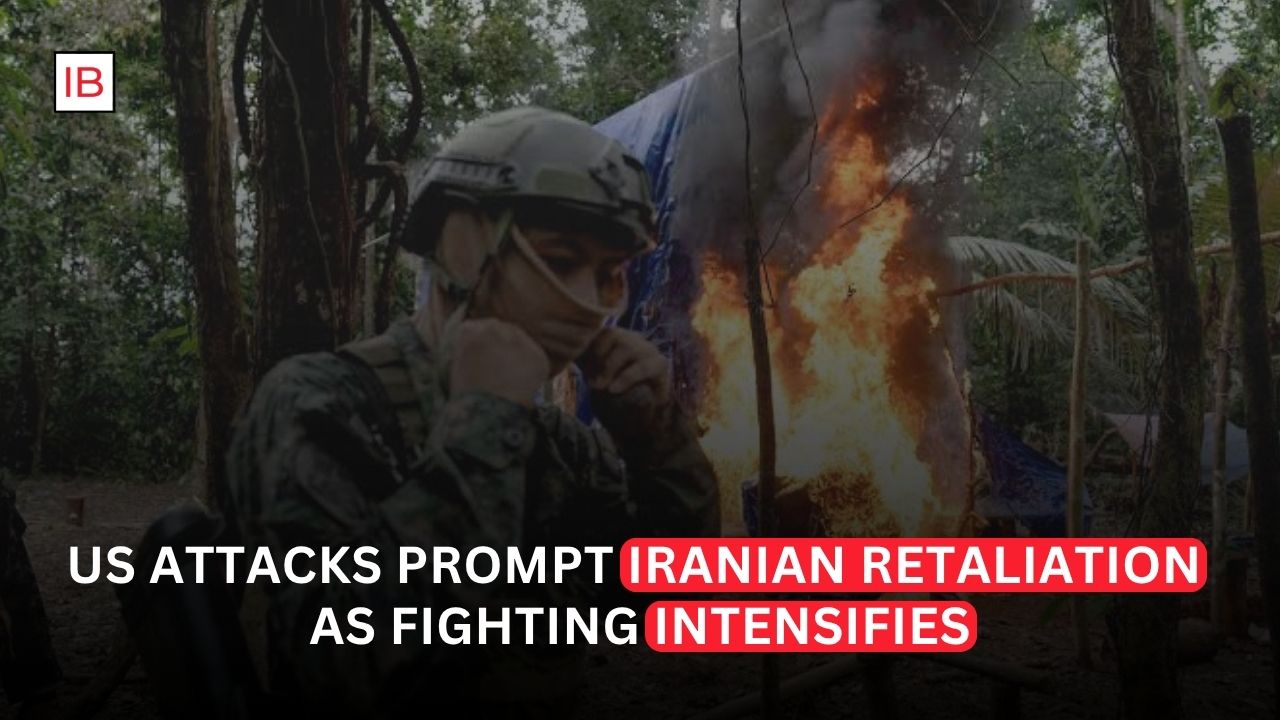
The conflict between the United States and Iran has sharply escalated after American forces launched a new wave of strikes on Iranian military targets, prompting Tehran to retaliate against US positions across the Middle East. The exchange marks the most serious escalation in weeks and raises fresh concerns that the conflict could spread further across the region.
US Central Command said American forces carried out strikes against Islamic Revolutionary Guard Corps targets, including air-defense systems, radar installations, maritime assets, mine-laying capabilities and communications facilities. Several of the targets were located near the strategically important Strait of Hormuz, a critical route for global oil shipments.
Iran responded with missile and drone attacks against US military facilities in several countries, including Bahrain, Jordan, Kuwait and Iraq. Tehran claimed that the attacks caused American casualties, but US officials disputed those claims and said there were no confirmed US fatalities from the latest strikes. Iran also targeted Kuwait’s Ali Al Salem Air Base, while a larger missile barrage toward Jordan was largely intercepted.
The escalation follows a period of relative calm that had raised hopes that the two sides might avoid another major confrontation. That pause now appears to have broken down. Washington has warned that further Iranian retaliation could trigger an even stronger US response, while Iranian officials have threatened a much more forceful reaction if American attacks continue.
The confrontation has also created a growing humanitarian concern. One US strike reportedly hit a wedding gathering in southern Iran, killing civilians and injuring dozens of people. Iranian officials have condemned the incident and used it to strengthen their argument that American military operations are causing unacceptable civilian casualties. Independent assessments of the exact circumstances and casualty figures remain subject to verification.
The Strait of Hormuz remains at the center of the crisis. The narrow waterway handles a significant share of global oil shipments, making any disruption a direct threat to energy markets. Iranian forces have repeatedly threatened shipping connected to countries supporting the US, while American forces have sought to keep commercial traffic moving. Recent attacks and security warnings have already increased risks for tankers operating in and around the waterway.
Oil prices have responded to the renewed fighting. Brent crude moved toward the upper $90s per barrel as traders assessed the possibility of further disruption to Gulf energy supplies. Higher oil prices could intensify inflation pressures in the US and other major economies, complicating monetary-policy decisions and putting additional pressure on consumers.
The conflict is also becoming increasingly costly for both sides. Iran’s economy has already been damaged by months of fighting, sanctions and disruptions to energy infrastructure. At the same time, the United States faces growing demands on its military resources. Reports have raised concerns about the depletion of some stocks of precision long-range missiles, potentially complicating Washington’s ability to sustain a prolonged campaign.
Diplomatic efforts have so far failed to prevent the renewed confrontation. Qatar and other regional governments have attempted to encourage dialogue, while Iranian President Masoud Pezeshkian has signaled openness to reciprocal steps if Washington returns to negotiations. Yet military actions and increasingly aggressive public statements from both governments are making a rapid return to diplomacy more difficult.
For financial markets, the latest escalation creates another layer of uncertainty. Investors must now assess not only military developments but also the potential impact on oil supplies, shipping costs, inflation and global economic growth. A prolonged disruption around Hormuz could have consequences far beyond the Middle East.
The immediate question is whether the latest exchange remains limited or develops into another sustained military campaign. Both sides have powerful incentives to avoid an uncontrolled regional war, but the sequence of strikes and retaliation is increasing the risk of miscalculation. With oil markets already reacting and diplomatic channels under pressure, the next military move could determine whether the conflict enters a significantly more dangerous phase.