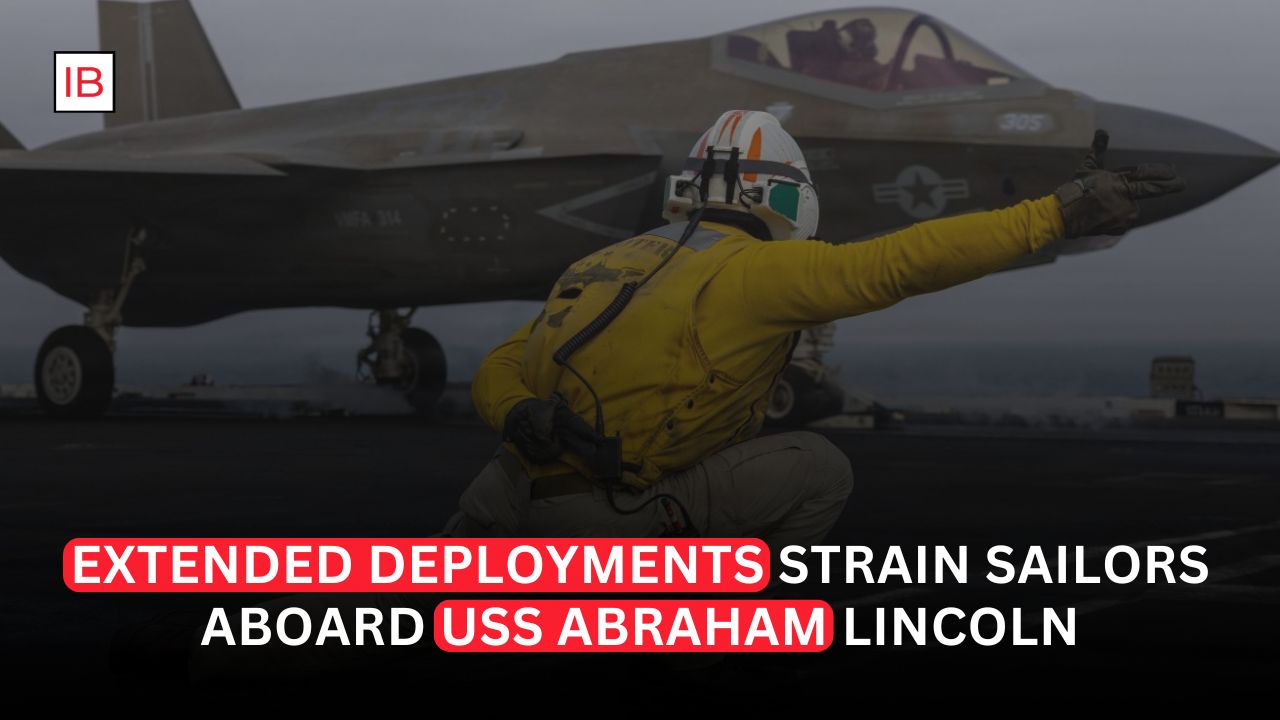
The USS Abraham Lincoln has become a stark example of the hidden cost of America’s increasingly demanding military posture in the Middle East.
The aircraft carrier has been at sea for more than 200 consecutive days without a port call and has been deployed for more than 250 days overall, making its current mission one of the longest in recent US Navy history.
The issue is bigger than one ship.
It raises a harder question for the Pentagon: How long can the Navy keep extending carrier deployments before personnel, maintenance and readiness begin to deteriorate?
The Lincoln Is Being Pushed Beyond the Normal Cycle
Aircraft-carrier deployments typically last roughly six to nine months, although wartime conditions can extend them. The Lincoln’s deployment has now gone well beyond that range.
The carrier has been supporting US military operations connected to the conflict with Iran and has spent months operating with extremely limited opportunities for port visits.
That matters because a carrier isn’t designed simply to remain at sea indefinitely.
Its crew needs:
- Rest and recovery
- Medical support
- Resupply
- Maintenance
- Contact with family
- Shore leave
- Replacement personnel
When those systems are repeatedly deferred, the consequences accumulate.
Crew Welfare Has Become the Central Controversy
Reports from sailors’ families and media outlets have described problems including food and hygiene-supply shortages, plumbing problems, water concerns and deteriorating morale. There have also been reports of sailors going overboard, including an August incident in which a sailor was rescued.
The Navy disputes parts of this picture.
Defense Secretary Pete Hegseth called reports of poor conditions “completely misrepresented,” while the Navy has said it has not seen an increase in suicidal ideation among the crew.
That distinction is important.
Some of the most serious claims remain based on family accounts and media reporting rather than publicly released Navy data.
But that doesn’t make the underlying concern irrelevant.
Even without a documented mental-health crisis, an unusually long deployment with minimal port access creates predictable stress on personnel.
The Maintenance Problem May Be Just as Serious
Crew welfare gets the headlines, but the longer-term military problem could be maintenance.
Aircraft carriers are extraordinarily complex systems.
Extended time at sea means repairs that would normally happen during maintenance periods have to be handled with the resources available onboard or postponed.
That can create a vicious cycle:
Long deployment → deferred maintenance → longer maintenance period later → fewer available carriers → greater pressure on remaining carriers → longer deployments.
The Navy already faces significant shipyard and maintenance constraints.
That means the Lincoln’s deployment could create problems well beyond the date when the ship finally returns home.
The Navy Is Operating With Too Little Slack
This is the deeper structural problem.
The US Navy has 11 aircraft carriers, but global commitments often require multiple carriers simultaneously across different theaters.
That leaves relatively little room for unexpected crises.
If one carrier stays deployed longer than planned, another ship has to absorb the burden.
Then another deployment gets extended.
Eventually the entire schedule begins to slip.
The problem isn’t simply:
“How long can the Lincoln stay at sea?”
It’s:
“How many additional deployments can the rest of the fleet absorb because the Lincoln stayed out longer?”
The George Washington Is the Pressure Release
The USS George Washington is being prepared to relieve the Lincoln in the region. US officials say the rotation was already planned.
That is important because the replacement will test whether the Navy can return to something closer to a normal deployment cycle.
If Washington arrives and Lincoln returns promptly, the current episode may remain an extreme wartime exception.
If the George Washington itself becomes stuck in an extended deployment, the problem becomes much more serious.
That would suggest the Navy isn’t merely dealing with one unusually long mission.
It would indicate a structural mismatch between operational requirements and fleet capacity.
Trump’s Response Highlights the Political Problem
President Donald Trump has dismissed concerns about the Lincoln’s deployment, saying its time at sea was “not nearly long enough.”
That creates a sharp contrast with sailors’ families and lawmakers who are demanding greater scrutiny.
Senator Richard Blumenthal has called for answers about the ship’s conditions and the repeated extensions of its deployment.
The disagreement isn’t just about morale.
It’s about how the US should measure military readiness.
A carrier that remains on station for months beyond its original schedule can look like a demonstration of military endurance.
But if that endurance creates:
maintenance backlogs + exhausted crews + retention problems + delayed deployments
then the apparent strength can conceal a weakening fleet.
There Is a Dangerous Incentive to Overuse Carriers
Aircraft carriers are politically attractive military assets.
They provide:
- Airpower
- Deterrence
- Long-range strike capability
- Visible US presence
- Flexibility without requiring a foreign base
That makes commanders reluctant to remove them from a theater when tensions remain high.
But carriers are not an infinite resource.
Every additional month at sea consumes some combination of:
People + machinery + maintenance capacity + future readiness.
The cost isn’t always visible immediately.
Iran Is Making the Problem Worse
The broader conflict is particularly demanding because the US cannot simply treat the Middle East as a short-duration deployment.
If the conflict with Iran continues, Washington may want sustained carrier coverage for:
- Air operations
- Maritime security
- Deterrence
- Missile defense
- Protection of shipping
- Operations around the Strait of Hormuz
That creates a fundamental dilemma.
The longer the conflict lasts, the more carriers Washington needs.
But the longer each carrier stays deployed, the harder it becomes to maintain the fleet.
That’s exactly the kind of feedback loop that can turn a temporary crisis into a readiness problem.
The Hidden Cost Is the Next War
This may be the most important issue.
A carrier can remain operational today while quietly becoming less available tomorrow.
If extended deployments push maintenance into later years, the US could eventually have:
Fewer carriers available when another crisis begins.
That is a strategic cost that won’t necessarily appear in today’s operational statistics.
It only becomes obvious when the next emergency arrives and the Navy doesn’t have enough ready ships.
What Investors and Defense Analysts Should Watch
USS George Washington
Does it relieve the Lincoln on schedule?
Lincoln’s Maintenance Period
How long does the carrier require once it returns?
Other Carrier Deployments
Are additional ships being extended to compensate?
Navy Shipyard Capacity
Does Washington have enough maintenance capacity to absorb the backlog?
Retention
Do unusually long deployments affect reenlistment and recruitment?
Iran War Duration
A prolonged conflict would put substantially more pressure on the carrier fleet.
The Bigger Picture
The USS Abraham Lincoln is not necessarily evidence that the US Navy is failing.
The Navy has demonstrated that it can keep a carrier operational under extraordinarily demanding circumstances.
The more uncomfortable question is whether the Navy can do this repeatedly without degrading its future readiness.
That’s a very different measure of military strength.
The Lincoln’s deployment therefore matters beyond the conditions aboard one ship.
It is a test of whether the United States has enough military capacity to sustain a prolonged conflict without consuming the readiness it will need for the next one.
The real warning sign isn’t that one carrier has stayed at sea too long. It’s that America’s military strategy increasingly assumes the fleet can operate at wartime tempo indefinitely.