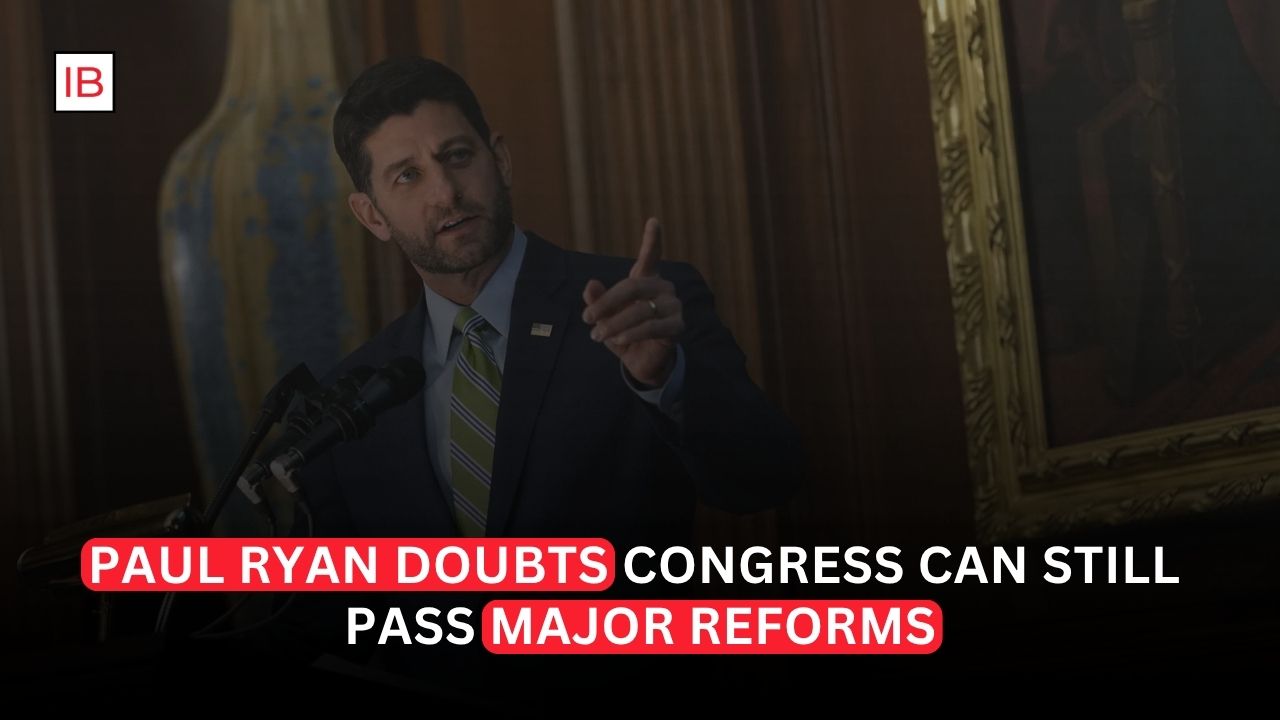
Former House Speaker Paul Ryan is once again trying to reshape the American social safety net. His latest proposal, developed with policy strategist Les Ford, seeks to simplify government benefits, strengthen work incentives and use technology to help low-income Americans move toward financial independence.
The problem is not necessarily the idea itself.
The bigger problem is Congress.
Ryan’s proposal arrives three decades after the bipartisan welfare overhaul signed into law in 1996, and its timing is deliberate. Ryan and Ford argue that the work-first philosophy behind that reform has been weakened while America’s existing welfare system has become fragmented and difficult to navigate. Their new RISE — Resources for Independence, Stability and Employment — pilot programs would allow states to experiment with combining existing benefits into a simpler system.
But Ryan’s history in Washington exposes the central weakness of his argument: he has spent years advocating ambitious entitlement and welfare reforms while Congress repeatedly demonstrated that it is far easier to propose structural change than actually enact it.
What Paul Ryan Is Proposing
The RISE proposal is designed as a state-level experiment rather than an immediate nationwide overhaul.
Its basic idea is to bring multiple forms of assistance into a more unified system.
Under the proposed pilots, states could:
- Combine existing benefits into one trackable payment
- Gradually reduce assistance as household earnings increase
- Require work, education or training
- Provide case management
- Use technology to monitor eligibility and benefits
- Reduce sudden “benefit cliffs”
- Measure results using randomized controlled trials
The objective is straightforward: make government assistance support a transition toward employment rather than creating incentives that keep people dependent on benefits.
That is a more modest approach than Ryan’s older proposals for transforming America’s entitlement system.
And that may be precisely why it has a better chance of generating useful evidence.
The Problem With the Current Safety Net
America’s welfare system is not one program.
It is a collection of programs with different eligibility rules, payment structures and administrative requirements.
Families can potentially interact with programs covering food assistance, healthcare, housing, tax credits and cash support.
The result can be confusing.
A household earning slightly more money may lose access to one benefit while gaining only a small amount of additional income.
That creates what economists call a benefit cliff.
Ryan and Ford argue that the system should instead ensure that earning more money always leaves a family financially better off.
That sounds straightforward.
Implementing it across America’s enormous federal and state welfare bureaucracy is not.
The RISE Approach Tries to Solve the Benefit-Cliff Problem
Imagine a household receiving $1,000 in combined assistance while earning $20,000 from work.
If a modest increase in wages causes several benefits to disappear suddenly, the household might effectively lose money despite working more.
A better-designed system would gradually reduce assistance as earnings rise.
That is the principle behind RISE.
Instead of:
More income → sudden loss of benefits
the goal would be:
More income → gradual reduction in benefits → higher total household resources
This could strengthen the financial incentive to work.
But designing the phase-out correctly is difficult.
If benefits decline too quickly, the problem remains.
If they decline too slowly, government costs could rise significantly.
Technology Is Central to Ryan’s New Proposal
One of the biggest differences between Ryan’s current proposal and welfare reform debates of previous decades is technology.
Modern digital systems can track eligibility and income much more efficiently than older paper-based bureaucracies.
Ryan and Ford argue that privacy-protected technology could create a unified platform for distributing benefits, applying requirements, auditing spending and adjusting assistance as household income changes.
In theory, that could eliminate some of the administrative complexity that makes today’s system difficult to navigate.
But technology does not solve the underlying political problem.
Someone still has to decide how much assistance families receive, who qualifies and how quickly benefits disappear.
Those are political decisions, not software problems.
Why Congress Is the Real Obstacle
This is where the proposal becomes a commentary on Washington itself.
Congress has repeatedly demonstrated an ability to debate welfare and entitlement reform without actually restructuring the system.
Ryan knows this better than almost anyone.
During his congressional career, he became one of the Republican Party’s most prominent advocates of entitlement reform.
His plans called for major changes to programs such as Medicare and Social Security and emphasized controlling long-term federal spending.
But turning those proposals into legislation proved enormously difficult.
Ryan’s Long History of Ambitious Reform
Ryan first became nationally prominent by arguing that America’s entitlement programs were financially unsustainable.
His “Roadmap for America’s Future” proposed sweeping changes to taxes, healthcare and retirement programs.
Later, as chairman of the House Budget Committee, he advanced versions of those ideas through Republican budget proposals.
The plans attracted substantial support among conservatives.
But they also faced fierce Democratic opposition and skepticism from voters concerned about changes to popular government programs.
The result was a familiar Washington pattern:
Big proposals, fierce political arguments, little structural change.
Congress Is Better at Avoiding Pain Than Solving Problems
Major safety-net reform creates obvious political risks.
Cutting benefits creates losers.
Raising taxes creates losers.
Changing eligibility creates losers.
Even simplifying a program can create people who believe they are worse off.
Politicians therefore have an incentive to defend the existing system while criticizing its inefficiencies.
That produces a strange equilibrium.
Everyone agrees the system is complicated.
Few politicians agree on how to simplify it.
Everyone talks about fiscal sustainability.
Few want to make the politically painful choices necessary to achieve it.
The 1996 Welfare Reform Is the Model Ryan Wants to Revive
The timing of the RISE proposal is important.
August 22 marks the 30th anniversary of the 1996 welfare reform law.
That legislation was one of the rare major bipartisan domestic-policy compromises of its era.
It shifted welfare policy toward work requirements and placed greater responsibility on states.
Ryan and Ford see that reform as an example of what Washington can accomplish when both parties agree on a basic principle: government assistance should help people move toward independence.
But today’s political environment is far less conducive to that kind of compromise.
The Political Landscape Has Changed
The Republican Party has changed substantially since 1996.
The Democratic Party has changed too.
The old bipartisan consensus around welfare reform is much weaker.
Some Republicans favor stricter work requirements and lower government spending.
Many Democrats argue that reducing benefits can push vulnerable families deeper into poverty.
Meanwhile, parts of the technology and political world increasingly support guaranteed-income policies.
That puts Ryan’s work-first philosophy in direct competition with an entirely different vision of the safety net.
Ryan Is Also Taking Aim at Universal Basic Income
Ryan and Ford argue against the growing popularity of unconditional cash assistance.
They contend that universal basic income-style programs risk weakening incentives to work and would be enormously expensive at national scale.
That argument is controversial.
Supporters of guaranteed income argue that unconditional cash can reduce poverty, provide flexibility and help families deal with unstable employment.
The debate therefore isn’t simply about whether government should provide assistance.
It is about what government assistance is supposed to accomplish.
The AI Economy Makes the Debate More Complicated
Ryan’s proposal arrives as artificial intelligence is creating new anxiety about employment.
AI could eliminate some jobs.
It could transform others.
It could also create new industries and increase productivity.
That uncertainty makes traditional work requirements harder to design.
If a person cannot find a job because their industry is being automated, simply requiring employment may not solve the problem.
That makes education and training increasingly important components of any modern safety-net reform.
RISE’s inclusion of work, education and training attempts to recognize that reality.
The Strongest Part of the Proposal Is the Pilot Concept
The most defensible part of Ryan’s plan is arguably not the ideological argument about welfare.
It is the decision to test reforms on a smaller scale before imposing them nationally.
States could experiment.
Researchers could measure results.
Successful models could expand.
Failed approaches could be abandoned.
That is much safer than transforming the entire national welfare system based on political assumptions.
The challenge is ensuring that the pilots are genuinely evaluated rather than being used to produce predetermined political conclusions.
Evidence Matters More Than Ideology
If RISE pilots are implemented, they should answer measurable questions.
For example:
- Do participants work more?
- Do their incomes rise?
- Does poverty decline?
- Does government spending fall?
- Do families become more financially stable?
- Are children better off?
- Do marriage and household stability improve?
- What happens to people who cannot meet work requirements?
Without credible answers, the program risks becoming another ideological experiment.
Ryan and Ford say the pilots will use randomized controlled trial standards.
That is important because welfare policy needs evidence rather than slogans.
The Biggest Weakness: Work Isn’t Always the Only Problem
Ryan’s framework puts heavy emphasis on employment.
That makes sense for many working-age adults.
But poverty can result from factors that work requirements alone cannot fix.
Childcare can be expensive.
Housing can consume a large share of income.
Healthcare costs can destabilize households.
Disability can prevent employment.
Education and transportation can limit access to jobs.
A system that assumes unemployment is primarily an incentive problem could therefore miss important causes of poverty.
The Safety Net Cannot Become a Maze of Requirements
There is another risk.
Adding work requirements, training requirements, reporting rules and digital monitoring could make the system even more complicated.
The stated goal is simplification.
But governments have a tendency to turn simple principles into complicated administrative systems.
A family struggling financially should not need an expert to understand how to receive assistance.
If RISE genuinely reduces administrative complexity, it could address one of the safety net’s biggest weaknesses.
If it merely adds another layer of rules, it will fail its own objective.
The Fiscal Argument Is Important — But Incomplete
America faces enormous long-term fiscal pressures.
Social Security, Medicare and other programs represent a significant share of federal spending.
But welfare reform alone cannot solve America’s fiscal problems.
That distinction matters.
The largest budgetary challenges involve programs serving older Americans as well as the broader healthcare system.
A reform focused primarily on low-income working-age households will not suddenly stabilize the federal debt.
Ryan’s critics have long argued that conservatives sometimes exaggerate the savings available from cutting safety-net programs while avoiding politically difficult decisions elsewhere.
That criticism deserves consideration.
Congress Has a History of Avoiding Entitlement Reform
The broader lesson from Ryan’s career is that entitlement reform is politically toxic.
Members of Congress can vote for abstract budget plans.
They can endorse long-term spending reductions.
They can campaign against deficits.
But once specific beneficiaries face specific cuts, political resistance becomes much stronger.
That is why Ryan’s latest proposal may be better understood as an attempt to change the debate rather than immediately rewrite federal law.
States May Be the More Realistic Laboratory
Federal reform may be nearly impossible in the current political environment.
States, however, can experiment.
They have different labor markets.
They have different poverty rates.
They have different administrative systems.
That makes them useful testing grounds.
One state could implement a RISE-style model while another maintains its existing structure.
Researchers could compare outcomes.
If the evidence is strong, Congress would have something more valuable than a partisan policy document.
It would have real-world results.
But State Experiments Have Limits
There is also a weakness in relying too heavily on states.
Poorer states may have fewer resources to experiment.
States with different economies may produce different outcomes.
A policy that works in a high-employment state may fail in a region with weak labor demand.
And states cannot fully control federal programs.
So the results of RISE pilots would need to be interpreted carefully.
Why Congress Keeps Producing the Same Failure
The deeper problem is institutional.
Congress operates on short political cycles.
Safety-net reform produces immediate controversy while many benefits appear years later.
That is almost the opposite of what politicians want.
A member of Congress may receive criticism today for supporting a reform whose benefits will not become visible until a decade later.
Meanwhile, the costs are immediate.
That encourages inaction.
The Politics of Winners and Losers
Every major welfare reform creates distributional consequences.
Some families receive more.
Some receive less.
Some gain stronger incentives to work.
Others may lose support.
Even a more efficient system can produce politically powerful losers.
That makes bipartisan compromise extremely difficult.
Politicians therefore tend to defend programs incrementally rather than redesigning them from scratch.
Ryan’s Proposal Could Be More Politically Useful Than Legislatively Powerful
That may be the most realistic way to view the RISE initiative.
It probably will not produce a sweeping national welfare overhaul immediately.
But it could influence the debate.
It could provide states with an alternative to both traditional welfare structures and universal basic income.
And it could generate evidence about whether combining benefits and gradually reducing assistance actually improves employment and household incomes.
That would be useful even if Congress never adopts the model nationwide.
What a Successful Reform Would Need
A serious safety-net modernization program should satisfy several conditions.
1. Work should pay
Families should never become poorer because they earn slightly more.
2. Benefits should be simple
People should understand what assistance they qualify for.
3. Vulnerable people need protection
Disabled people, children and those genuinely unable to work cannot be treated like able-bodied workers who simply refuse employment.
4. Results should be measurable
Programs should be evaluated using credible data.
5. Government spending must remain sustainable
A program cannot promise unlimited assistance without addressing its long-term cost.
6. Reform should survive political changes
The system should not be redesigned every time the presidency changes parties.
The Real Lesson From Ryan’s Career
Ryan’s return to welfare reform carries an obvious irony.
He spent much of his congressional career arguing that Washington needed to confront America’s long-term fiscal problems.
Yet Congress largely failed to deliver the kind of structural reform he advocated.
That does not automatically prove that his ideas were wrong.
It demonstrates how difficult it is to turn them into policy.
The distinction is important.
A policy can be economically coherent and politically impossible at the same time.
Congress May Be the Biggest Barrier to Any Solution
America’s welfare debate often focuses on competing ideologies.
Republicans are accused of wanting to cut assistance.
Democrats are accused of wanting to expand dependency.
But the more fundamental problem may be institutional paralysis.
The country has accumulated a complicated network of programs because each program was created to solve a specific political problem.
Removing those layers requires Congress to reopen old compromises.
Politicians have little incentive to do that.
The Next Generation of Welfare Reform May Come From Technology
If anything changes, technology could make it easier.
A modern benefits platform could theoretically integrate income data, eligibility rules and payments in real time.
That could make gradual benefit reductions possible.
It could reduce fraud.
It could reduce administrative costs.
It could also make programs easier for families to understand.
But technological efficiency cannot substitute for political agreement.
Washington still has to decide what the system should achieve.
Conclusion
Paul Ryan’s latest safety-net proposal is notable because it attempts to move the welfare debate away from sweeping national legislation and toward state-level experimentation.
The RISE pilot programs would combine existing benefits, gradually phase assistance down as earnings rise, provide case management and require work, education or training. The proposal also emphasizes modern technology and rigorous evaluation.
Those ideas deserve testing.
But the proposal’s biggest challenge is not technological.
It is political.
Ryan’s career illustrates how difficult it is to transform America’s social programs through Congress. Washington can produce budgets, speeches and ambitious plans far more easily than it can pass reforms that create immediate political losers.
That is why the state-pilot approach may be the most realistic part of the proposal.
Instead of asking Congress to redesign the entire safety net overnight, states can test whether simpler benefits, gradual phase-outs and work incentives actually improve people’s economic outcomes.
If they work, the evidence could eventually make broader reform easier.
If they fail, the country can learn without imposing the experiment on everyone.
The larger lesson is uncomfortable: America does not necessarily lack ideas for reforming its safety net. It lacks the political system capable of turning difficult ideas into durable compromises.
Paul Ryan is trying once again to change that.
Whether Congress is capable of following him is another question entirely.