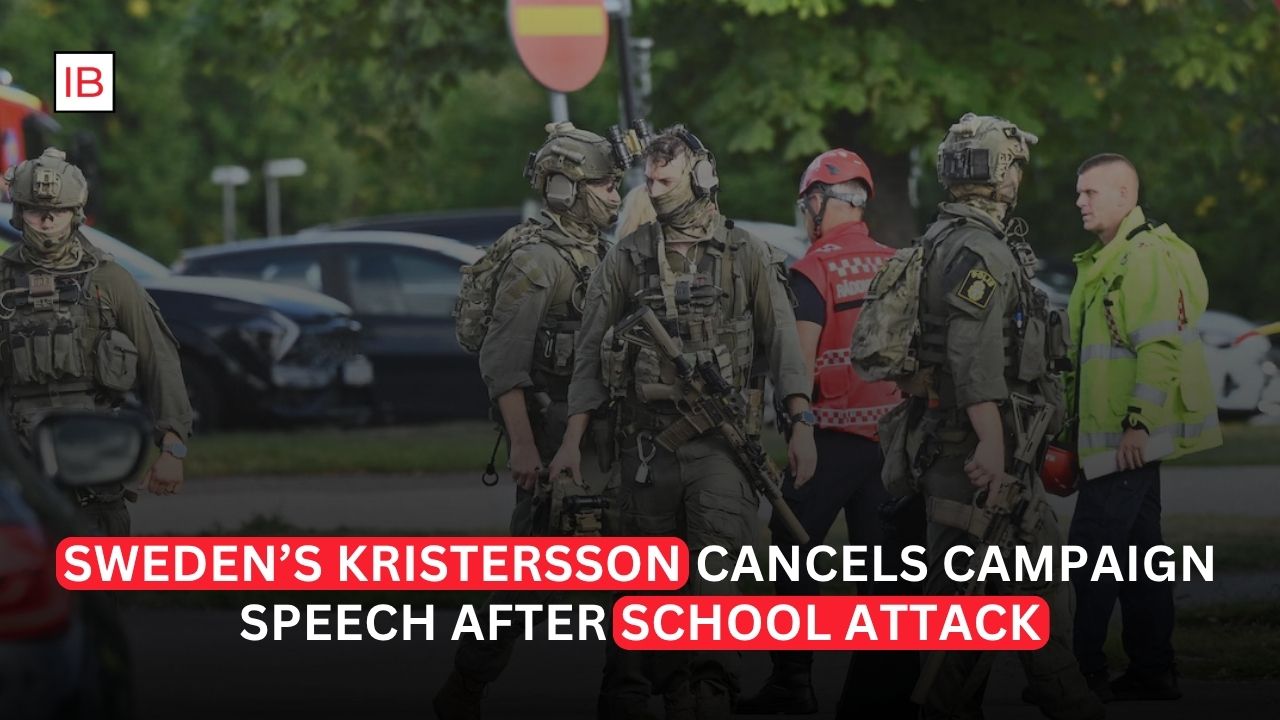
Swedish Prime Minister Ulf Kristersson has canceled a planned campaign speech after a deadly attack at a school in the central Swedish town of Fagersta, as the country confronts another episode of violence at an educational institution just weeks before a national election.
The decision to cancel the event reflects the seriousness of the attack and the political sensitivity surrounding school violence in Sweden. Kristersson had been scheduled to deliver a summer campaign speech in Nacka on Saturday, August 22, but canceled it following Friday’s attack at Brinell School. The speech had been officially announced earlier in the week, with the event scheduled to begin at 11:30 a.m. and Kristersson’s address at 1 p.m.
The attack has left one person dead and three others injured, according to Reuters. Police detained an 18-year-old suspect after officers responded to the school and fired shots during his arrest.
The incident is likely to intensify an already sensitive debate over public safety, school security and violence in Sweden.
Deadly Attack Hits School After Summer Break
The attack took place Friday afternoon at Brinell High School in Fagersta, a town in central Sweden with a population of roughly 13,000.
The school had only recently reopened following the summer holiday, meaning many students were returning to classes when the violence occurred.
Police said an 18-year-old man armed with a sword entered the school and attacked people inside.
One person was killed and three others were injured. Two of the injured victims were seriously hurt, while another was later released from hospital, according to Reuters.
Police eventually detained the suspect after shooting him during the arrest.
Authorities said they had no immediate reason to believe there were multiple attackers.
Kristersson Cancels His Campaign Event
Kristersson’s decision to cancel his Saturday speech demonstrates how quickly the attack changed the country’s political agenda.
The prime minister had been preparing to campaign ahead of Sweden’s upcoming parliamentary election.
His event was scheduled to take place in Nacka, where he was expected to address supporters and discuss the government’s political priorities.
Instead, the government shifted its focus toward the attack and its aftermath.
Kristersson expressed condolences to those affected and urged the public to allow police to carry out their investigation without interference.
The cancellation also reflects the difficulty politicians face when campaigning immediately after a tragedy.
A normal political speech could easily appear inappropriate while victims, families and the local community are still dealing with the consequences.
The Attack Has Shocked Fagersta
Fagersta is a relatively small community, making the incident particularly disruptive.
Following the attack, the school and several nearby buildings were placed under lockdown.
Parents faced hours of uncertainty as authorities secured the area and students remained inside.
The local government established a crisis center to provide assistance to people affected by the attack.
Police, emergency services and healthcare workers were involved in the response.
Local officials emphasized that the immediate priority was protecting students and staff and providing support to those affected.
Police Are Investigating the Suspect’s Background
Investigators are now trying to determine why the attack occurred.
The motive has not been definitively established.
Police have conducted searches connected to the suspect and are interviewing witnesses while reviewing available evidence.
Reuters reported that Swedish media had identified a TikTok account believed to be associated with the suspect. The account reportedly posted an image of a sword shortly before the attack and contained references to previous acts of mass violence.
That information is potentially significant, but investigators still need to establish whether the online material directly explains the attack.
Authorities have been cautious about drawing conclusions before the investigation is complete.
Online Extremism Is Becoming Part of the Investigation
The reported online activity has raised questions about whether the attacker was influenced by internet communities that glorify violence.
According to Reuters, investigators are examining possible connections between the suspect’s online activity and previous acts of mass violence in Sweden and Norway.
This is increasingly relevant to investigations into attacks involving young perpetrators.
Online communities can expose vulnerable individuals to violent material, extremist ideologies and previous attackers.
But the existence of violent content on a social-media account does not automatically establish motive.
Investigators will need to determine whether the material was simply consumed by the suspect or whether it played a direct role in planning or encouraging the attack.
Sweden Has Experienced Previous School Attacks
The Fagersta attack is particularly disturbing because Sweden has experienced other serious acts of violence at schools.
In February 2025, the country suffered its worst mass shooting when a gunman killed 10 people at Campus Risbergska in Örebro before taking his own life.
The scale of that attack prompted national discussions about gun laws, school security and the broader problem of violence.
Sweden also experienced a fatal sword attack at a school in Trollhättan in 2015, when a masked attacker killed a teaching assistant and two students. Police later said that attack was racially motivated.
The recurrence of serious school attacks makes the latest incident especially sensitive.
A Different Kind of Security Challenge
The Fagersta incident also highlights the difficulty of preventing school violence.
Security measures can be increased.
Schools can improve emergency procedures.
Police response times can be reduced.
But it is extremely difficult to eliminate every potential threat.
An attacker using a bladed weapon can potentially enter a public building without the same barriers that might prevent someone carrying a firearm.
That creates a difficult policy question for Swedish authorities.
How much security should schools introduce before they begin to resemble heavily guarded facilities?
And how can authorities improve protection without making schools feel like prisons?
The Election Makes the Timing More Sensitive
Sweden is approaching a parliamentary election, making security and crime important political issues.
Kristersson’s government has already made law enforcement and reducing criminal violence central parts of its political agenda.
The attack therefore comes at a politically difficult moment.
Opposition parties will likely face pressure to respond to the incident while avoiding politicizing a tragedy before investigators establish the facts.
The government faces an equally difficult balance.
It must demonstrate that it is taking school safety seriously without claiming knowledge about the motive or circumstances that investigators have not yet confirmed.
Kristersson’s Government Has Emphasized Law and Order
Crime reduction has been one of the central themes of Kristersson’s government.
Earlier this year, the prime minister highlighted reductions in deadly gang violence while arguing that Sweden still had significant work to do on crime and public safety.
The Fagersta attack is different from gang violence.
It does not appear, based on currently available information, to be part of the country’s organized-crime problem.
That distinction matters.
A government cannot assume that policies designed to tackle gangs will automatically prevent school attacks.
Different types of violence require different prevention strategies.
The Motive Remains the Key Question
Perhaps the biggest unanswered question is why the attacker targeted the school.
Police have not yet established a definitive motive.
Investigators are examining the suspect’s background, digital activity and possible connections to previous violence.
Until that work is complete, it would be premature to characterize the attack as political, ideological or extremist.
That caution is especially important because early assumptions can distort public debate.
A violent act can have multiple contributing factors, including personal grievances, mental health problems, extremist influence or other circumstances.
Investigators need evidence before deciding which explanation applies.
Political Leaders Have Put Aside Campaigning
Kristersson is not the only political figure responding to the tragedy.
Opposition leader Magdalena Andersson also expressed sympathy for the victims and said Sweden stood together with Fagersta during the crisis.
That kind of response is politically significant.
During election campaigns, parties normally compete aggressively over policy.
But major national tragedies often produce a temporary political pause.
Cancelling a campaign event can signal that political competition is secondary to national mourning.
The King Has Also Expressed Condolences
Sweden’s King Carl XVI Gustaf expressed shock and sadness following the attack.
The royal household said his thoughts were with those directly affected, their families and the broader community of students, staff and parents.
The response from Sweden’s political and constitutional leadership reflects the seriousness with which the country is treating the attack.
Fagersta Now Faces a Long Recovery
The immediate emergency may be over, but the psychological effects could last much longer.
Students who witnessed violence may require counseling.
Teachers and school employees may need support.
Families may struggle with fear about sending children back to school.
The broader community can also experience anxiety.
That is why the crisis center established by local authorities is important.
The response cannot end once the police investigation moves forward.
Schools Across Sweden May Reassess Security
The attack could prompt other Swedish schools to review their own emergency procedures.
Potential measures could include:
- Improved emergency communication systems
- Updated lockdown procedures
- Better coordination with police
- Staff training
- Crisis-response exercises
- Improved access control
- Greater psychological support
But each measure involves trade-offs.
More security can increase safety, but excessive restrictions can change the atmosphere of schools.
The Political Debate Could Become Broader
The attack may eventually become part of Sweden’s election debate over public safety.
Political parties could argue about:
- Police resources
- School security
- Youth violence
- Online radicalization
- Mental health services
- Knife and weapons laws
- Prevention programs
- Criminal justice policy
The challenge will be ensuring that policy responses are based on evidence from the investigation rather than emotional reactions to the tragedy.
Sweden’s Previous Experience Will Shape the Response
The country has already learned difficult lessons from previous attacks.
The 2025 Örebro shooting led to major public concern about school security and gun violence.
The 2015 Trollhättan attack highlighted the dangers of ideological and racially motivated violence in educational environments.
The Fagersta incident adds another case that authorities will need to study carefully.
The goal should not simply be to respond to this particular attacker.
It should be to understand whether there are warning signs or vulnerabilities that can be addressed before another attack occurs.
The Online Dimension Could Become More Important
One area likely to receive increasing attention is social media.
If investigators establish that the suspect consumed or shared violent material before the attack, policymakers may face renewed questions about how online platforms deal with content glorifying mass violence.
That could involve cooperation between:
- Police
- Schools
- Parents
- Social-media companies
- Mental-health professionals
- Intelligence agencies
But there is also a danger of overreaction.
Removing violent content alone will not necessarily prevent violence.
Authorities need to understand how online material interacts with real-world behavior.
Why Kristersson’s Cancellation Matters
The cancellation of the campaign speech is symbolic, but it also sends a practical political message.
The government is choosing not to continue normal campaigning while the country is processing a deadly school attack.
That reduces the risk of appearing insensitive and allows officials to concentrate on the emergency response and investigation.
For Kristersson personally, it also prevents the event from becoming dominated by questions about the attack rather than the government’s election platform.
The Government Will Face Questions
Once the immediate crisis passes, political questions will inevitably emerge.
Could the attack have been prevented?
Were there warning signs?
Was the suspect known to authorities?
Were schools sufficiently prepared?
Did online activity provide clues?
Were police resources adequate?
Those are legitimate questions.
But they should be answered after investigators establish the facts.
The Broader Challenge for Sweden
The deeper problem is that Sweden, like many other countries, is trying to deal with several forms of violence simultaneously.
Gang crime remains a major concern.
Extremist violence remains a threat.
Online radicalization presents new challenges.
And isolated individuals can sometimes commit devastating attacks without fitting neatly into existing security categories.
That makes prevention extremely difficult.
There is no single policy capable of eliminating every threat.
Conclusion
Prime Minister Ulf Kristersson’s decision to cancel his planned campaign speech follows a deadly attack at Brinell School in Fagersta that killed one person and injured three others. Police have detained an 18-year-old suspect and are investigating his motive and possible online connections.
The attack has shocked a country that is still dealing with the memory of previous school violence, including the 2025 Örebro mass shooting and the 2015 Trollhättan attack.
For Kristersson, the incident creates an uncomfortable political situation just weeks before an election.
His government has made law and order a central issue, but the Fagersta attack does not appear, based on currently available evidence, to fit neatly into Sweden’s organized-gang violence problem.
The most important task now is establishing the motive and understanding whether the attacker was influenced by online communities or previous acts of violence.
Political arguments will come later.
For now, the priority is supporting victims, protecting students and staff, and allowing investigators to establish what happened.
The tragedy also raises a difficult question for Sweden’s schools: how can authorities make educational institutions safer without turning them into heavily fortified spaces?
That question will likely remain at the center of Sweden’s public debate long after the campaign speech Kristersson canceled would otherwise have been forgotten.