Strong Technology Exports, Resilient Domestic Demand and Rising Investment Put Hong Kong on Track for Faster Expansion in 2026
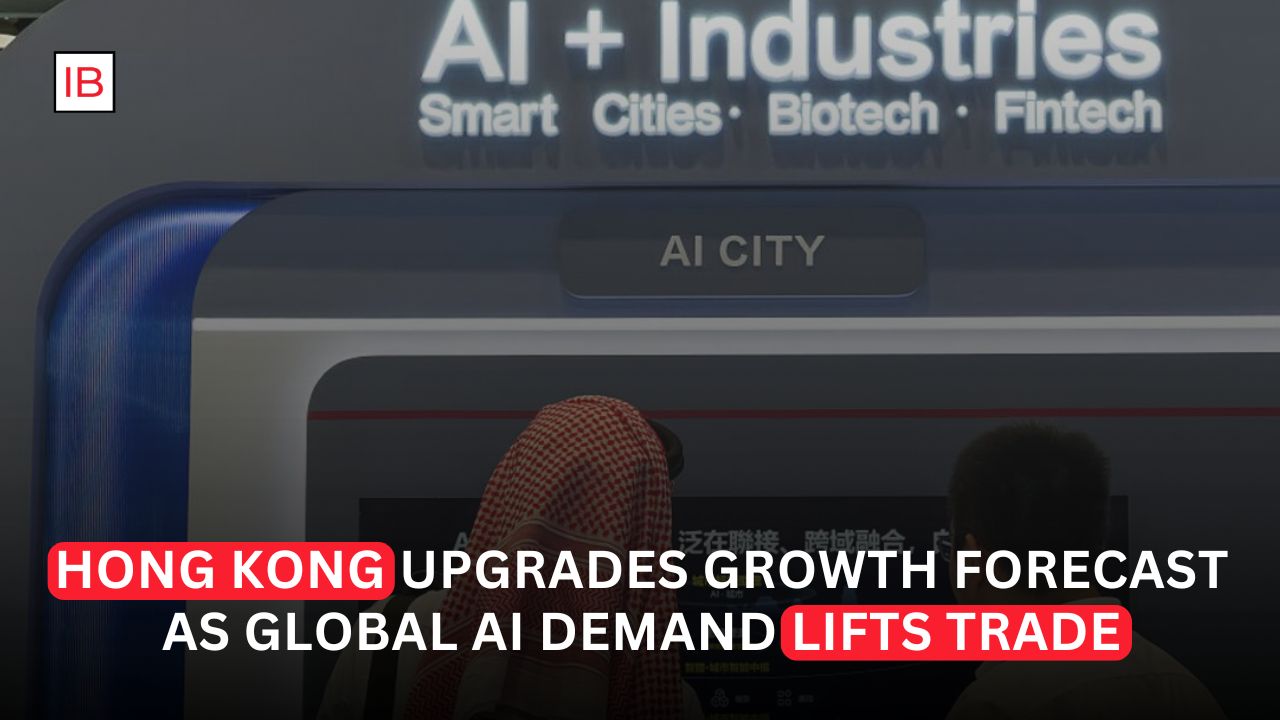
Hong Kong has raised its economic growth forecast for 2026 as a powerful artificial-intelligence boom drives exports, investment and activity across the financial hub.
The Hong Kong government now expects the economy to expand by 3.5% to 4.5% in 2026, upgrading its previous forecast of 2.5% to 3.5%. The revision follows significantly stronger-than-expected economic performance during the first half of the year, when real GDP expanded by 5.1%, the strongest half-year growth in almost five years.
The upgrade highlights the increasingly important role that AI-related technology demand is playing in Hong Kong’s economy.
AI Demand Drives Export Surge
Hong Kong’s position as a major trading and logistics hub has allowed it to benefit from the global expansion of artificial intelligence.
Demand for AI-related electronics and computing equipment has pushed merchandise trade sharply higher, with total exports of goods rising 28.9% year over year in real terms during the second quarter. That was an acceleration from 23.8% growth in the first quarter.
The strength of exports reflects the enormous investment taking place across the global technology industry.
As companies build data centers and expand AI computing capacity, demand for advanced electronics, semiconductors, networking equipment and related components continues to increase.
Hong Kong is benefiting from the trade flows associated with that expansion, particularly across Asia.
GDP Growth Remains Strong
Hong Kong’s economy expanded 4.3% in the second quarter compared with a year earlier, following a particularly strong 5.9% expansion in the first quarter.
Although quarterly growth slowed from the exceptional pace recorded at the beginning of the year, the overall performance remains considerably stronger than the government had expected when it established its earlier forecast.
The government expects economic activity to remain solid during the second half of 2026.
AI-related exports are expected to continue supporting merchandise trade, while logistics companies should benefit from increased regional trade activity.
Domestic Demand Is Holding Up
The AI boom is not the only source of strength.
Domestic demand has also remained resilient.
Private consumption increased 2.8% in real terms during the second quarter, marking the fifth consecutive quarter of growth. Investment also continued to expand, with overall investment expenditure rising 4.4% year over year.
The performance suggests that the improvement in Hong Kong’s economy is becoming broader rather than relying entirely on external trade.
Business confidence and consumer sentiment have improved as financial and property markets have stabilized.
Private Investment Accelerates
Private-sector investment has been particularly encouraging.
While overall investment growth slowed from the exceptionally high rate recorded during the first quarter, private-sector investment continued to rise strongly and recorded its third consecutive quarter of double-digit growth.
Businesses increased spending on machinery, equipment and intellectual-property products.
That trend could become increasingly important if Hong Kong wants to turn the current AI-driven trade boom into longer-term productivity growth.
Investment in technology and intellectual property can strengthen the city’s position in high-value industries and support economic expansion beyond traditional finance and property.
Financial Markets Benefit From AI Enthusiasm
Hong Kong’s financial markets are also benefiting from the global enthusiasm surrounding artificial intelligence.
The government said trading activity remained vibrant during the second quarter, with average daily turnover on the local stock market rising 21.8% from a year earlier to HK$289.5 billion. IPO fundraising activity was also strong, reflecting investor enthusiasm for frontier technology and AI-related assets.
That is particularly significant for Hong Kong because the city is seeking to strengthen its position as a major international capital-raising center.
A sustained technology boom could help attract more listings, investment and financial activity.
Property Market Shows Signs of Recovery
Hong Kong’s property market has also improved.
Residential property transactions increased substantially during the second quarter, reaching their highest quarterly level in 14 years.
Overall residential prices rose about 3% during the quarter, bringing the year-to-date increase to around 8%. Rents also remained resilient.
A healthier property market can support consumer confidence and reduce pressure on household balance sheets.
It also provides another channel through which stronger economic conditions can feed into domestic demand.
Tourism and Services Add Support
Services are another important part of Hong Kong’s recovery.
Exports of services expanded 3.4% in real terms during the second quarter, with growth across major service categories. Transport, financial and business services all benefited from stronger cross-border activity, while travel services continued to improve as visitor arrivals increased.
The government expects tourism to remain an important contributor during the second half of the year.
A combination of rising visitor numbers, stronger financial activity and continued demand for business services could help offset some of the volatility traditionally associated with Hong Kong’s trade-dependent economy.
Labor Market Remains Stable
The improvement in economic activity has not yet created major labor-market pressures.
Hong Kong’s seasonally adjusted unemployment rate remained at 3.7% in the second quarter, unchanged from the previous quarter. The underemployment rate also stayed at 1.6%.
Average employment earnings continued to increase, providing additional support for household consumption.
A stable labor market is important because stronger employment and wages can make the economic recovery more sustainable.
Inflation Remains Moderate
Despite stronger economic activity, inflation remains relatively contained.
Underlying consumer inflation reached 1.7% in the second quarter, up from 1.4% during the previous quarter.
The government has maintained its full-year forecasts for underlying and headline inflation at 2.5% and 2.6%, respectively.
However, higher international energy prices could create additional pressure later in the year.
The continuing conflict in the Middle East has increased uncertainty around oil prices and global inflation, creating a risk for Hong Kong’s economic outlook.
AI Boom Also Creates Risks
The government is optimistic about AI-related demand but recognizes that the rapid expansion of global AI investment carries risks.
The current boom has encouraged technology companies around the world to spend enormous amounts on computing infrastructure.
If that investment cycle remains strong, Hong Kong can continue benefiting from higher trade volumes and technology-related activity.
But a sudden slowdown in AI spending could have the opposite effect.
Because the city’s export growth is increasingly connected to technology-related trade, any sharp correction in global AI investment could weaken demand.
Global Trade Remains Uncertain
Hong Kong’s economic outlook is also exposed to broader international trade conditions.
Protectionist measures by major economies could disrupt trade flows and create additional uncertainty for exporters.
The government has warned that trade protectionism, monetary policy changes and geopolitical tensions remain important risks.
Hong Kong’s close integration with mainland China and its role as a gateway for international trade mean developments in both Chinese and global economies will continue to influence its performance.
Hong Kong Benefits From Asia’s Technology Supply Chain
One of Hong Kong’s advantages is its position within the wider Asian technology ecosystem.
The city’s trade links with mainland China and Southeast Asia allow it to participate in supply chains supporting the AI industry even when the underlying manufacturing takes place elsewhere.
This is particularly important as regional demand for advanced electronics continues to increase.
The IMF has also highlighted the importance of technology and AI-related demand to Hong Kong’s recent export performance, noting that robust technology-related exports helped support economic growth in 2025.
Greater Bay Area Creates Additional Opportunities
Hong Kong’s integration with the Greater Bay Area could provide another source of long-term growth.
The government has been seeking to deepen economic links with mainland cities while developing technology, innovation and advanced industries.
Hong Kong’s role as an international financial center could complement the manufacturing and technology capabilities of nearby mainland cities.
The combination could help the city capture more value from the AI economy while maintaining its traditional strengths in finance, logistics and professional services.
Growth Outlook Improves, But Risks Remain
The revised forecast is encouraging, but Hong Kong still faces a complicated external environment.
Global interest rates, trade policies, energy prices and geopolitical tensions could all affect economic activity.
The government specifically warned that Middle East tensions could spill over into energy markets and global inflation.
There is also uncertainty surrounding the sustainability of the global AI investment cycle.
The extraordinary pace of technology investment has generated strong demand for Asian electronics, but policymakers will need to monitor whether that demand can remain at current levels.
Looking Ahead
Hong Kong’s decision to raise its 2026 economic growth forecast to 3.5% to 4.5% marks a significant upgrade and reflects the powerful impact of the global AI boom on the city’s trade and investment activity.
The economy grew 5.1% during the first half of 2026, while second-quarter exports surged 28.9% as global demand for AI-related electronics strengthened.
Domestic demand is also providing support, with private consumption continuing to grow and investment remaining strong.
Financial markets have benefited from renewed investor enthusiasm for technology and AI-related assets, while the property market has shown signs of recovery.
The combination of technology exports, tourism, financial services and stronger domestic activity gives Hong Kong a broader foundation for growth than it had at the beginning of the year.
But the outlook is not without risks.
Hong Kong’s stronger performance is closely tied to global technology demand, making the city increasingly exposed to the sustainability of the AI investment boom.
A prolonged expansion in AI infrastructure could provide another major boost to trade, logistics, financial services and investment.
On the other hand, a sharp slowdown in global AI spending could weaken the same channels that are currently driving the recovery.
For now, however, momentum remains strong.
Hong Kong’s economy has entered the second half of 2026 with stronger exports, resilient consumers, rising investment and a rapidly expanding technology-driven trade cycle.
The government’s upgraded forecast suggests policymakers believe those forces will remain powerful enough to deliver significantly faster growth than previously expected.