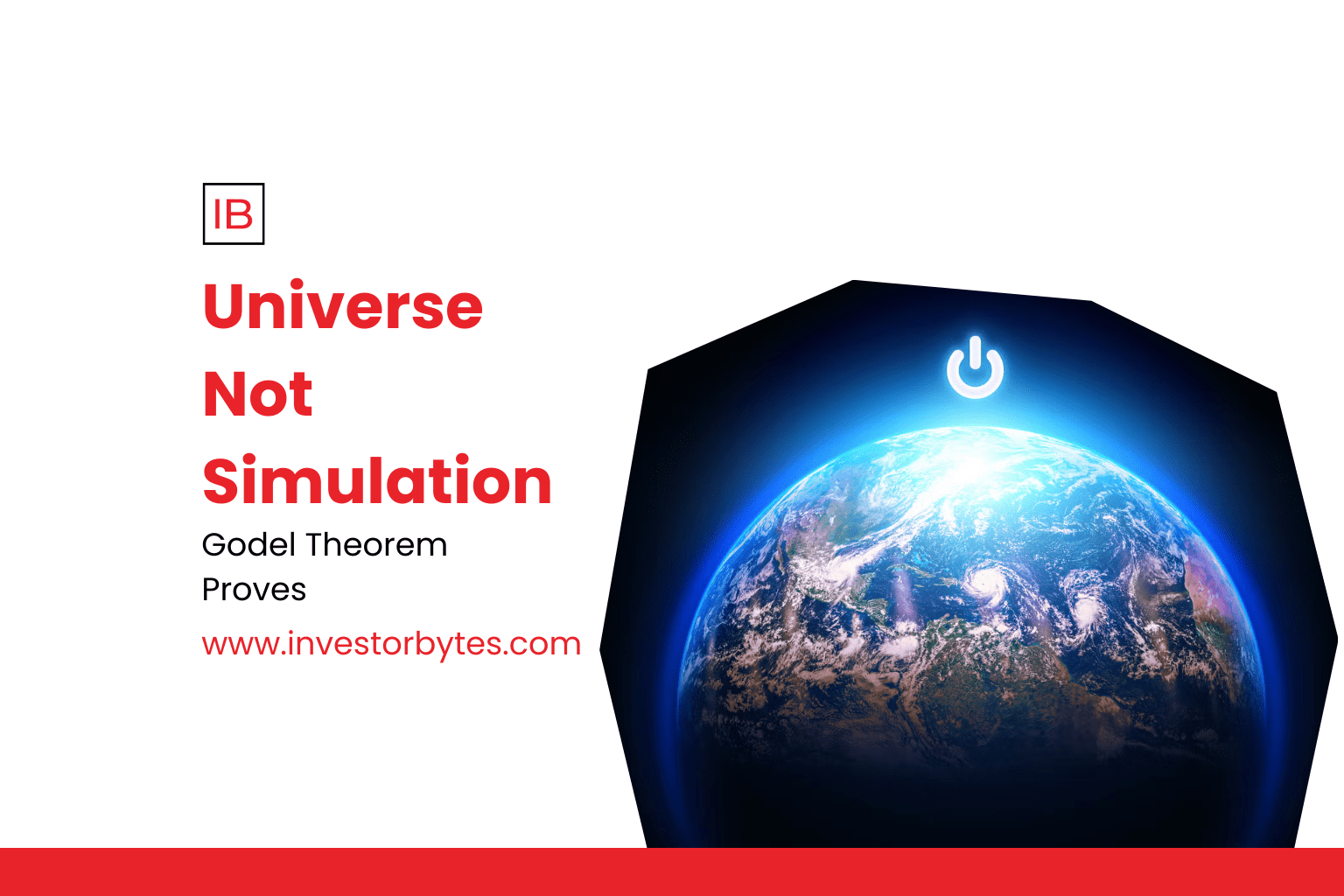
Physicists at UBC Okanagan delivered a mathematical deathblow to the simulation hypothesis on October 30, 2025, wielding Gödel’s incompleteness theorems to demonstrate the universe’s foundational “non-algorithmic understanding”—undecidable truths impervious to computation—rendering any simulated cosmos logically impossible, as no program could replicate reality’s inherent unprovability. Published in Journal of Holography Applications in Physics, Mir Faizal et al.’s “Meta-Theory of Everything” formalizes how quantum gravity’s undecidables—e.g., halting problem analogs in black hole information paradoxes—defy Turing-complete encapsulation, collapsing the “Theory of Everything” into Platonic realms beyond bits.
This rigor transcends philosophy: simulations demand algorithmic fidelity, yet Gödelian loops ensure “true but unprovable” statements—like “This axiom is inconsistent”—permeate spacetime’s fabric, from quantum fluctuations to cosmic inflation, per coauthor Lawrence Krauss: “Laws precede space-time; no code births them.” Empirical echoes? Holographic duality’s non-computable entropy bounds align, with arXiv preprints (2507.22950) projecting 10^120 undecidables in observable universe.
Universe not simulation proof 2025 shatters sci-fi: no Matrix, as AI’s algorithmic cage can’t cage consciousness or causality’s Gödel ghosts; implications? Ethical AI pivots to hybrid models, blending computation with intuition for $97B quantum revenue by 2035 (McKinsey). Critics query self-reprogramming sims, but Faizal retorts: “Even adaptive code halts at incompleteness.” Broader, it affirms 2025’s quantum year—UNESCO-declared—with Unruh effect bridges (Hiroshima’s annular junctions) underscoring relativity’s non-simulable warmth.
For cosmologists contesting universe simulation November 2025, this isn’t debunk—it’s deliverance: Gödel’s ghost guards genuineness, where undecidables decree not digital dreams, but the universe’s unyielding, uncodeable essence.