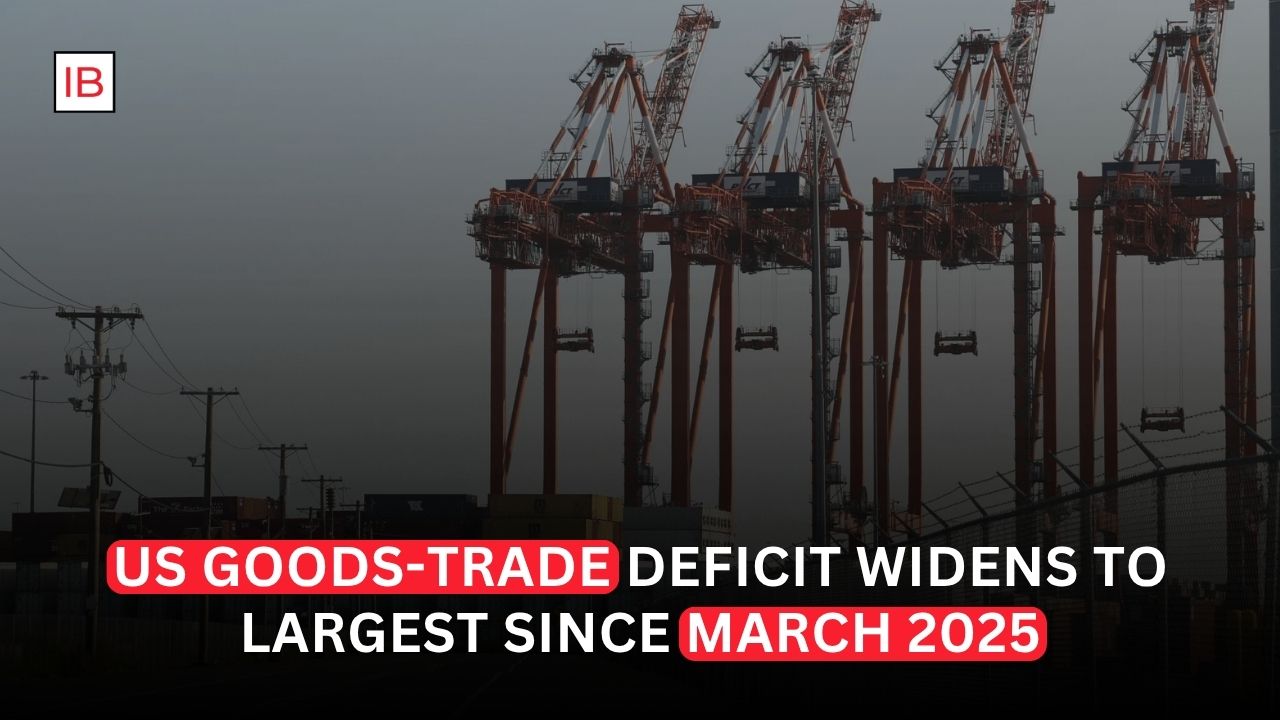
The US merchandise trade deficit has widened to its largest level since March 2025, highlighting the continuing difficulty President Donald Trump’s administration faces in reshaping America’s trade balance through tariffs and other trade policies.
The latest figures show that imports are once again running ahead of exports by a substantial margin. The development is important for the US economy because trade flows affect economic growth, manufacturing activity, inflation and the value of the dollar.
The widening gap also illustrates a basic problem with trying to reduce the trade deficit through tariffs alone: American consumers and businesses continue to demand large quantities of foreign goods, while US exporters face their own competitive challenges overseas.
Trade Deficit Widens Again
The merchandise trade balance measures the difference between the value of goods imported into the US and goods exported by American companies.
When imports exceed exports, the country records a trade deficit.
The US has run persistent merchandise trade deficits for decades, but the size of the gap can change considerably from month to month.
Recent official data showed that the overall US goods-and-services deficit narrowed to $73.3 billion in June from $77.6 billion in May. However, the goods component remained substantially negative, reflecting the continuing imbalance between merchandise imports and exports.
Why Merchandise Trade Matters
The merchandise deficit attracts particular attention because it represents physical goods crossing America’s borders.
These include machinery, computers, electronics, pharmaceuticals, vehicles, industrial equipment and consumer products.
The US economy relies heavily on imported manufactured goods.
That dependence cannot be changed quickly.
Even when tariffs increase the cost of foreign products, American businesses may continue importing them if equivalent domestic alternatives are unavailable.
Tariffs Have Changed Import Behavior
Trump’s trade policies have created significant incentives for companies to alter the timing and sourcing of imports.
Businesses sometimes bring goods into the country ahead of expected tariff increases.
That can temporarily push imports higher.
After the front-loading period ends, imports can fall sharply.
This creates unusually large month-to-month movements in the trade data.
The pattern was especially visible in 2025, when businesses accelerated imports before major tariff changes.
The March 2025 Comparison Is Significant
March 2025 was an unusually large month for the US trade deficit.
Companies rushed to import products before the Trump administration’s tariff measures took effect.
The resulting surge pushed the goods deficit to exceptionally high levels.
The fact that the latest merchandise deficit has reached its highest level since that period suggests that the trade imbalance remains substantial despite the policy changes introduced since then.
Imports Remain Strong
Strong imports are not necessarily a sign of a weak economy.
In fact, rising imports can reflect strong domestic demand.
American households and companies purchase foreign products because they want them, because they are cheaper, or because domestic suppliers cannot provide sufficient quantities.
Imports of capital goods can also indicate that American businesses are investing in technology and productive capacity.
Consumer Goods Matter
Consumer products make up an important share of US imports.
Electronics, pharmaceuticals, clothing, household products and other manufactured goods arrive from overseas supply chains.
American consumers have become deeply integrated into these global networks.
Replacing those products with domestic production would require significant investment and time.
Capital Goods Are Important Too
The US also imports large amounts of machinery and technology.
Companies may rely on foreign manufacturers for computers, telecommunications equipment, industrial machinery and other capital goods.
That means tariffs can create an unusual trade-off.
They may reduce imports over time, but they can also increase production costs for American companies that depend on imported inputs.
AI Is Affecting Trade Flows
The artificial-intelligence investment boom has become another important factor in US trade.
American companies are spending heavily on data centers, semiconductors, servers and other computing infrastructure.
Much of that equipment is produced internationally.
As AI investment accelerates, imports of technology-related goods can increase.
That can widen the merchandise trade deficit even while domestic investment remains strong.
The Manufacturing Challenge
The Trump administration argues that tariffs can encourage companies to manufacture more products inside the United States.
There is some economic logic behind that argument.
If imported products become more expensive, domestic manufacturers may become more competitive.
But building new factories takes years.
Companies need land, workers, electricity, suppliers, financing and infrastructure.
A tariff can change the price of an imported product immediately.
It cannot create a domestic supply chain overnight.
Supply Chains Cannot Be Rebuilt Quickly
Modern manufacturing is highly interconnected.
A product labeled as American-made may still contain components from multiple countries.
Semiconductors, batteries, machinery and specialized materials often cross borders several times before reaching the final consumer.
Reducing imports therefore requires more than imposing tariffs on finished products.
It requires rebuilding entire supply networks.
Companies Are Diversifying Suppliers
American companies have responded to trade uncertainty by looking for alternative suppliers.
Some production has shifted away from China toward countries such as Vietnam, Mexico and India.
But changing suppliers does not necessarily eliminate the US trade deficit.
It can simply change the countries from which America imports.
China Is Still Important
The US has reduced some direct imports from China in recent years, but the underlying supply chains remain connected.
Products can be manufactured or assembled in other Asian countries before being exported to the US.
This means bilateral trade figures do not always capture the full structure of global supply chains.
Mexico Has Become More Important
Mexico has benefited from companies seeking shorter supply chains and alternatives to China.
Its proximity to the US makes it attractive for manufacturing.
But greater imports from Mexico can still contribute to the overall US merchandise deficit.
Nearshoring changes the location of production without necessarily eliminating America’s dependence on foreign manufacturing.
Vietnam and Other Asian Economies
Vietnam and other Asian economies have also become increasingly important suppliers to the US.
Manufacturing investment has expanded as companies seek to diversify production.
This trend could continue as businesses attempt to reduce their exposure to tariffs and geopolitical risks.
The Trade Deficit Is Not Simply a Policy Failure
A trade deficit is sometimes portrayed as money that America is “losing” to other countries.
That interpretation is too simplistic.
The US imports goods because Americans want to buy them.
Foreign countries receive dollars in exchange, but those dollars can ultimately be invested back into US financial markets, businesses and assets.
The trade deficit is therefore connected to broader capital flows.
The Dollar Matters
The US dollar’s role as the world’s primary reserve currency also influences trade.
Demand for dollar assets attracts foreign capital.
That can support the dollar’s value.
A stronger dollar makes imports relatively cheaper for Americans and can make US exports more expensive for foreign buyers.
That can contribute to persistent trade deficits.
Tariffs Do Not Automatically Reduce the Deficit
This is the biggest economic question surrounding the latest data.
If tariffs make imports more expensive but do not substantially increase domestic production, the trade deficit may not fall by much.
Instead, businesses may simply pay more for imported goods or switch suppliers.
The overall quantity of imports can remain high.
Consumers Can Ultimately Pay the Cost
Tariffs are collected from importers rather than directly from foreign governments.
US companies may absorb the additional cost, negotiate lower prices with suppliers or pass some of the expense on to consumers.
That means trade policy can influence domestic prices.
The effect varies by product and market.
Businesses Face Higher Uncertainty
Frequent tariff changes make long-term planning harder.
Companies deciding where to build factories or establish supply chains need to estimate future trade rules.
Uncertainty can delay investment.
At the same time, the possibility of higher future tariffs can encourage companies to invest domestically.
The net economic effect depends on which force is stronger.
Trade Policy Can Distort Investment
A company may build a factory in the US because tariffs make foreign production uneconomical.
That creates domestic investment.
But if the plant would otherwise have been more efficiently located elsewhere, the economy may pay a higher production cost.
Trade policy therefore involves a trade-off between resilience and efficiency.
Exports Are the Other Side
Reducing the trade deficit also requires increasing exports.
American companies are highly competitive in industries such as technology, financial services, aerospace, energy and agriculture.
But exporting physical goods can be more difficult when foreign countries impose their own tariffs or when US products are relatively expensive.
Retaliation Is a Risk
US trading partners can respond to American tariffs with tariffs of their own.
That can hurt US exporters.
Farmers have experienced this dynamic before, when foreign retaliation reduced demand for American agricultural products.
Manufacturers can also face weaker overseas sales.
The Services Surplus Helps
The US has a large surplus in services.
American companies export financial services, technology services, intellectual property, consulting, entertainment and other services around the world.
That surplus offsets part of the merchandise deficit.
In 2025, the US services surplus reached $339.5 billion, according to official data.
Goods and Services Must Be Viewed Together
Looking only at merchandise can therefore exaggerate the overall external imbalance.
The US goods deficit is much larger than its combined goods-and-services deficit because services exports provide a substantial offset.
Still, the merchandise deficit matters for manufacturing and supply-chain policy.
Manufacturing Jobs Are Politically Important
Trade deficits have become closely associated with the decline of some US manufacturing communities.
Politically, that makes the issue extremely sensitive.
Trump has argued that tariffs can bring manufacturing jobs back to the US.
Whether they can do so sustainably depends on productivity, labor costs, infrastructure and global competitiveness.
Automation Changes the Equation
Even if manufacturing returns to the US, it may not recreate the number of jobs that existed decades ago.
Modern factories are highly automated.
Companies can produce more goods with fewer workers.
That means reshoring can increase domestic output without generating massive employment gains.
Productivity Is Critical
US manufacturers need to compete globally on productivity as well as price.
Higher wages do not automatically prevent American manufacturing from being competitive if workers and factories are substantially more productive.
Technology, robotics and AI could help narrow that gap.
AI Could Reshape Manufacturing
Artificial intelligence can improve factory operations, logistics, quality control and predictive maintenance.
If combined with automation, it could make US production more competitive.
That could strengthen the long-term case for reshoring.
But these investments take time.
The Trade Deficit and GDP
Trade flows also affect GDP calculations.
A rise in imports can mechanically subtract from GDP because imports are deducted from economic output in the national accounts.
But that does not mean imports are inherently harmful.
If imported machinery helps an American company expand production, the investment and resulting output can provide broader economic benefits.
A Wider Deficit Can Have Multiple Causes
The latest widening should therefore not be interpreted as evidence of a single economic problem.
It could reflect stronger consumer demand, business investment, tariff-related timing, changes in global supply chains or fluctuations in exports.
The composition of imports and exports matters as much as the headline number.
Gold Can Distort the Data
Gold flows have also played a role in recent trade statistics.
Large movements in nonmonetary gold exports and imports can create significant changes in the reported trade balance.
Official data show that gold was a major contributor to changes in US goods trade in recent periods.
That makes it important to distinguish temporary commodity movements from underlying trade trends.
The Federal Reserve Will Watch
Trade data can influence expectations for economic growth and inflation.
If imports surge because businesses are buying more equipment, that may signal strong investment.
If imports rise because domestic supply is inadequate, the inflation implications can be different.
The Federal Reserve therefore has to look beyond the headline deficit.
The Dollar Could Respond
A widening trade deficit can also influence currency markets.
In isolation, a larger deficit might put downward pressure on the dollar.
But global demand for US financial assets can offset that effect.
Investors therefore need to consider trade flows alongside interest rates, fiscal policy and capital movements.
The Bond Market Matters
Foreign investors hold large amounts of US Treasury securities.
Those capital flows are connected to America’s external accounts.
A persistent trade deficit means the US is importing more than it exports and effectively sending dollars abroad.
Those dollars can return through purchases of US assets.
This relationship helps explain why the US can sustain large trade deficits for long periods.
Trump’s Trade Strategy Faces a Test
The latest figures provide another test of the administration’s tariff strategy.
If the objective is to reduce imports and expand domestic production, policymakers will need to demonstrate that tariffs are producing structural changes rather than simply shifting supply chains.
The results will take time to become clear.
Companies Need Stability
Businesses can adapt to tariffs.
What is harder is adapting to constantly changing rules.
Long-term investment decisions require predictable policy.
If tariff rates, exemptions and trading relationships change frequently, companies may delay major commitments.
The Cost of Reshoring
Building domestic factories is expensive.
US land, labor and regulatory costs can be higher than those in many competing countries.
Companies may therefore need significant incentives to move production home.
Tariffs provide one incentive, but they also raise costs for downstream industries.
Infrastructure Is Essential
A manufacturing revival also requires infrastructure.
Factories need reliable electricity, transportation networks, ports, water supplies and telecommunications.
Without those foundations, tariffs alone cannot create a competitive manufacturing ecosystem.
Skilled Labor Is Another Constraint
American manufacturers also face shortages of skilled workers in some industries.
New factories require technicians, engineers, electricians and other specialized employees.
Training those workers can take years.
The Long-Term Goal
The administration’s broader objective is not simply to reduce one month’s trade deficit.
It is to change the structure of US trade.
That means encouraging domestic production of strategically important goods, reducing dependence on vulnerable foreign suppliers and strengthening supply-chain resilience.
The latest deficit figures show how difficult that transformation will be.
Trade Flows May Remain Volatile
The US trade balance is likely to remain volatile as companies adapt to tariffs.
Importers may accelerate shipments before new duties take effect.
Exports may respond to retaliation.
Companies may move production between countries.
All of these factors can create large monthly swings.
Investors Should Look Beyond One Number
A single trade report should not determine the outlook for the US economy.
Investors should examine:
- Import growth
- Export growth
- Capital-goods imports
- Consumer-goods imports
- Energy flows
- Semiconductor and technology imports
- Trading-partner balances
- Services exports
- Tariff revenues
- Business investment
Together, these indicators provide a much clearer picture.
The Bigger Question Is Competitiveness
Ultimately, the US trade deficit reflects more than trade policy.
It reflects the competitiveness of American companies, consumer preferences, savings and investment patterns, currency values and the structure of the global economy.
Tariffs can influence those factors.
They cannot override all of them.
Conclusion
The widening US merchandise trade deficit to its highest level since March 2025 is a reminder that changing America’s trade structure will be considerably harder than simply imposing tariffs.
The US continues to import enormous quantities of goods, ranging from consumer products to advanced technology and capital equipment. Recent official data also show how large the country’s underlying goods deficit remains, even as the overall goods-and-services deficit has fluctuated.
For the Trump administration, the latest figures create an uncomfortable question: Are tariffs actually reducing America’s dependence on foreign goods, or are they mainly changing where those goods come from and when they enter the country?
The answer will take time.
Companies are restructuring supply chains, investing in domestic production and searching for alternative suppliers. Mexico, Vietnam and other manufacturing centers are becoming increasingly important as businesses diversify away from China.
But these changes cannot happen overnight.
The US would need factories, skilled workers, infrastructure and competitive production costs to replace a meaningful share of imported goods.
At the same time, the trade deficit itself should not be viewed as an automatic measure of economic weakness. Strong imports can reflect strong domestic demand and business investment. The US also maintains a substantial services surplus that offsets part of its merchandise deficit.
The real test for US trade policy is therefore not whether the deficit disappears from one monthly report.
It is whether the country becomes more competitive in producing strategically important goods while maintaining productivity and avoiding excessive costs for consumers and businesses.
If tariffs succeed in encouraging investment, strengthening supply chains and increasing domestic production, the trade balance could improve over time.
If they mainly redirect imports from one country to another while increasing costs, the underlying imbalance may remain.
The latest numbers suggest the transformation is far from complete.